Happy Topia
A landmark that fits through a service lift
Designing a 25-foot capsule machine to stop families in Indian malls, and a 2-foot one for every counter.
Role: Lead industrial designer and design consultant. Product architecture, form, CAD, design for manufacture, colour and finish, visualisation and vendor development for both machines, and the deck Happy Topia took to malls.
Team: Aryan Kunzang Chawla and Amit Chawla (founders, Happy Topia), Happy Topia's mechanical and electronics partners, and fabricators in Bengaluru.
When: 2023–24
Tools: Paper sketches, SolidWorks, KeyShot, Photoshop, InDesign, Midjourney and Gemini
Status: The Mega Ball was designed through to fabrication drawings, parts lists and vendor quotes, and was not built. The countertop machine went to Happy Topia's engineering partner as a motorised, QR-paid machine and on to sourcing for a first batch of 2,000.
8
Weeks from the first call to fabrication files for a 25-foot machine
2
Moulds for all 86 clear windows in its dome
12
Forms before the countertop machine was final
Happy Topia sells surprise collectible toys to children from capsule machines in malls and metro stations, paid for with a scan of a parent's phone.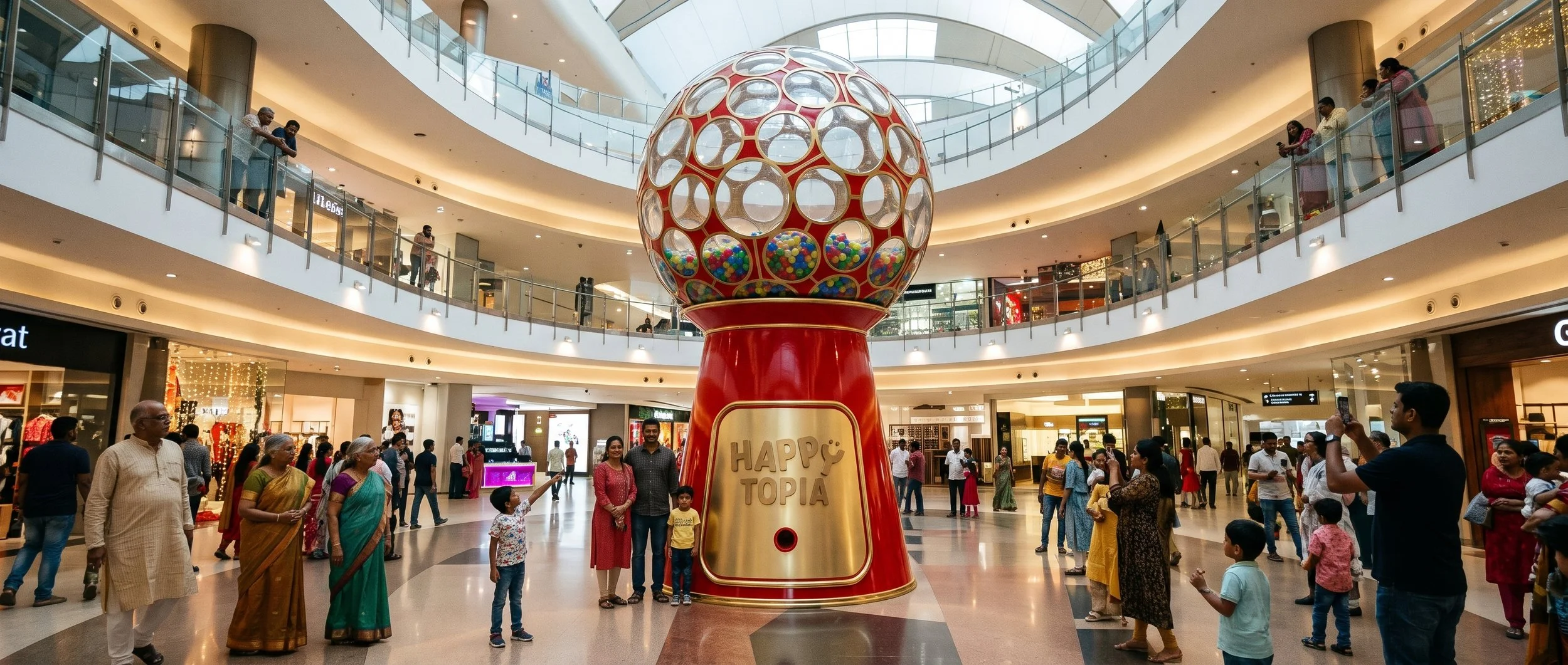
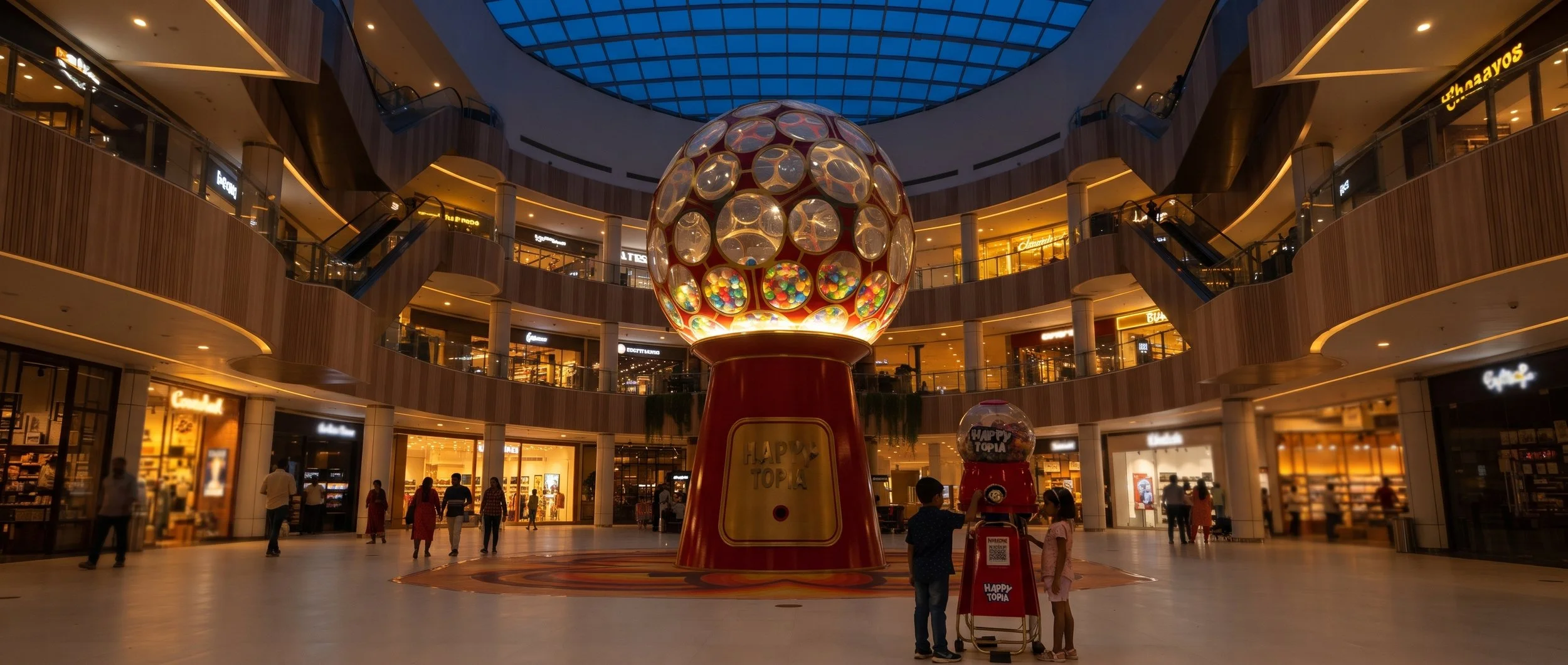
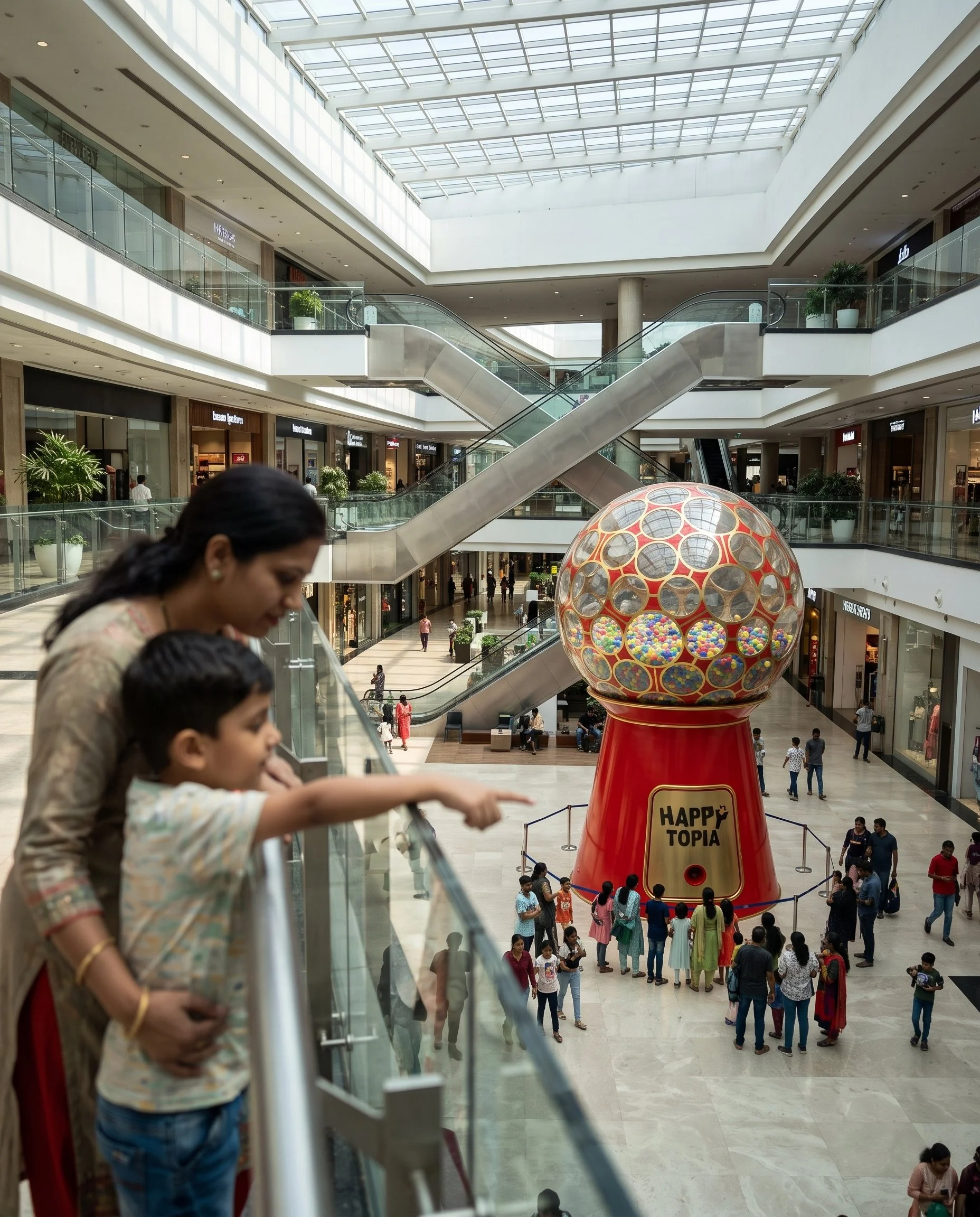
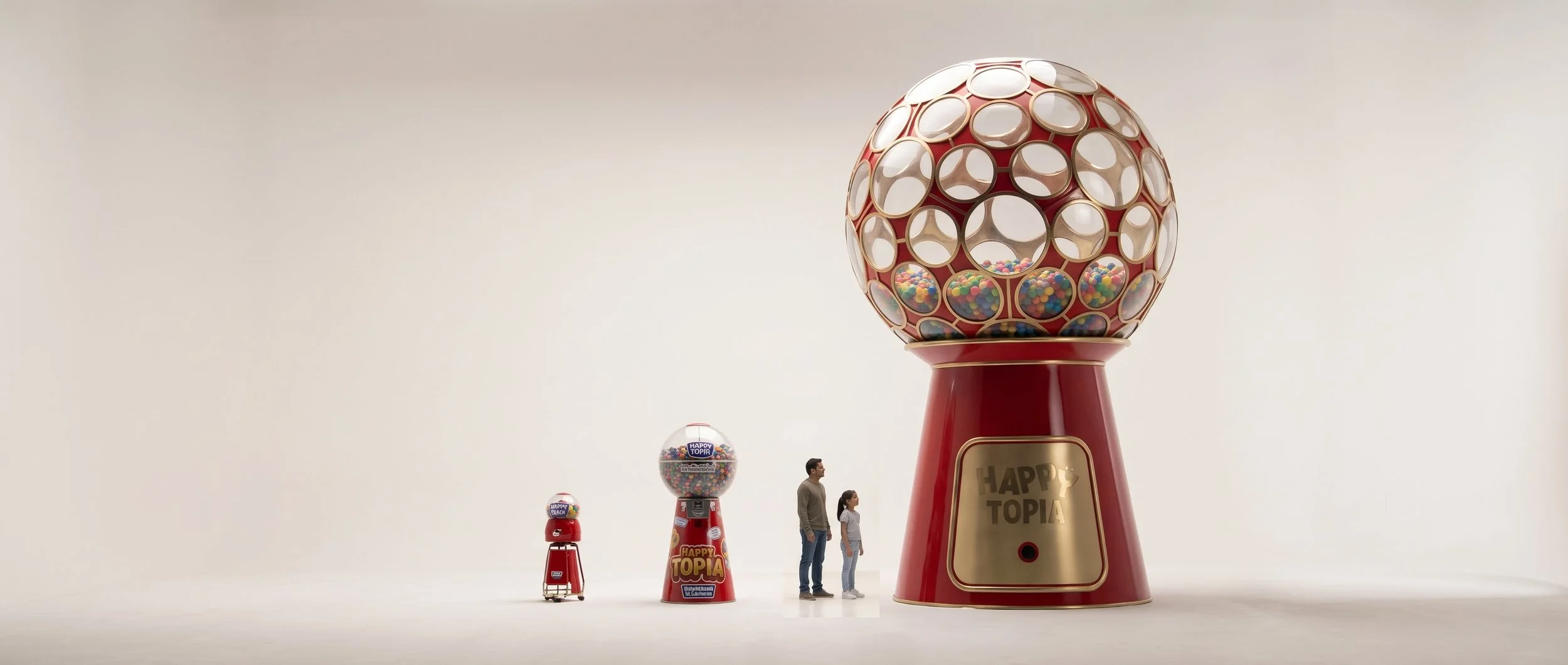
The Mega Ball as it would stand in a Bengaluru atrium. It was designed to fabrication and never built.
Happy Topia needed a landmark for the festive season and a cheaper, sturdier machine to grow its fleet, both on a startup's clock. I designed each around the people a vending machine depends on: children, parents, mall managers, installers, fabricators and the staff who refill it. The landmark reached fabrication files in eight weeks and stayed on paper. The countertop machine went from a capsule-packing study to a motorised design ready for its first 2,000 units.
Happy Topia wanted a machine you could see from three floors up
Aryan Kunzang Chawla started Happy Topia as a school project with his father, Amit Chawla, and one machine in a Bengaluru mall. Within a year there were about 150 machines in Bengaluru and Hyderabad, and a plan for more than 5,000 across India.
A capsule machine earns when a child notices it. In a mall atrium, among escalators, fountains and festival decorations, a small machine is easy to walk past. For the festive season the founders wanted something nobody could walk past: a gumball machine 25 to 30 feet tall that would pull families across the atrium from three floors away and into every photo they took that day.
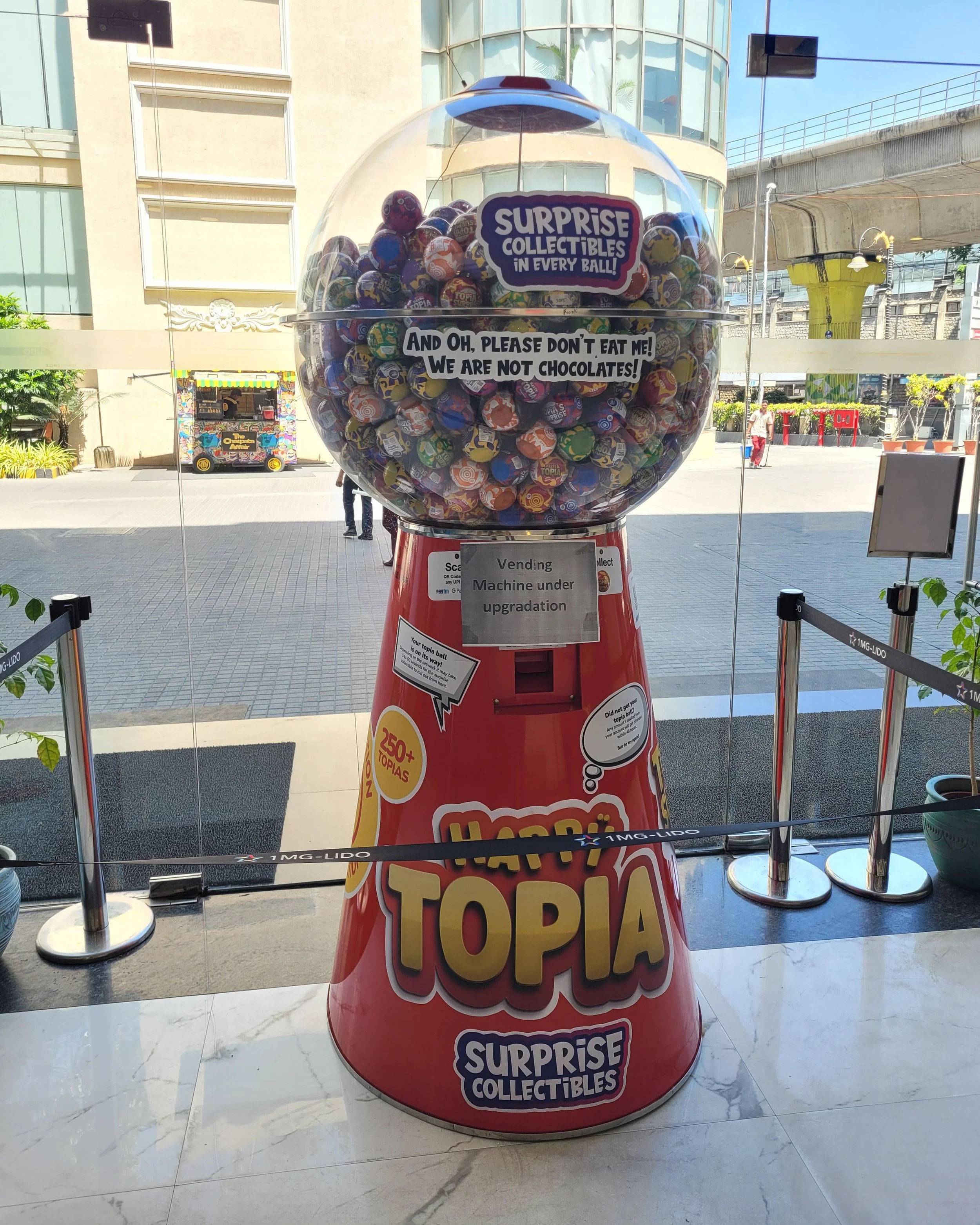
One of Happy Topia's 7-foot machines. The landmark had to be more than three times its height.
The calendar set the deadline. A machine standing by the end of November could earn for 40 to 45 days before schools reopened in January. The first call came at the end of October.
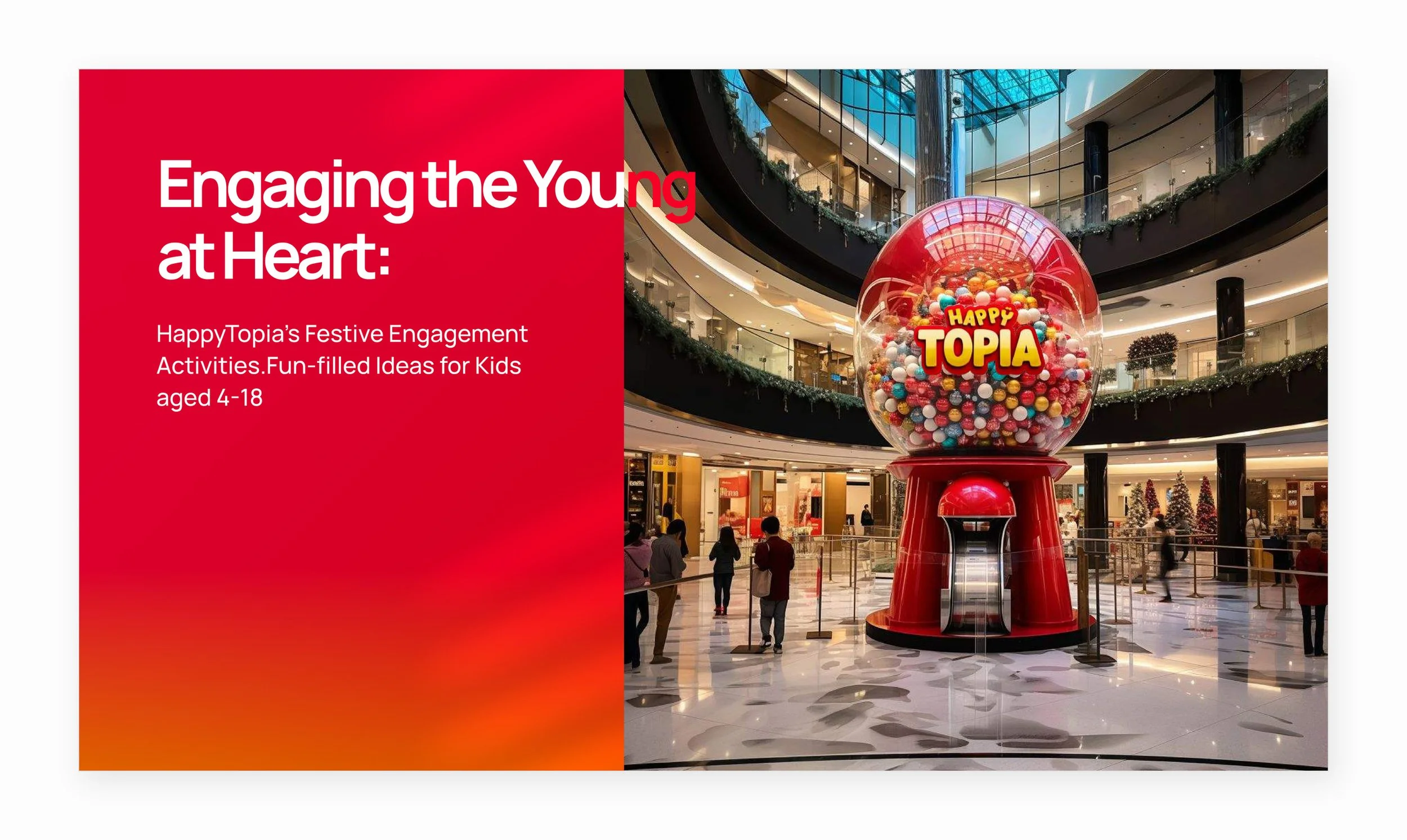
Happy Topia's own deck of festive activities for children, with a giant machine at its centre.
It is never just a kid and a toy
A machine this large has more users than the child at the front of it. The child wants wonder. The parent wants something safe, and a capsule for every payment. Mall management wants footfall without a crowd crushed around the base, and a machine that runs from an ordinary 15 to 20 amp socket. Installers need parts they can carry through a service corridor and bolt together in a night. Fabricators need panel sizes, finishes and quantities they can actually make. Happy Topia's staff need to refill and repair it without closing the atrium.
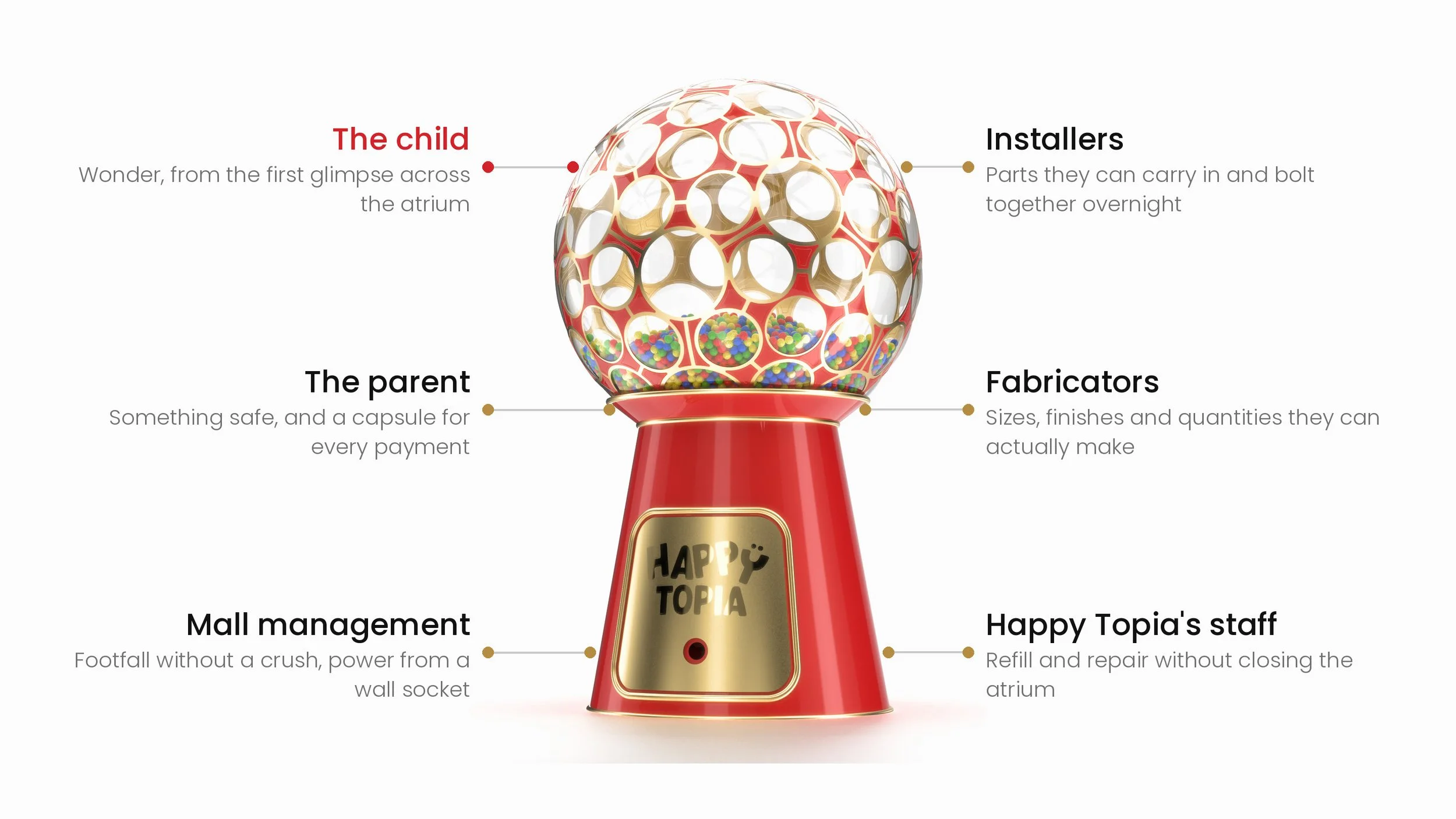
Six people depend on one machine. Only one of them is a child.
Nearly every decision traded one of these people against another. A bigger dome reads from further away, until it no longer fits through the service door. A clear sphere in one piece is the most magical answer, and at this size nobody can form one. A dome filled with real capsules is honest, and it hangs the weight of two grown men above a crowd of children.
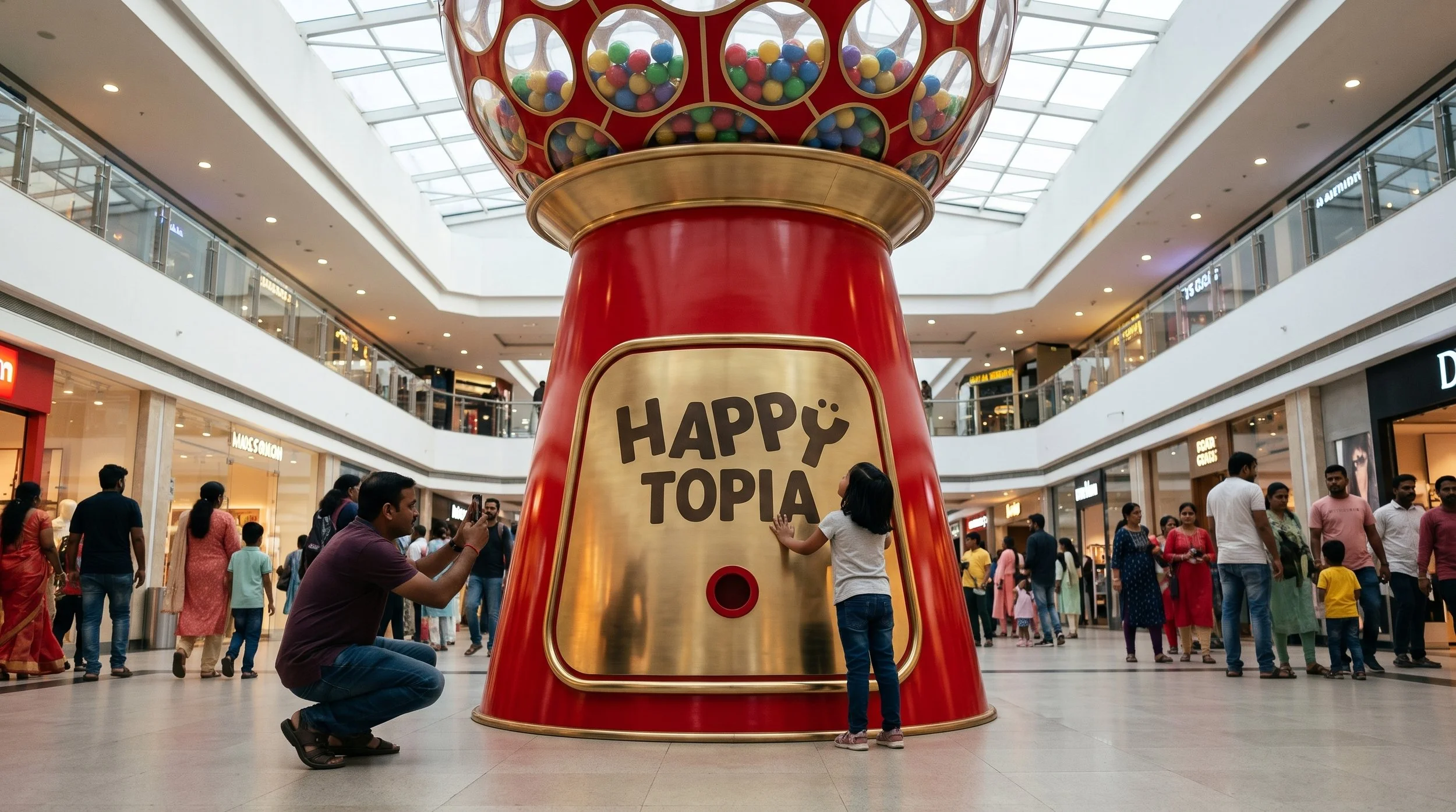
The moment everything else serves: a child at the fascia, a parent with a phone.
The first brief described furniture
Amit described the first version as furniture. A tall red cone would hide the dispensers from Happy Topia's smaller machines. A clear ball on top, cut into eight or more pieces, would slot together like flat-pack furniture with as few screws as possible. Dummy capsules would fill the view while the real stock waited inside, where staff could refill it.
I kept the furniture logic and changed what it served. The dispensers, the slots and the hidden stock all stayed. But a cone does not stop anyone in an atrium. The dome does. So the dome would lead the design, and the night of the install would be designed as carefully as the object.
Within three days the project had a working name, The Mega Ball, and its first renders: a clear sphere banded in brass on an arched red base. Amit liked the brass and wanted the body as one continuous red surface. The next round turned the base into a plain cone with brass plates set two inches proud of it, lit from behind by LEDs. Later rounds gathered the brass into a single fascia and a ring under the dome.
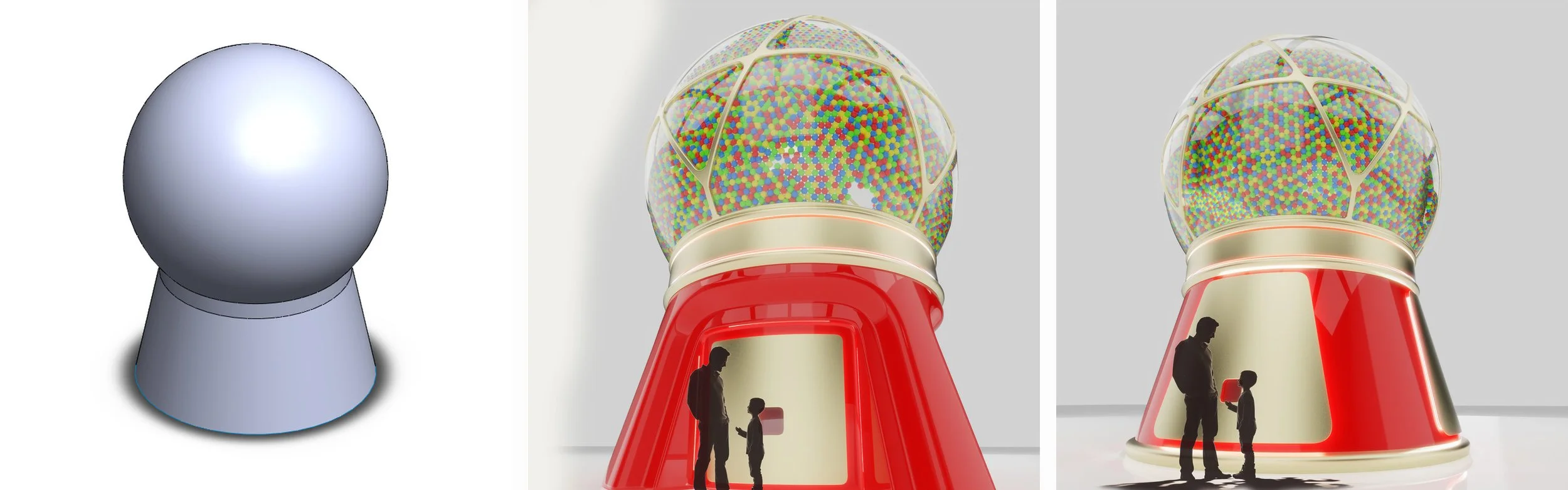
A form study from the day after the first call, then the first two concepts, drawn with a parent and child for scale.
Every scale drawing had a parent and child in it
At 26 feet, proportion is most of the design. I put the silhouette of a father holding his son's hand into every scale drawing, so each decision about the sphere, the base and the brass was judged against the people who would stand beside it. The early volumes settled on a 17-foot sphere on a machine 26 feet tall.
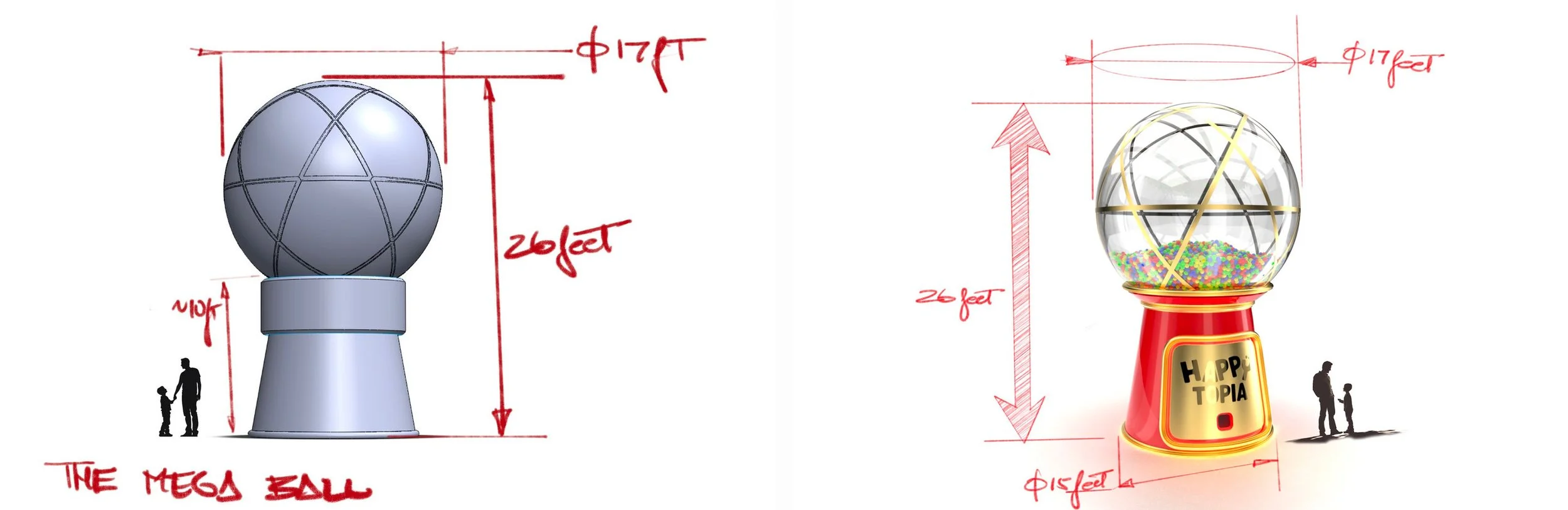
Every scale drawing carried a father and his son.
I tried the fascia two ways, with the event's name in brass and with Happy Topia's wordmark on the red body. Then I set the machine into photographs of two Bengaluru atriums, to see what a shopper would see from the railings three floors up and from the ground floor.
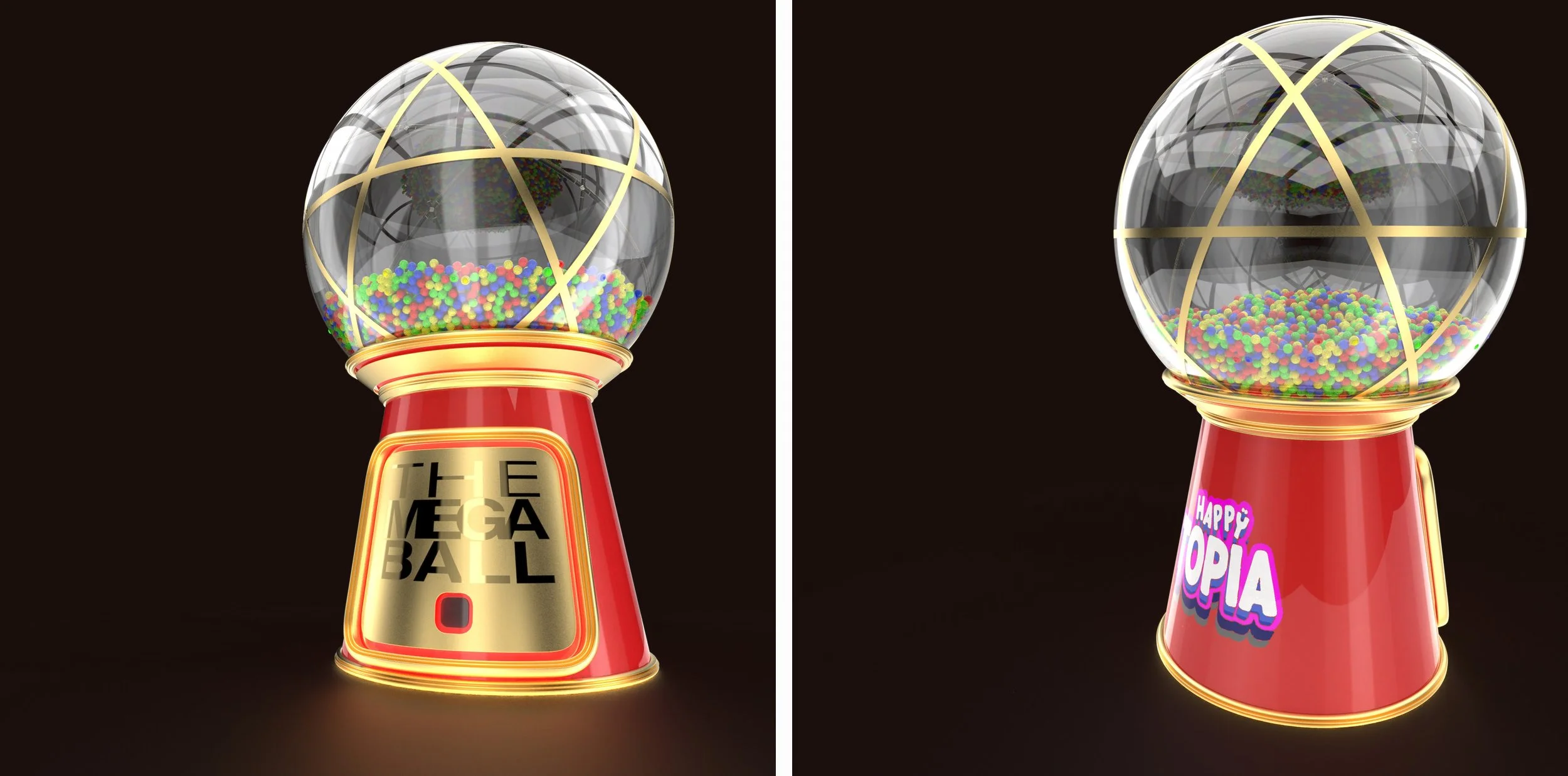
Two faces for the fascia: the event's name in brass, and the brand.
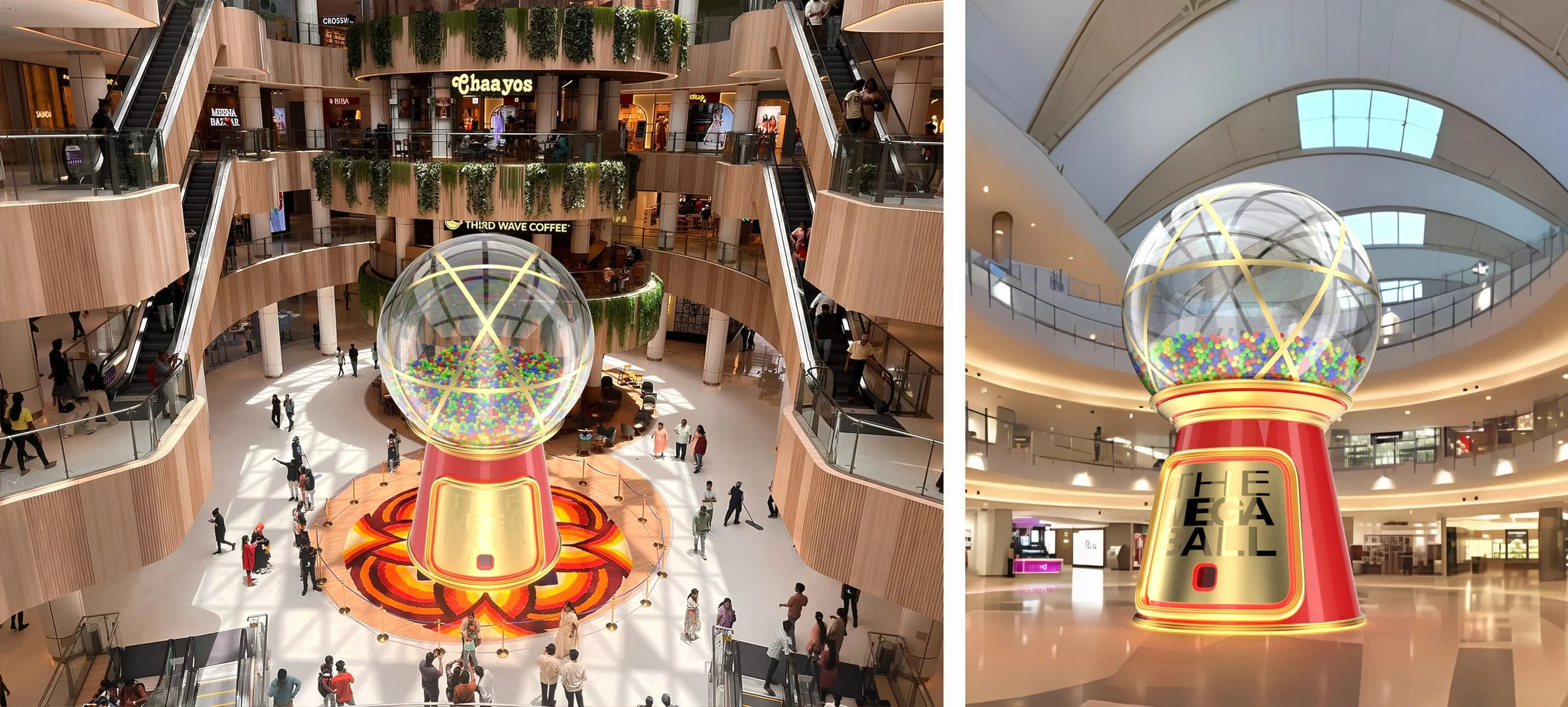
A landmark has to read from the railings three floors up and from the ground floor.
Those composites became a short deck Happy Topia could take to mall managers. It made the case for footfall and photographs, showed the machine's size at a glance, and pointed to a reference everyone already knew, MrBeast's giant gumball machine at VidCon.
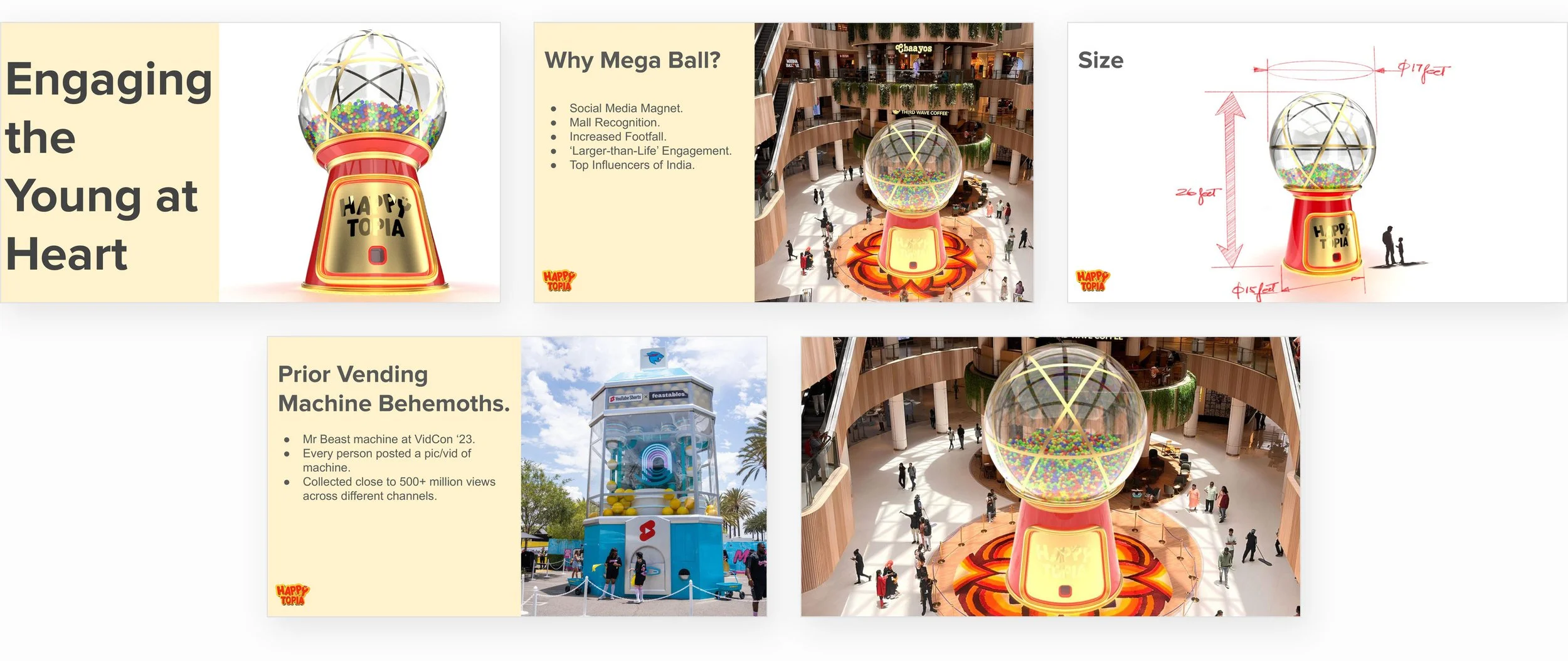
The five-slide deck Happy Topia took to mall managers.
Triangles are easy to draw and hard to make
The first structure was a geodesic sphere. Triangular fibreglass frames met at steel brackets, and curved triangles and pentagons of polycarbonate filled the openings. It was strong and it read as a sphere. It also asked for large clear panels curved in two directions, and a clear panel this size is vacuum formed over a mould, one mould for every shape.
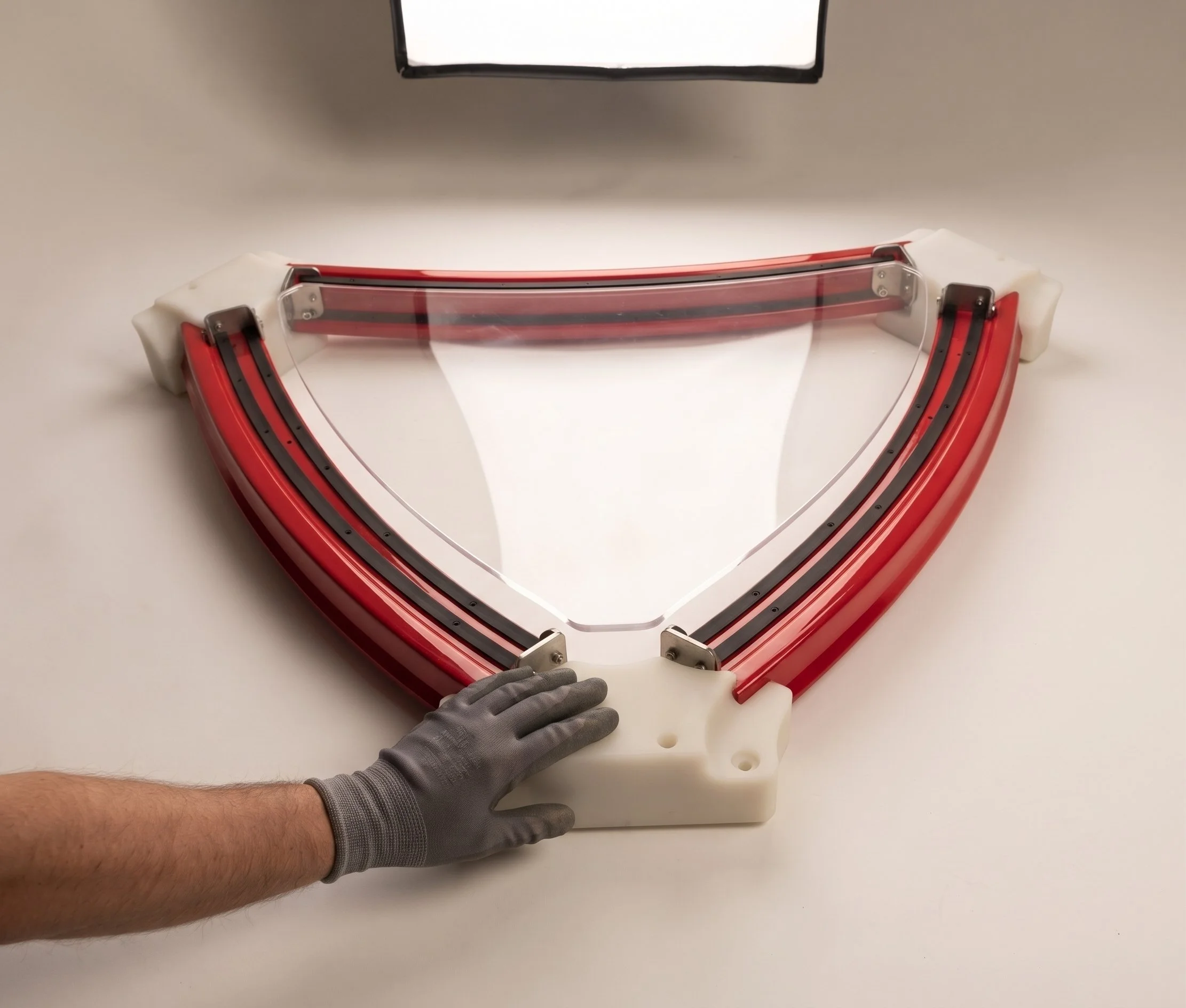
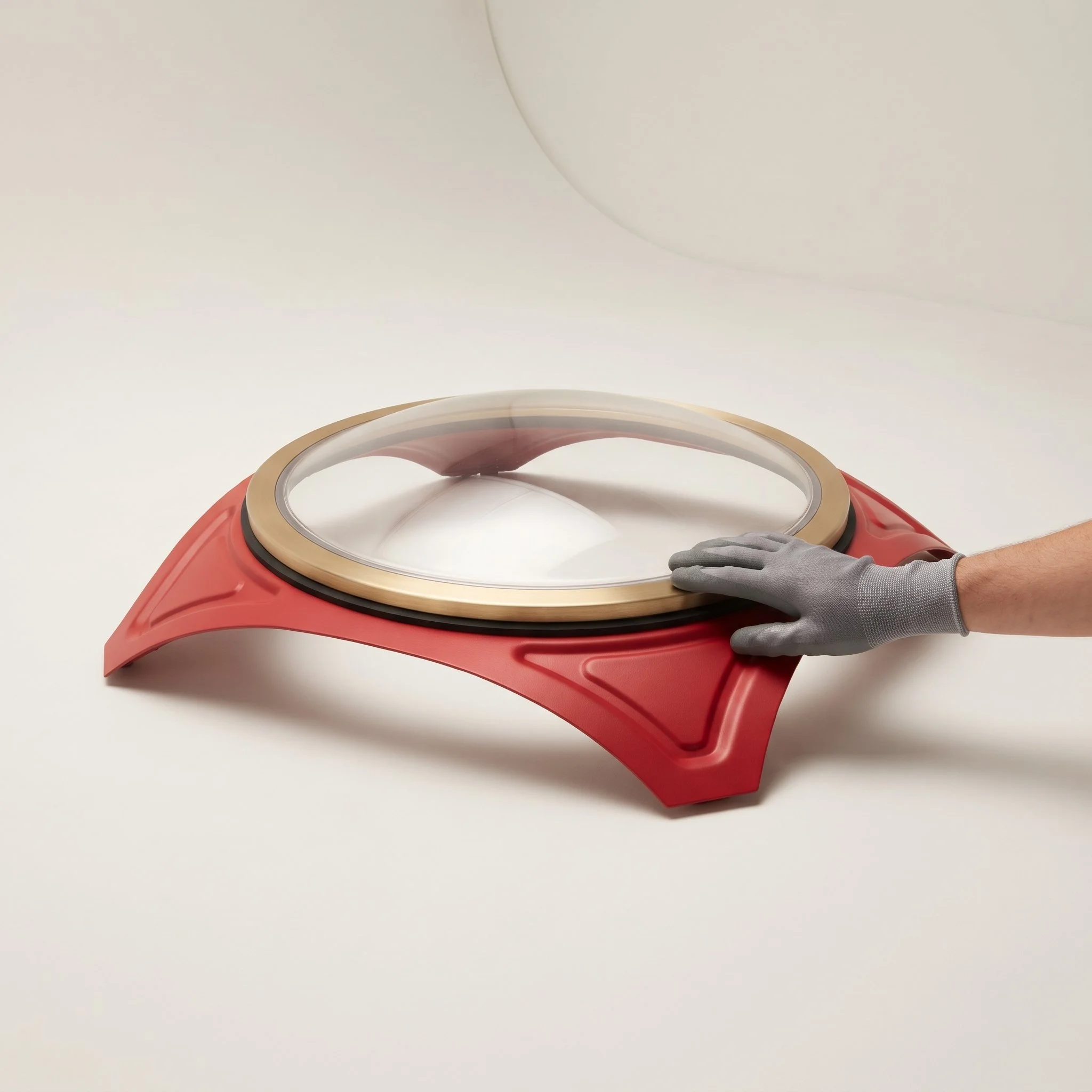
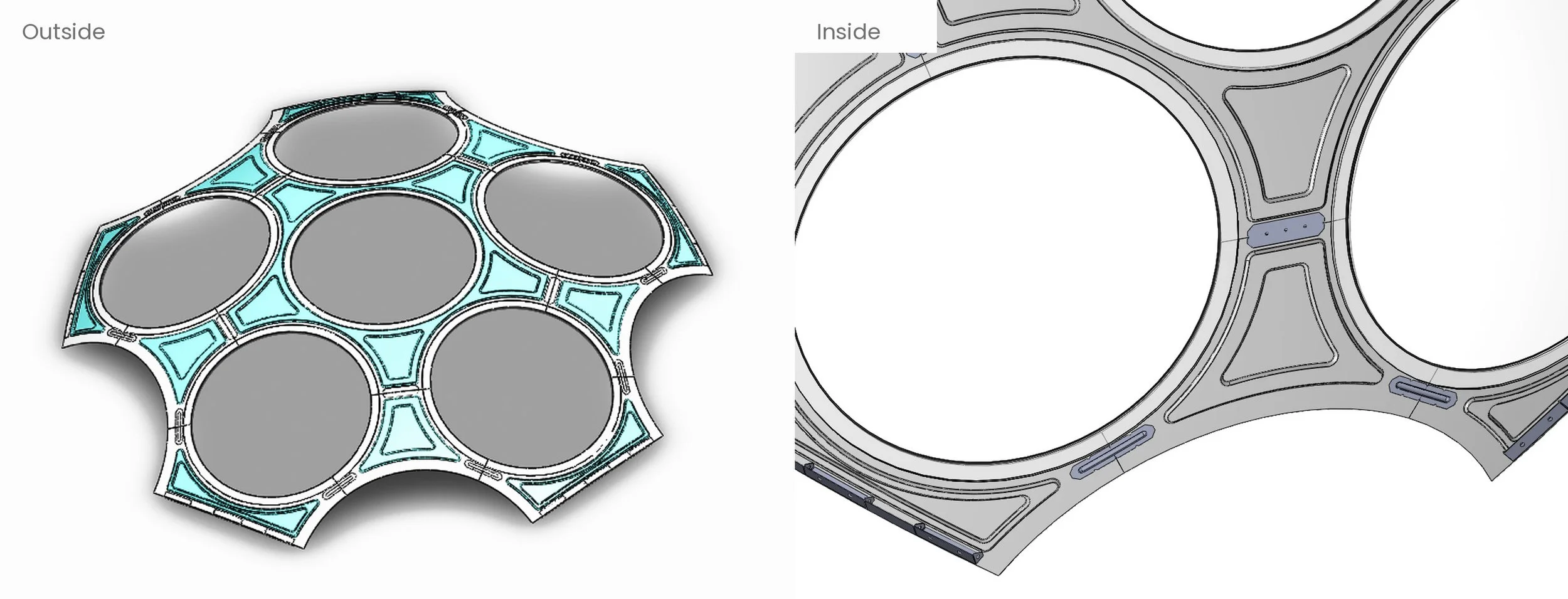
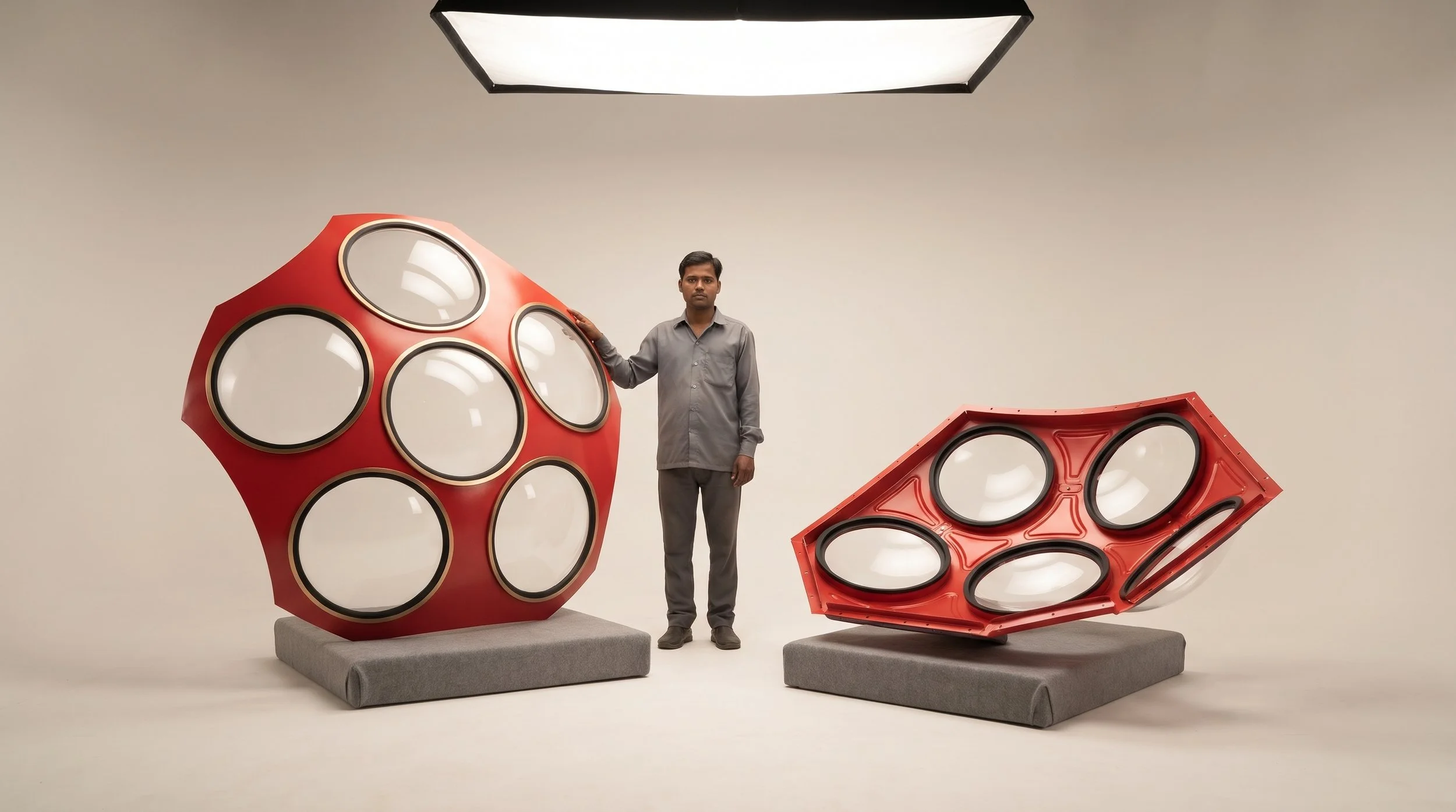
I simplified the frame first, into triangles of three curved fibreglass bands that meet at machined nylon corners. The bigger change came when I stopped fitting the plastic to the frame and designed the frame around the plastic. A circle is the easiest shape to vacuum form: a shallow dome pulled from a flat sheet and sealed all round by one gasket. The sphere became a lattice of thin frames stamped from galvanised steel and powder coated, stiffened from inside, holding circular windows of optical-grade polycarbonate in two sizes. I packed the two sizes until they covered the sphere evenly, first as 41 large windows and in the final version as 86 smaller ones.
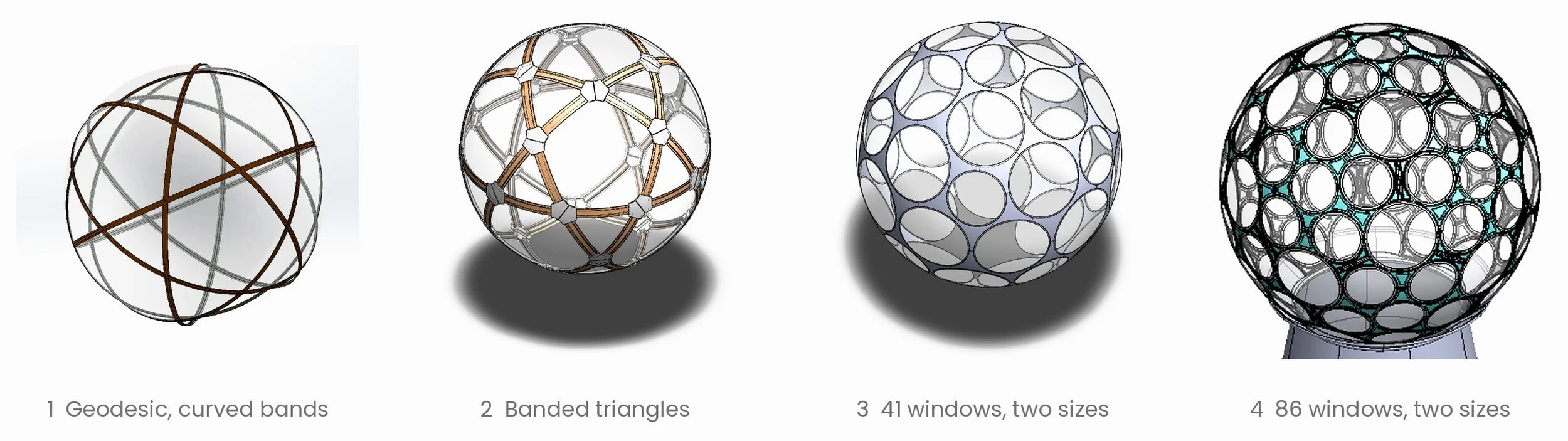
Four domes, from curved triangles to two sizes of circle.
Everything had to fit through a service lift
A mall gives you one night. The machine arrives after closing, through a loading dock, a service corridor and a goods lift, and it has to be standing before the shutters go up. That made the lift door as important a dimension as the atrium.
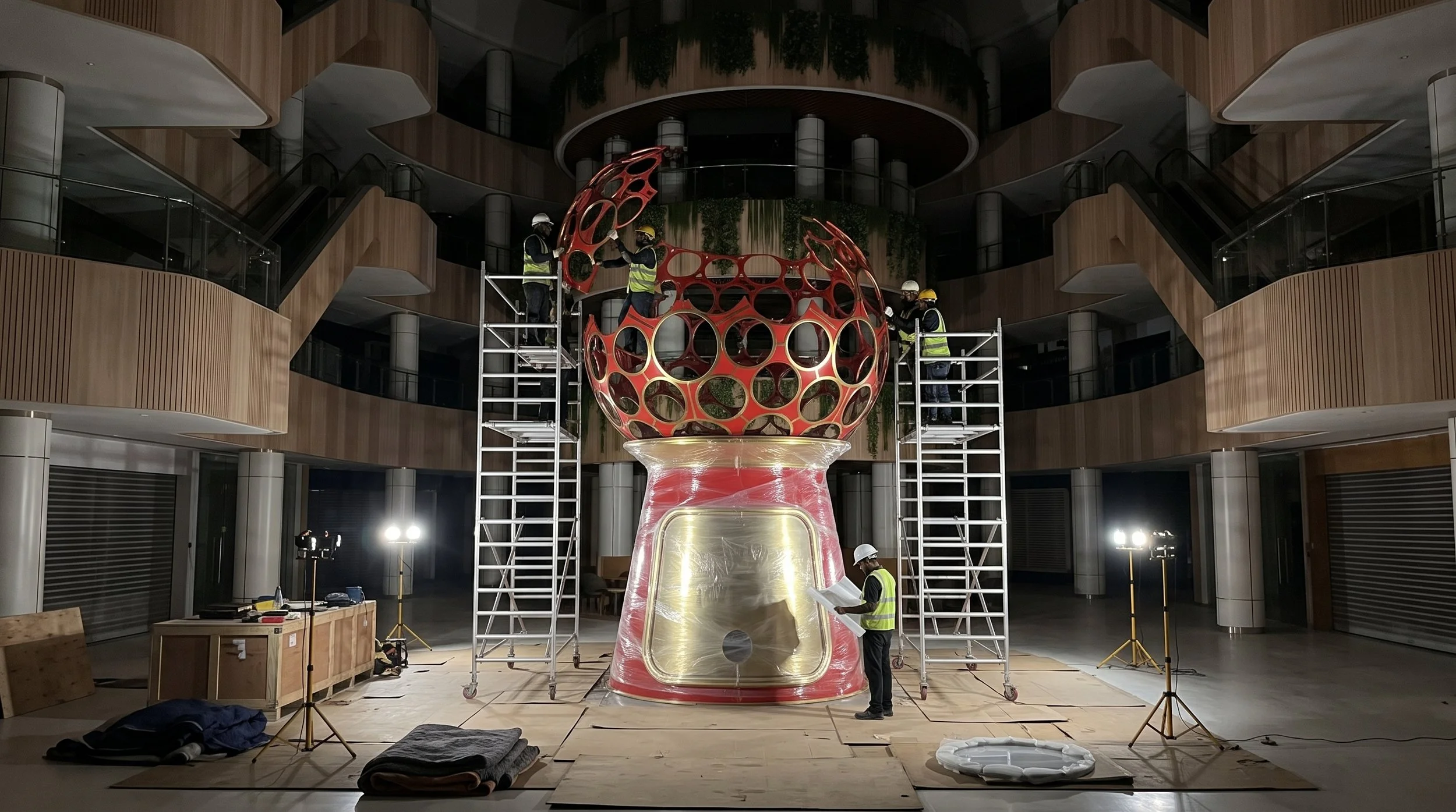
Install night: the sphere goes up panel by panel after the mall closes.
The 30-foot ambition became a 25-foot structure, sized by the atriums Happy Topia wanted and by what Bengaluru's vendors could make. Amit's flat-pack idea came back here. The sphere broke down into three kinds of sheet-metal frame, repeated 121 times, and two people can carry any one of them. The base split into 57 fibreglass parts, five millimetres thick, drawn one by one for a shop that had built large installations for an airport terminal. Everything was planned to travel in crates on a single truck.
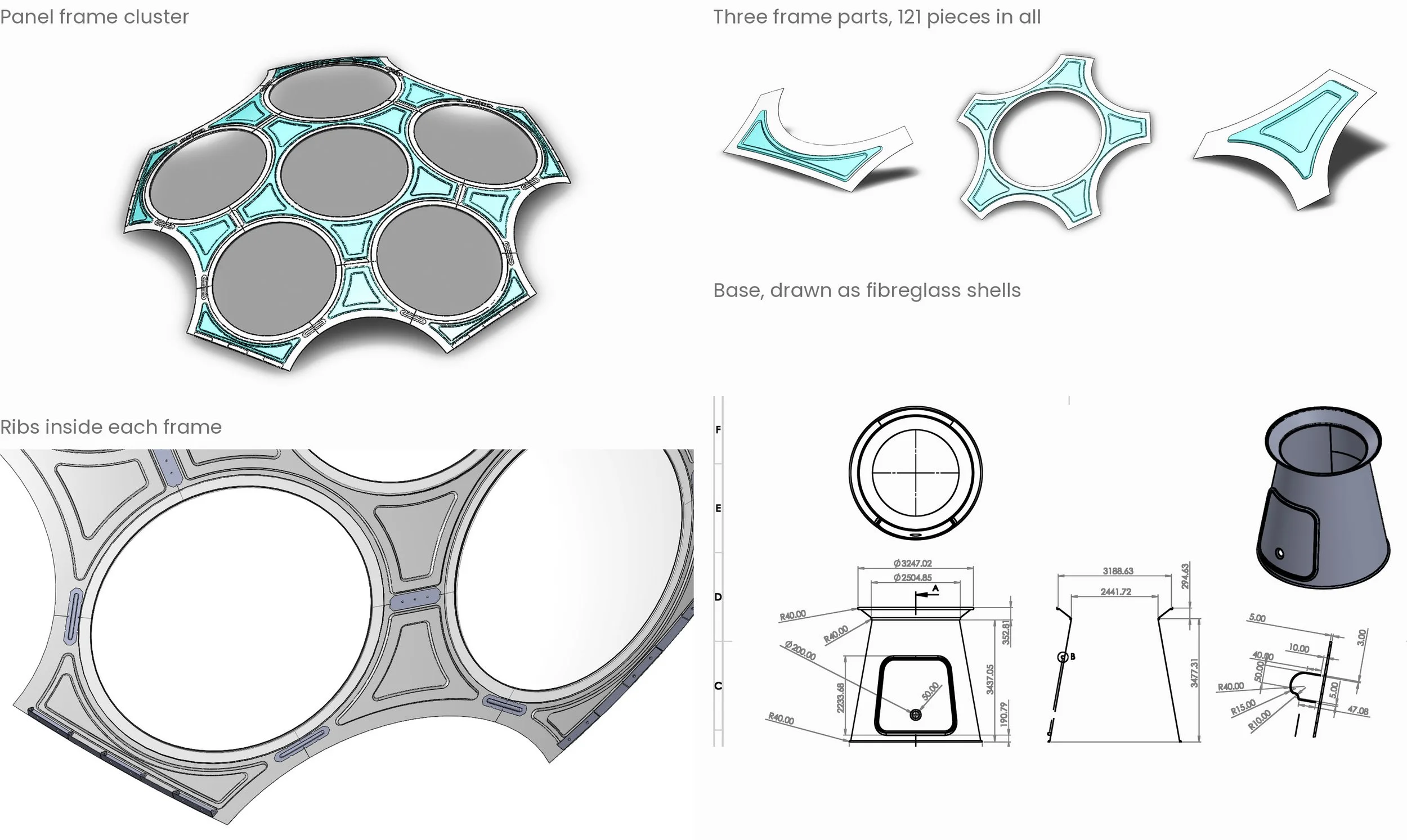
The whole machine as a kit: three kinds of frame repeated 121 times, 86 windows from two moulds, and a base of fibreglass shells. Nothing is bigger than a goods-lift door.
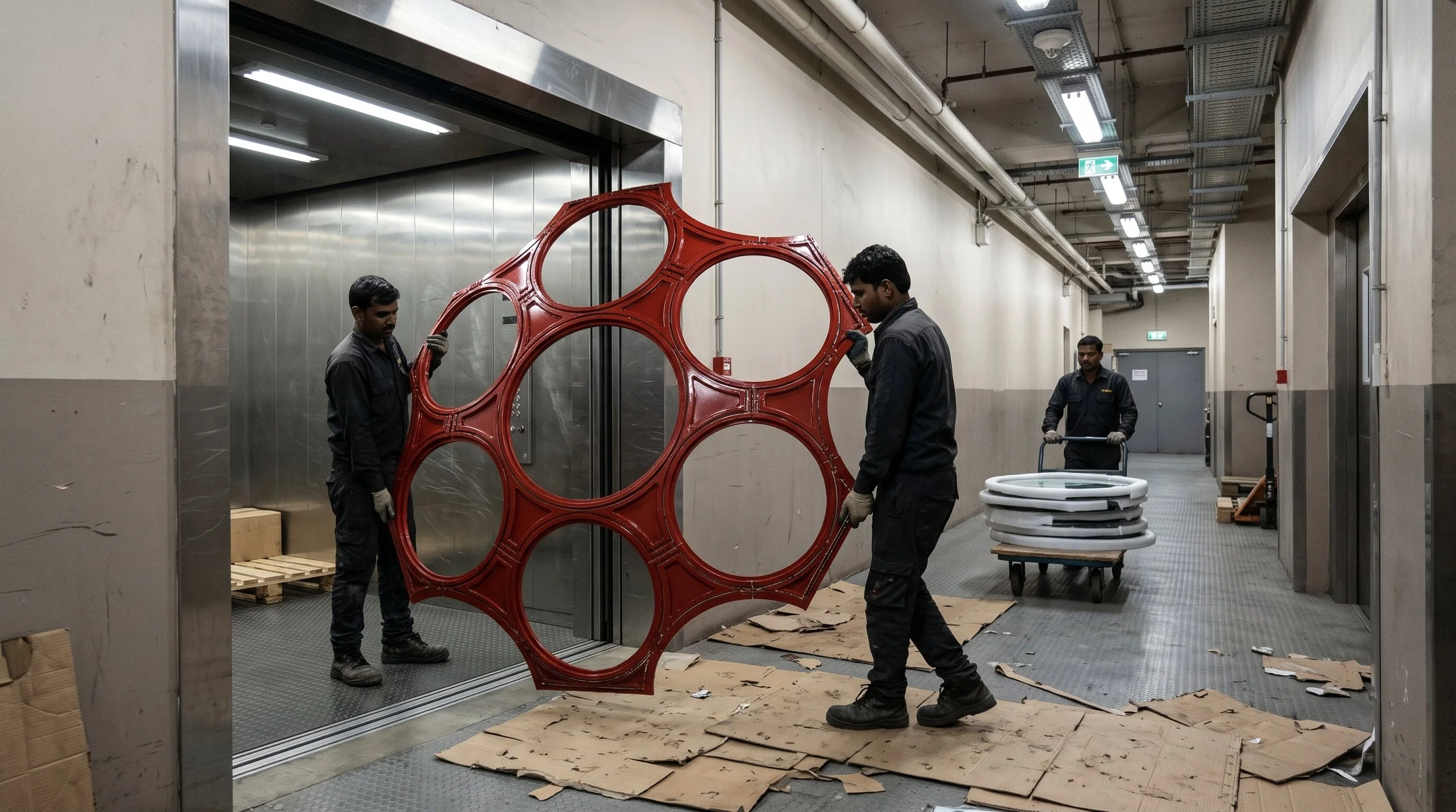
Two installers, one panel, one goods lift.
Inside, a frame of galvanised steel C-channels carries the dispensers and close to 2,000 capsules, about 160 kilos of them. Rubber gaskets keep dust out of the windows, and pockets in the base hold the tools for refilling. The whole machine runs from an ordinary wall socket.
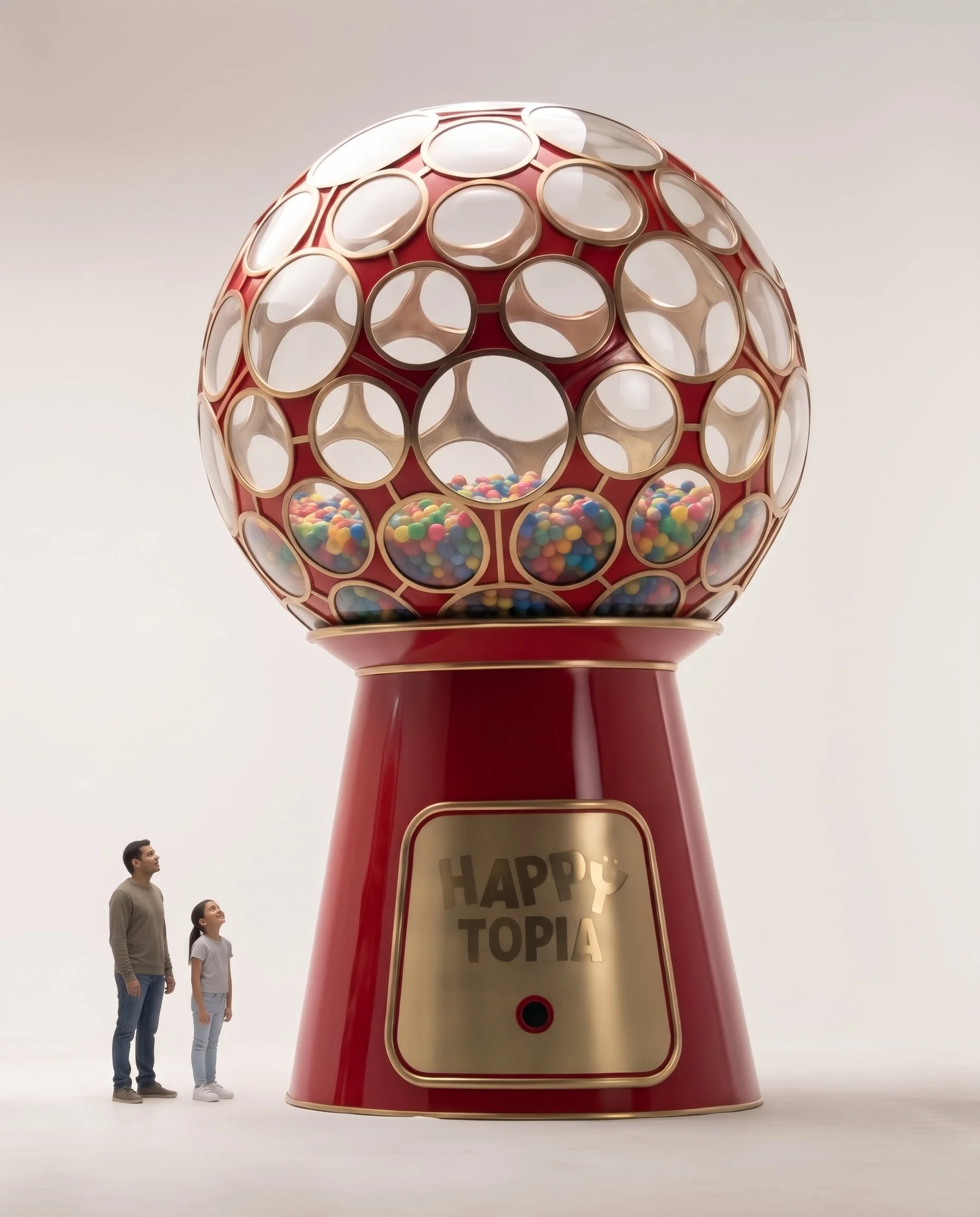
The Mega Ball beside a father and his daughter: 25 and a half feet, a red body, a brass fascia and a sphere of clear circles.
A child who pays must get a capsule
While the Mega Ball went out for quotes, Happy Topia asked for the opposite. The fleet needed a countertop machine about two feet tall, The Small Ball, that could go where a landmark never would: cafés, toy stores, smaller malls and events. It had to cost less and fail less than the machines already running.
Those machines had taught hard lessons. Sensors failed. Connectors shook loose on the road. Nothing tied the payment to the dispense, so a child could pay and get nothing. For a parent that is a refund to chase. For a seven-year-old it is the whole visit.
The functional brief I wrote for Happy Topia's engineering partner started from that moment. Scan a QR code to pay. The knob unlocks with a sound or a light. One full turn gives exactly one capsule. The mechanism would be judged on easy repair, off-the-shelf parts, no jams, no false positives, a cellular link that reports every dispense and error, and cost.
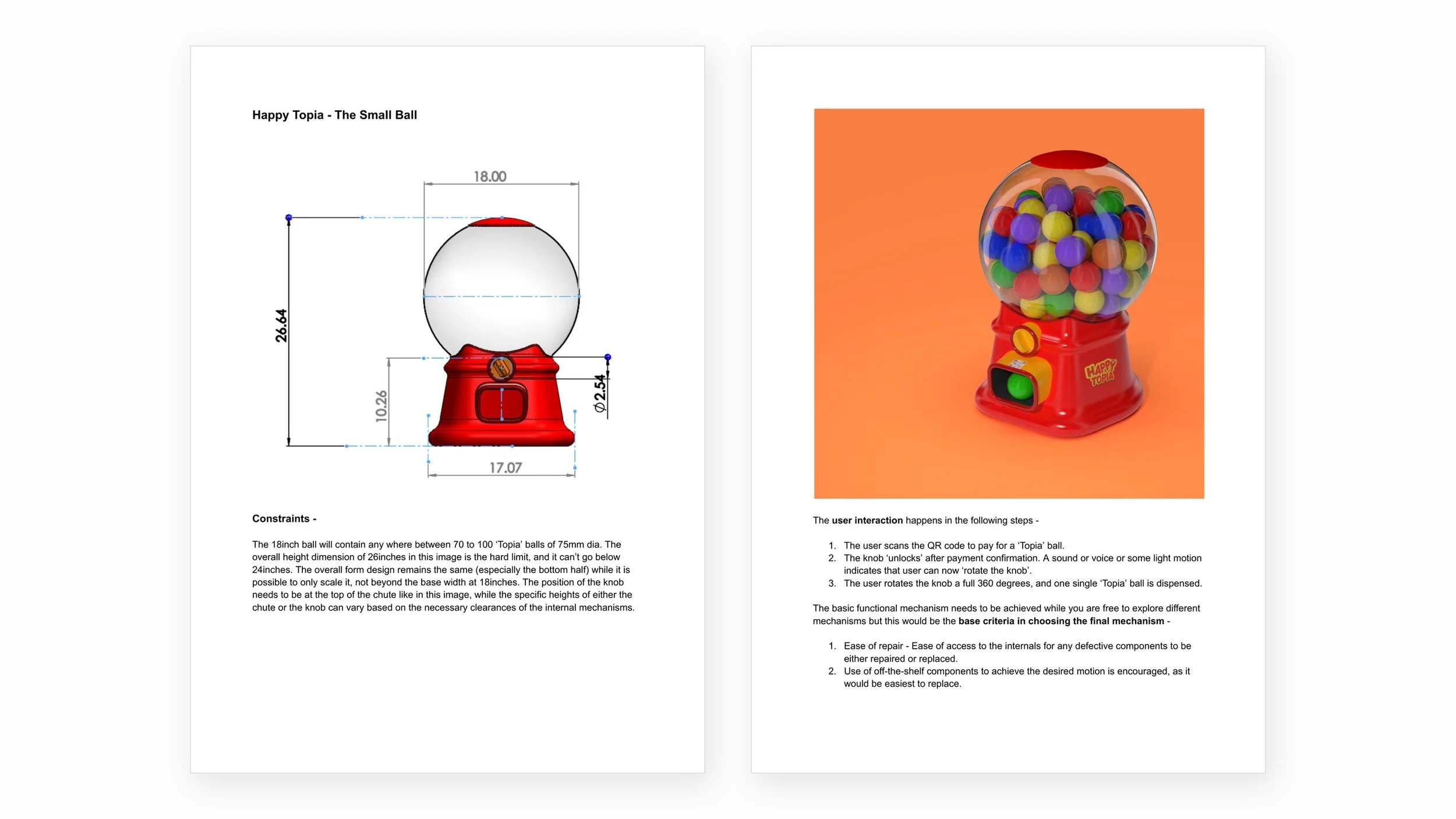
The functional brief: limits first, then the interaction, then how the mechanism would be judged.
Capsules came before curves
Happy Topia wanted 70 to 100 capsules in each machine, each 75 millimetres across, so the first question was how big a dome that takes. I packed virtual capsules into domes of different sizes. A 10-inch dome held 17. A 16-inch dome held 43. An 18-inch dome held 104, the smallest that met the brief, and that number set the rest.
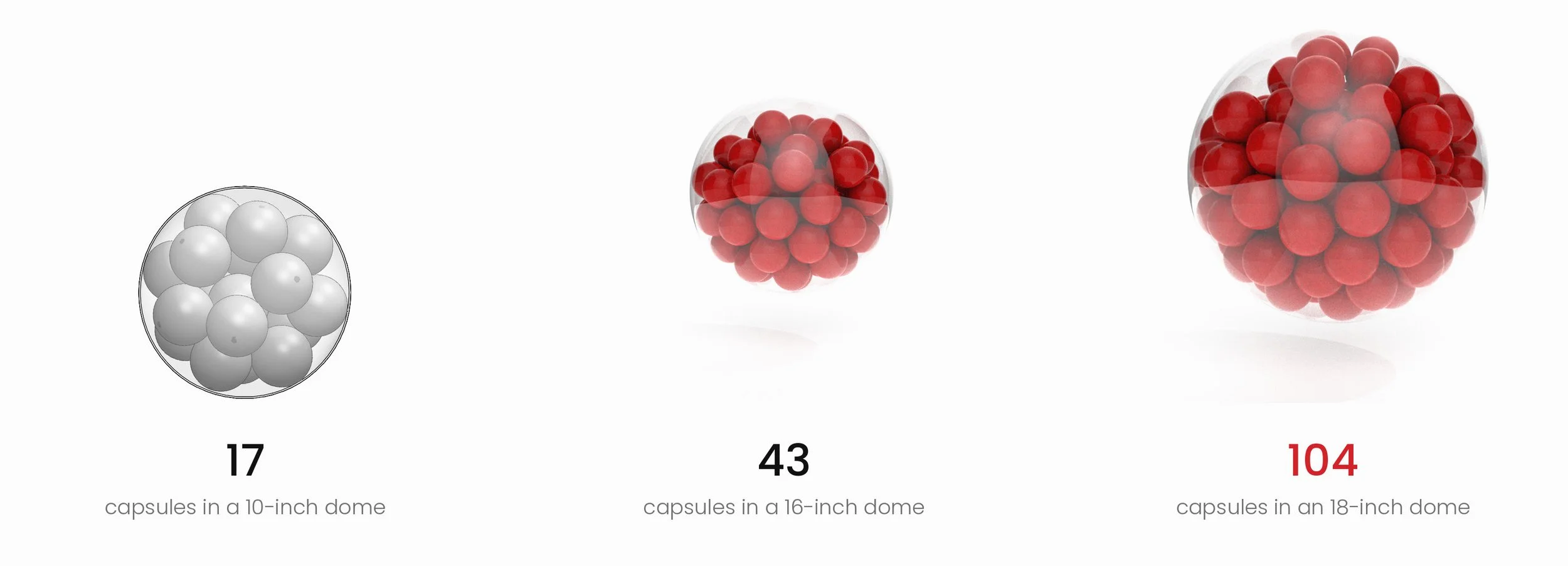
The 18-inch dome was the smallest that held enough.
The machine had to stay between 24 and 26 inches tall, small enough for a counter, and the base could be no wider than the dome. Four forms worked out the proportions around the mechanism's footprint. The fourth went to the engineering partner with drawings for every part, from the dome and its gasket to the knob and chute, and a Pantone reference for each colour.
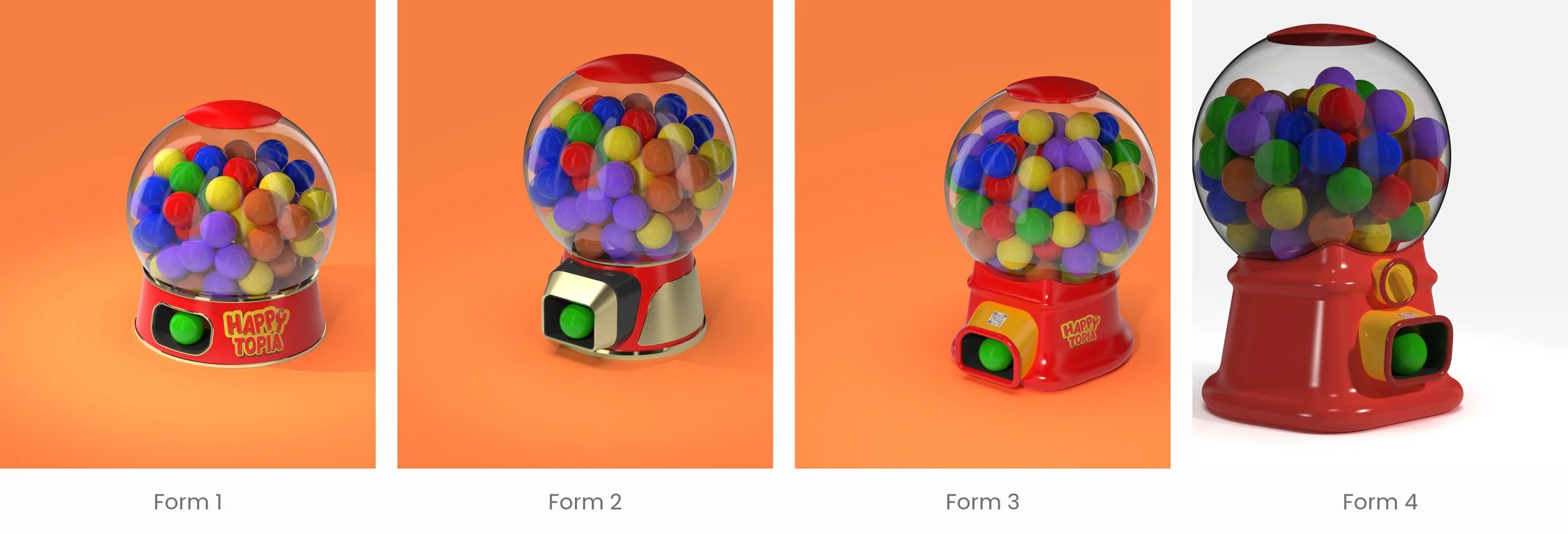
Forms one to four, shaped around the mechanism.
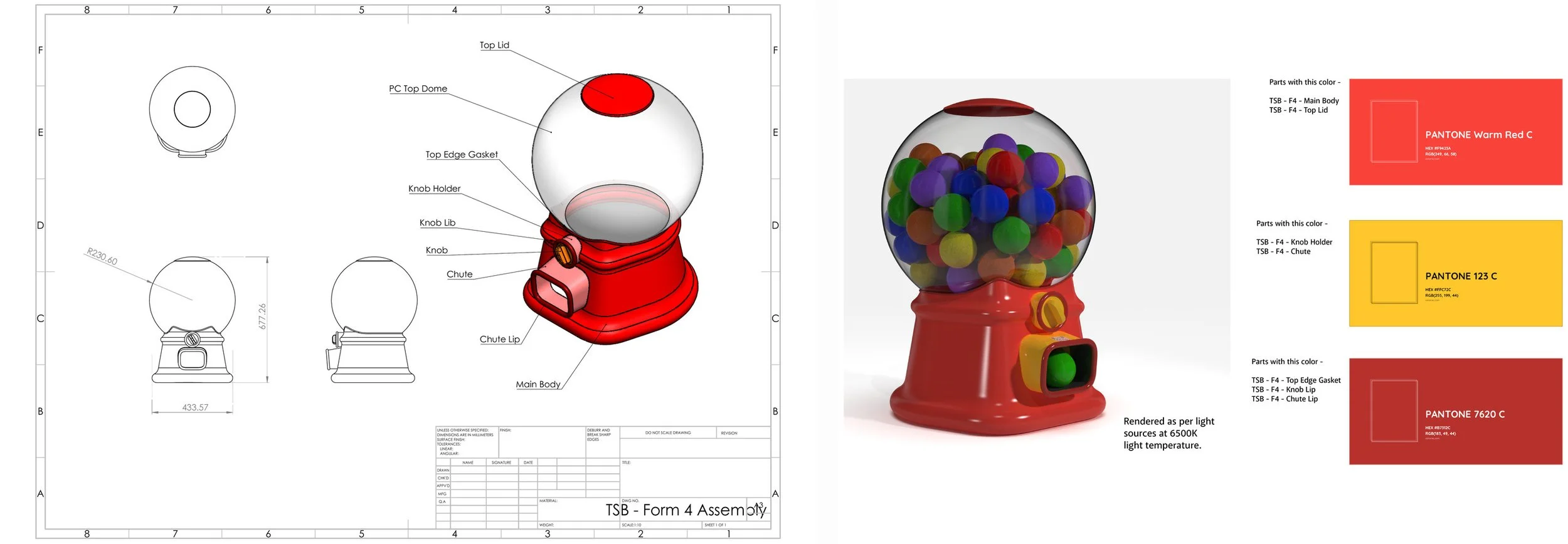
Form four, drawn part by part, with a Pantone reference for every colour.
The partner designed the mechanism and electronics. Their first costing showed what a purely mechanical knob would take: 13 parts, eight of them die-cast in aluminium, each with its own tool. So the knob went and a motor took its place. The final machine works like Happy Topia's 7-foot machines. A parent scans the QR sticker, the payment clears, and the machine drops one capsule into the exit on its own. The brief's promise outlived its mechanism: a child who pays gets a capsule.
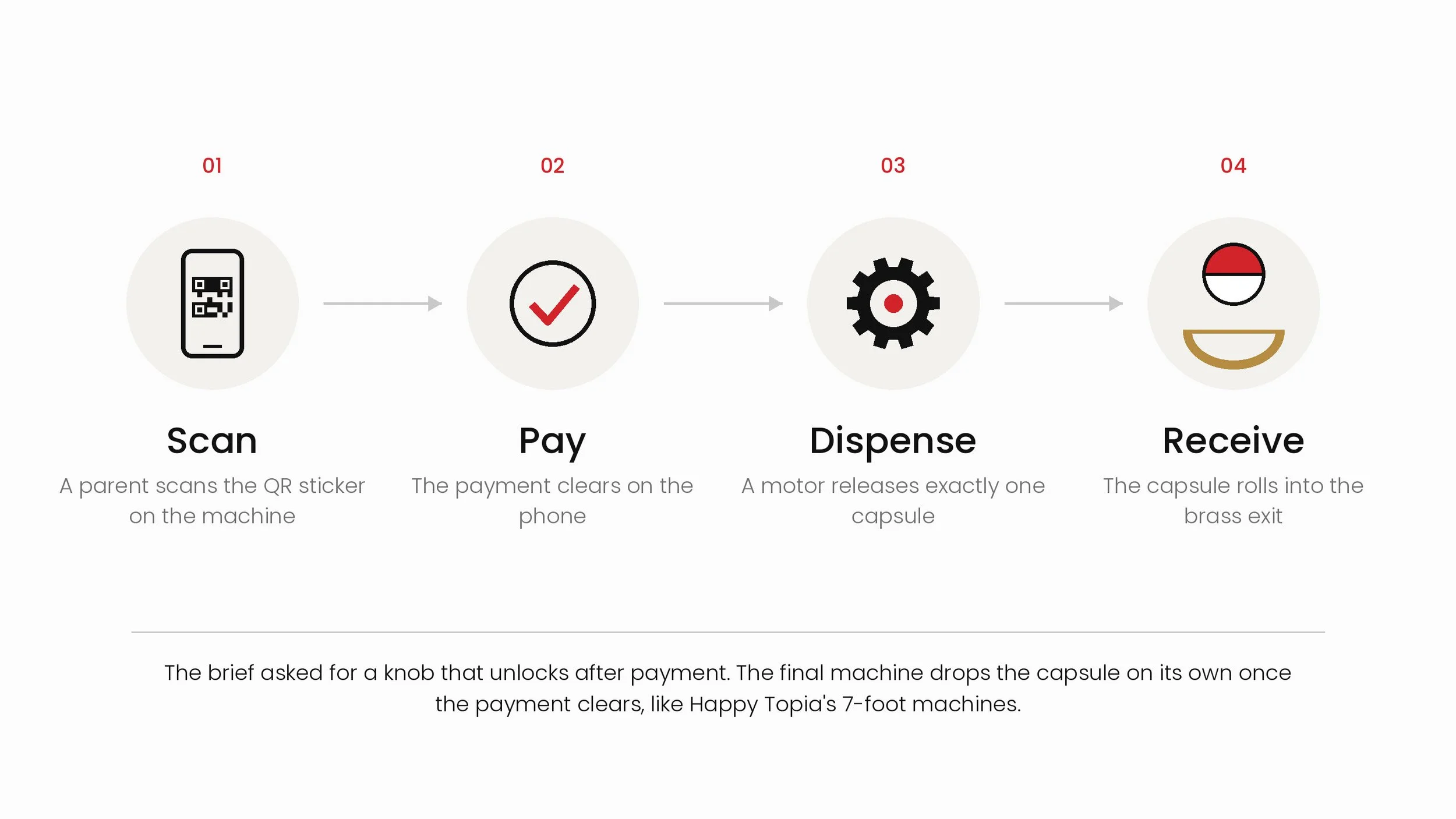
Scan, pay, dispense, receive. The knob went and the promise stayed.
Grandeur needed a definition
Early in the new year the founders asked for a more refined machine, one with grandeur. Grandeur is a feeling. A machine needs a specification, so I turned the word into questions before opening CAD. Which toys and brands do Happy Topia's children already want? Which colours belong to the brand? What should a child feel at first sight, while using the machine, and afterwards, the three levels Don Norman calls visceral, behavioural and reflective?
The answers became mood boards, some of them AI-generated, and a run of forms reviewed with the founders midway. The mechanism moved low into a rounder base. Brass arrived as a ring and then as a bezel around the exit. I wrapped Happy Topia's real capsule labels onto the rendered capsules, so the founders judged a full machine rather than an empty one, and I set each form beside the image that inspired it to show where they still differed.
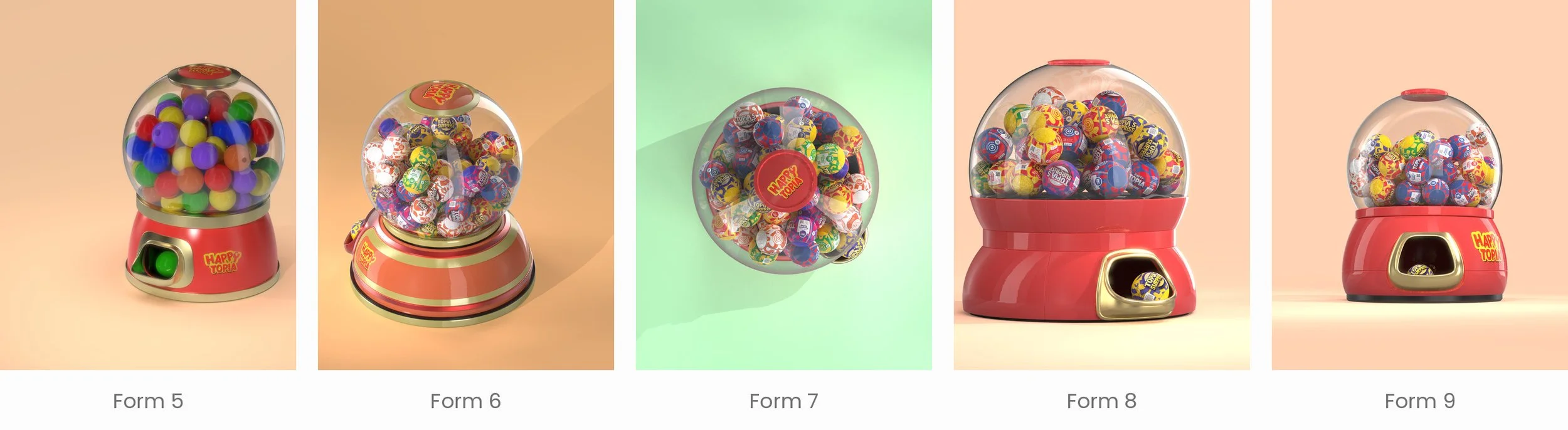
Forms five to nine, from a squat drum to a softer body with a brass exit.
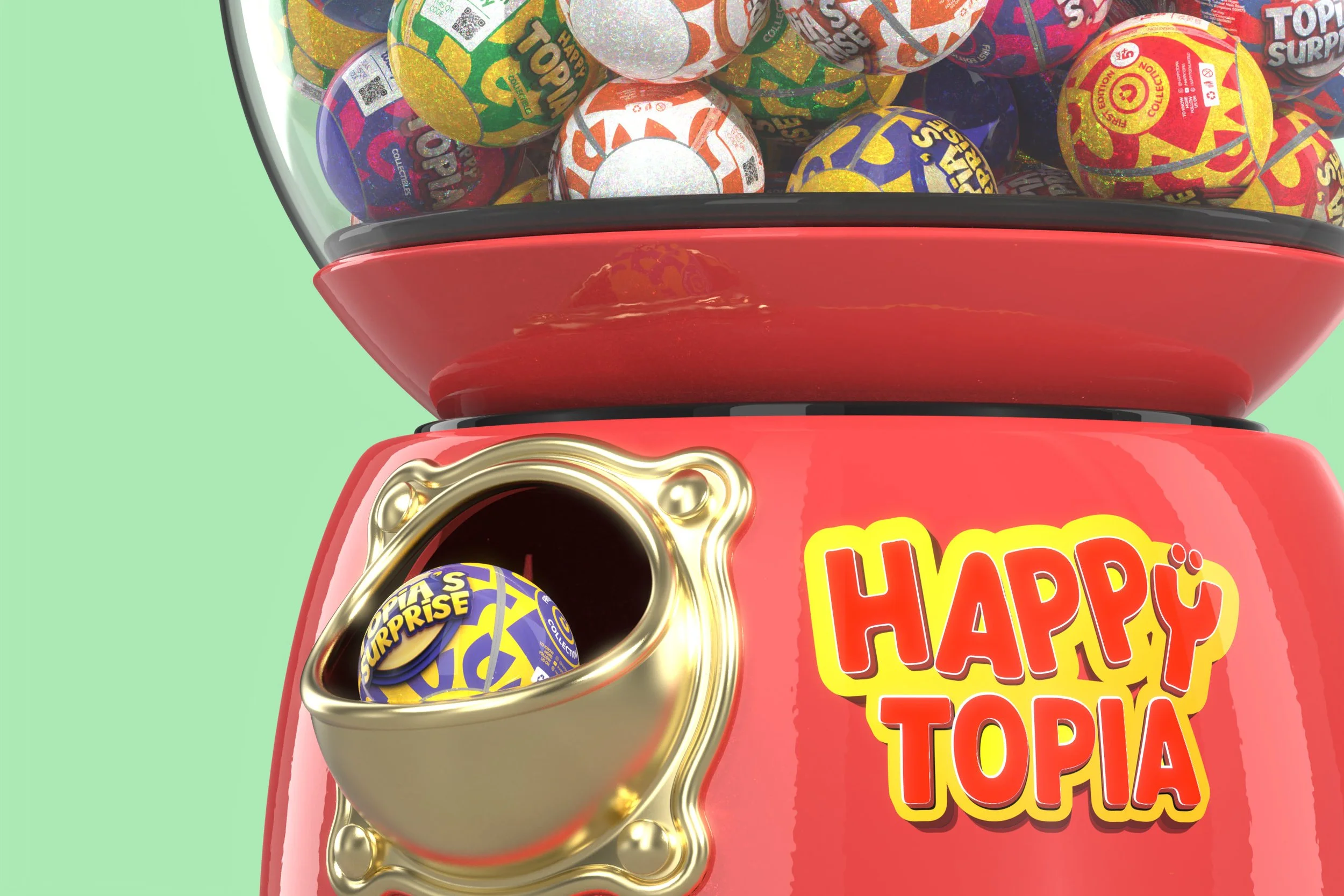
Real capsule labels on the rendered capsules, so the founders saw the machine full.
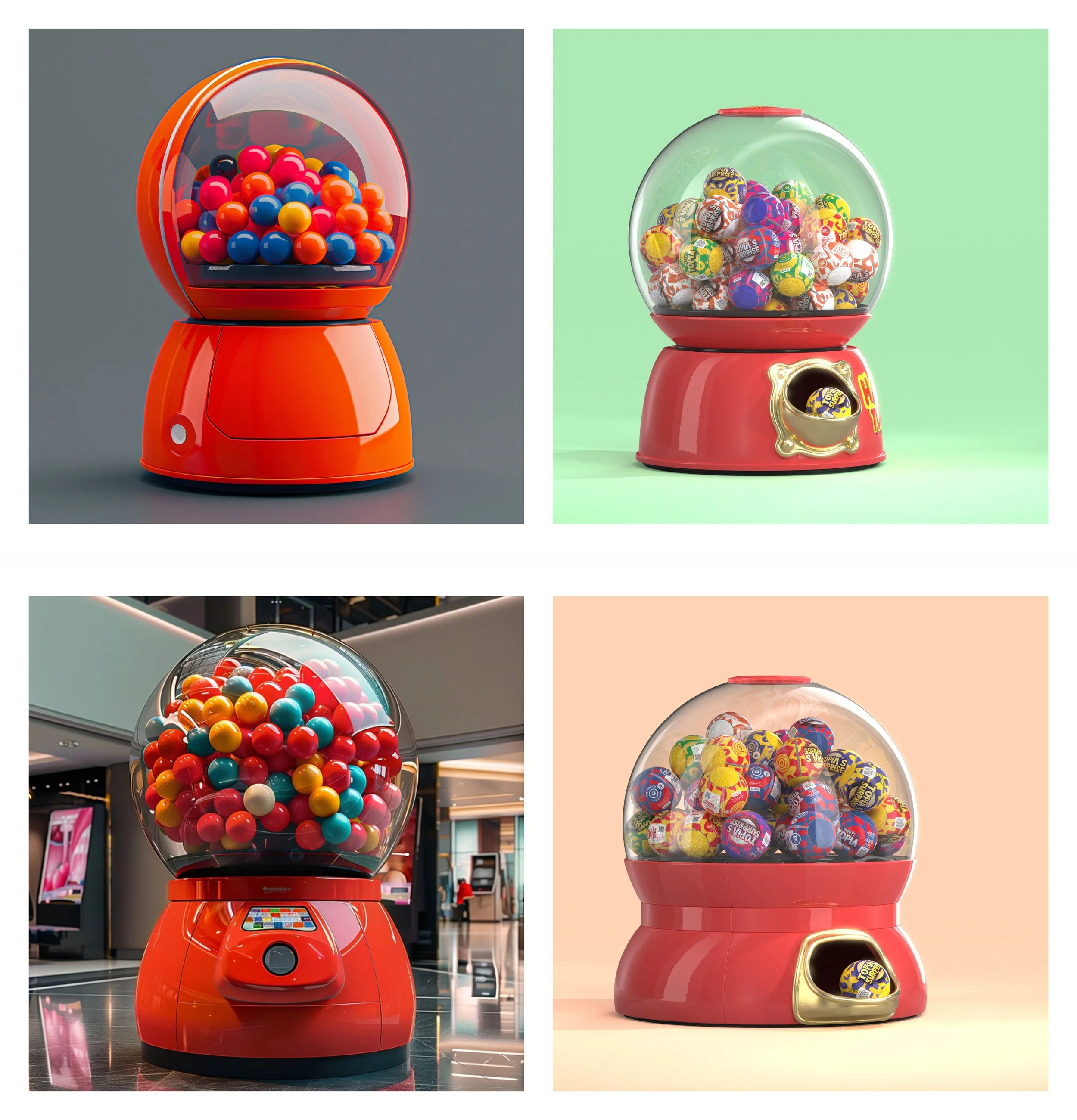
Each form beside the mood image it answered. The gap between them set the next round.
Ornament went where the hand goes
The last references were ornate: cast-iron scrollwork, a die-cast housing and silver gumball machines from another century, some of them generated with AI. Ornament all over would have been costly to tool and hard to keep clean in a mall, so I put it into the one part every child reaches for. The capsule exit became a single piece of brass, sketched by hand as a lip of metal fixed into the body, and the red body around it became soft and plain.
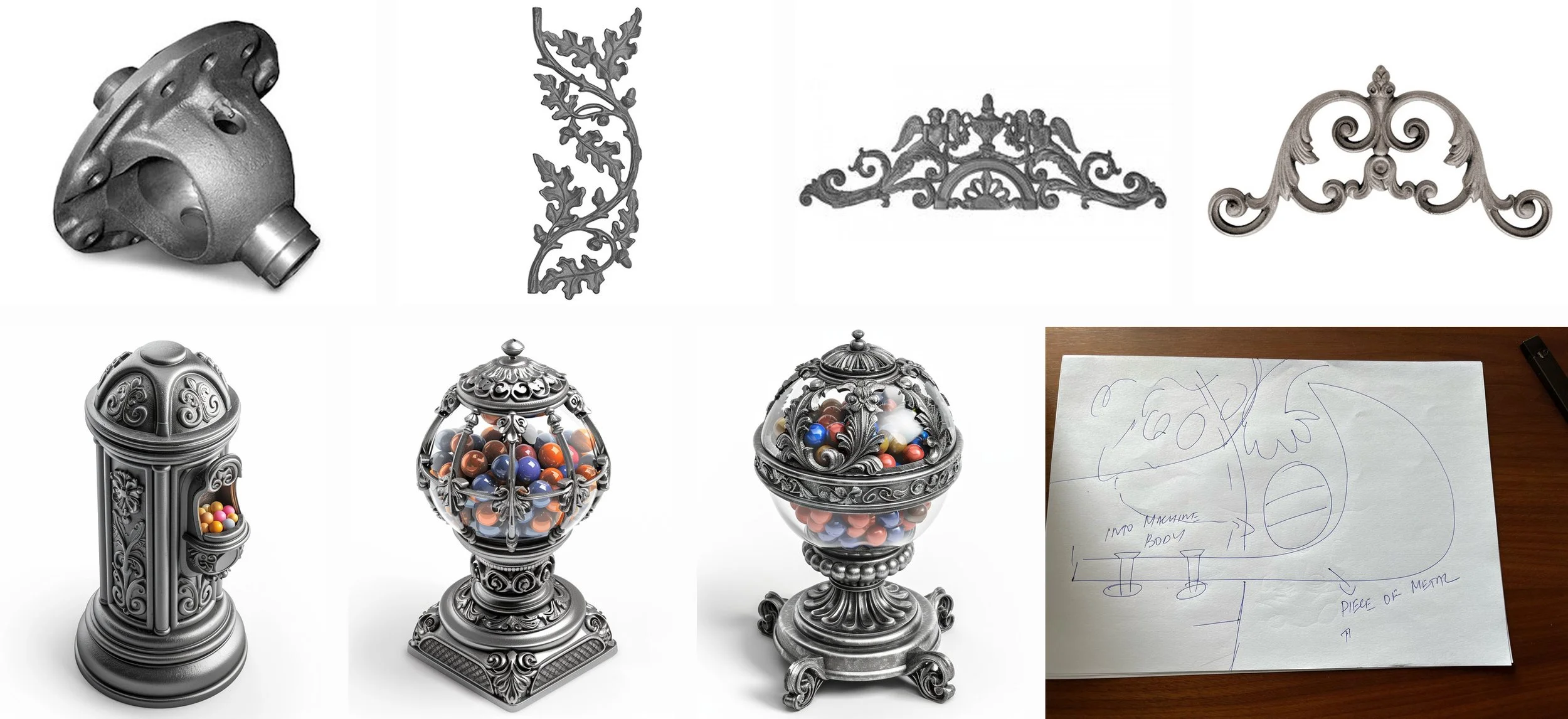
Ornate references, from cast-iron scrollwork to AI-generated silver machines, and the sketch that reduced them to one brass part.
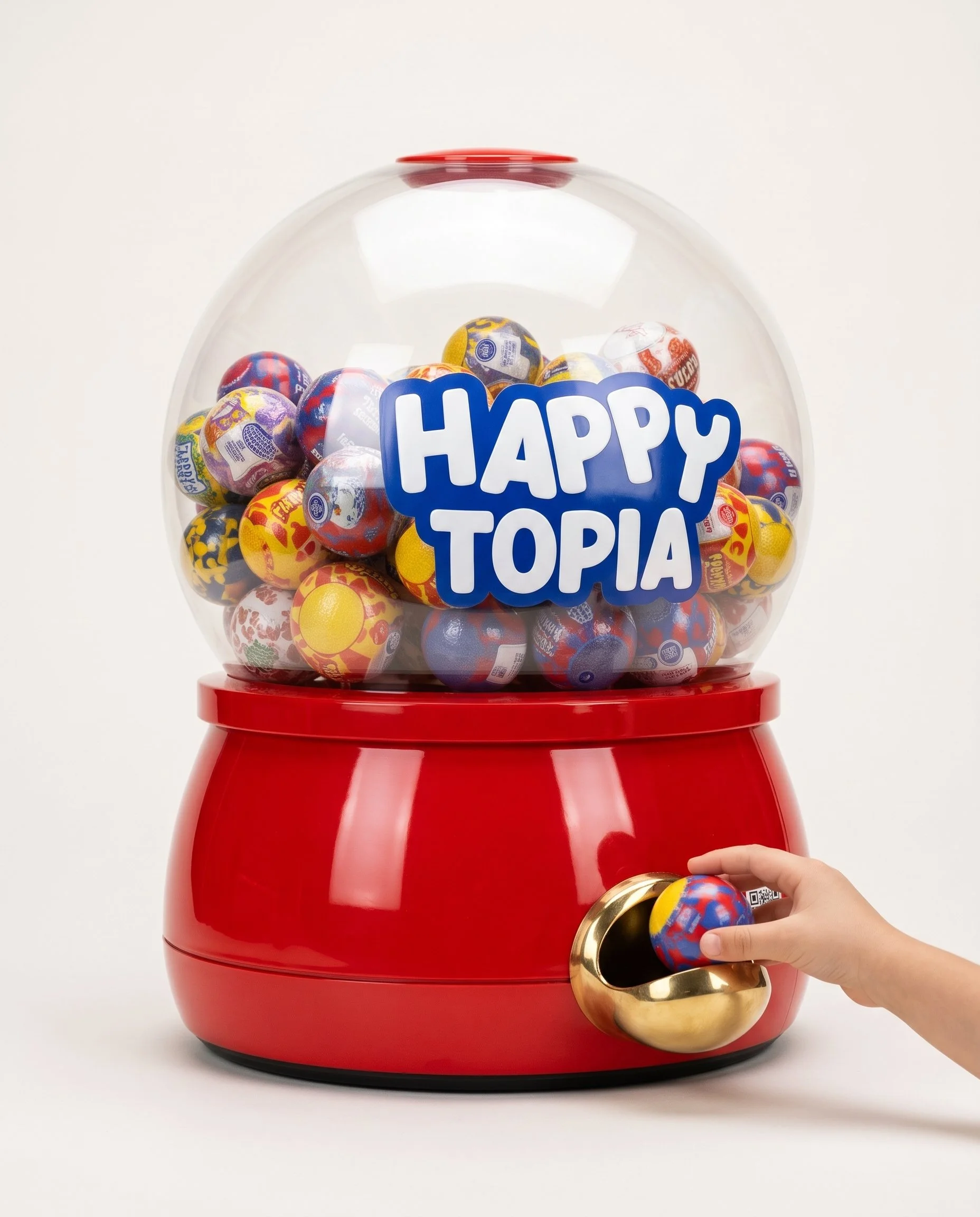
The final countertop machine, 24 inches tall, beside the hand it was made for.
The wordmark moved off the body and onto the dome, where it reads from across a room. The exit came in four finishes.
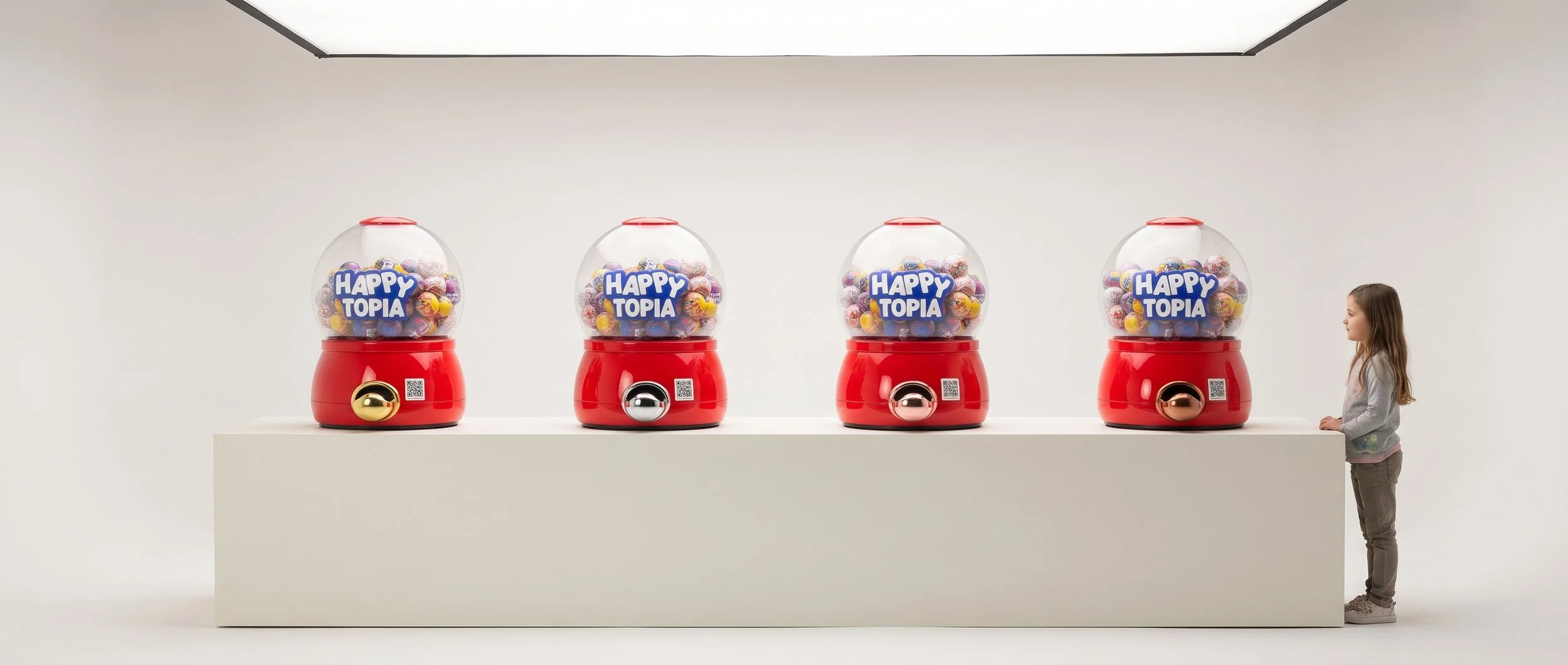
One exit, four finishes.
Four stands let the same machine stand on its own in a mall or a lobby: turned wooden legs, black steel with brass rings, a black hoop, and folded red sheet metal that carries the brand.
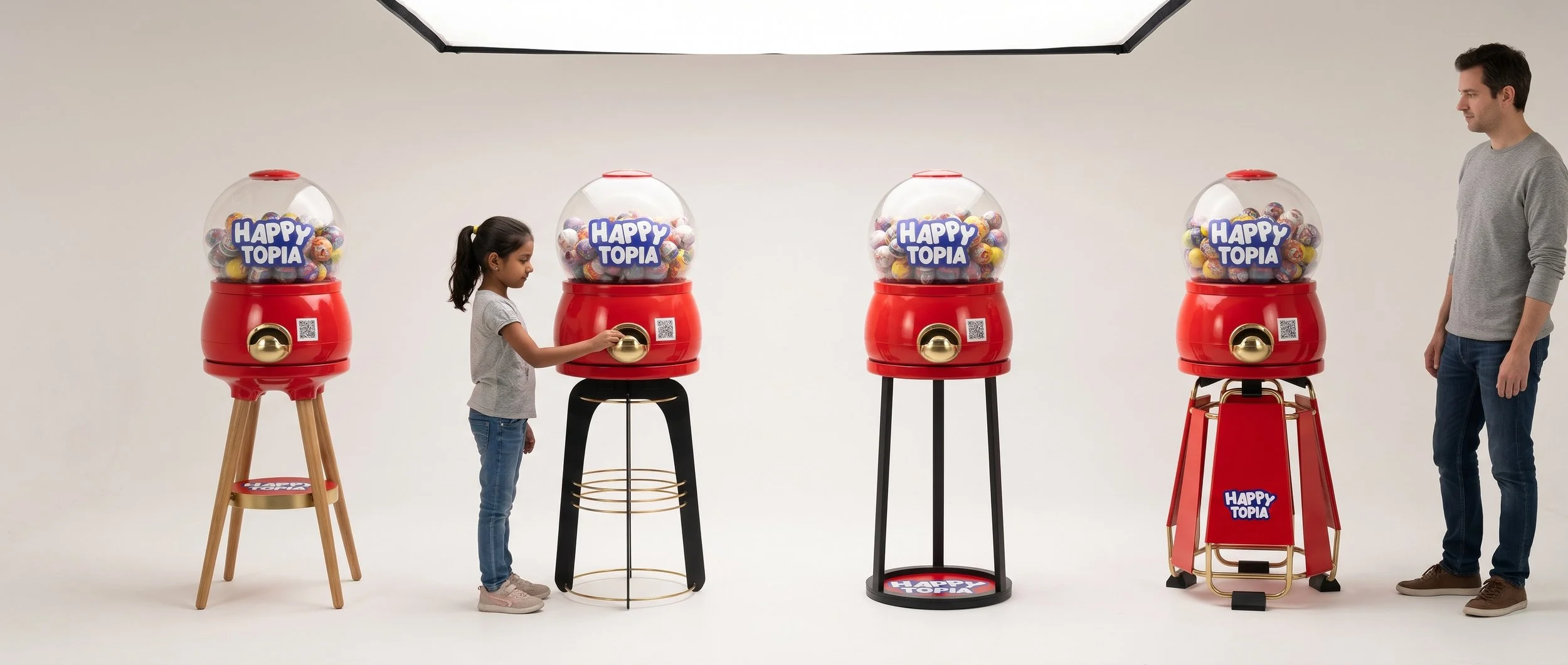
Four stands for the same machine, with a child for scale.
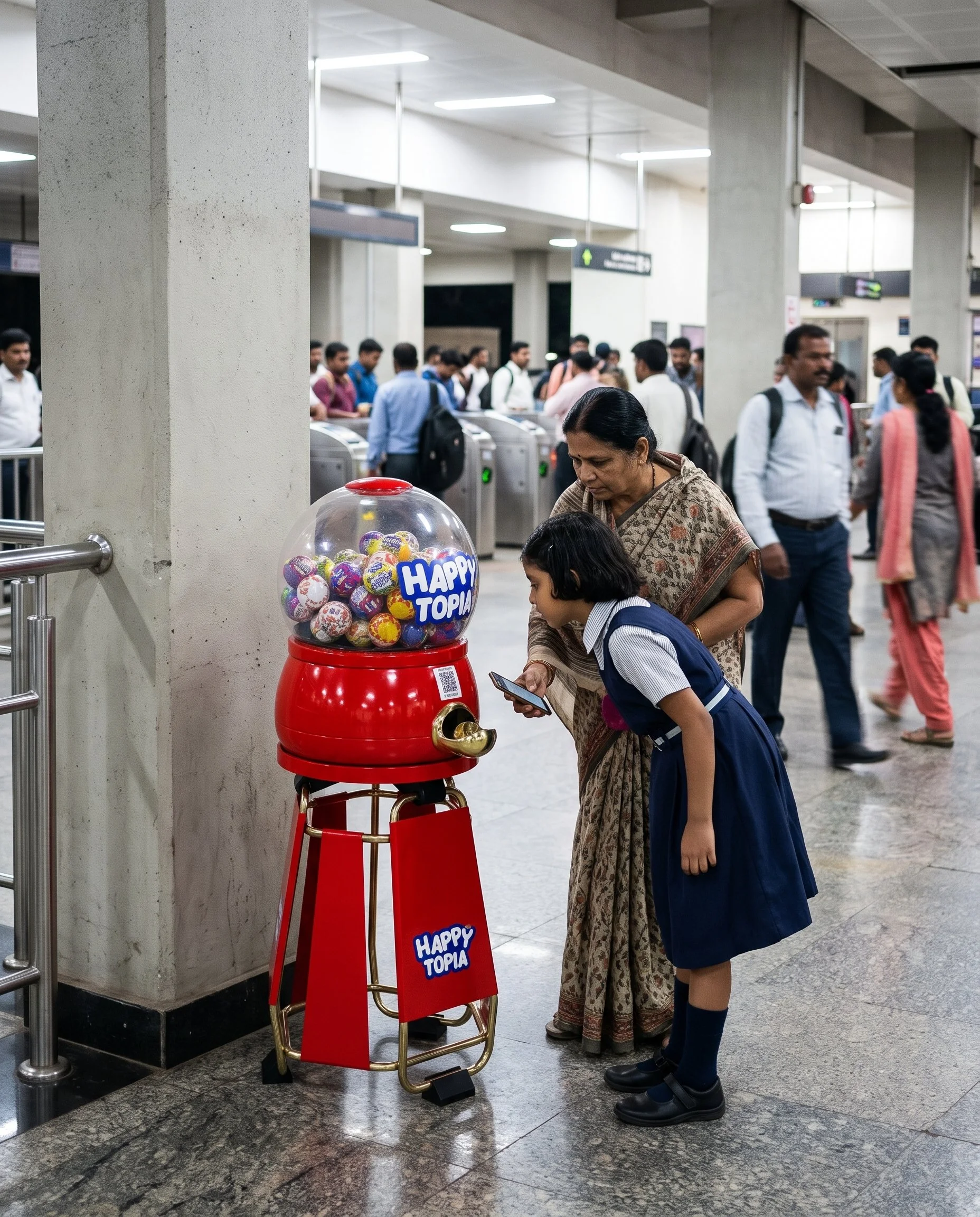
On its stand in a metro concourse, where Happy Topia's machines already stand.
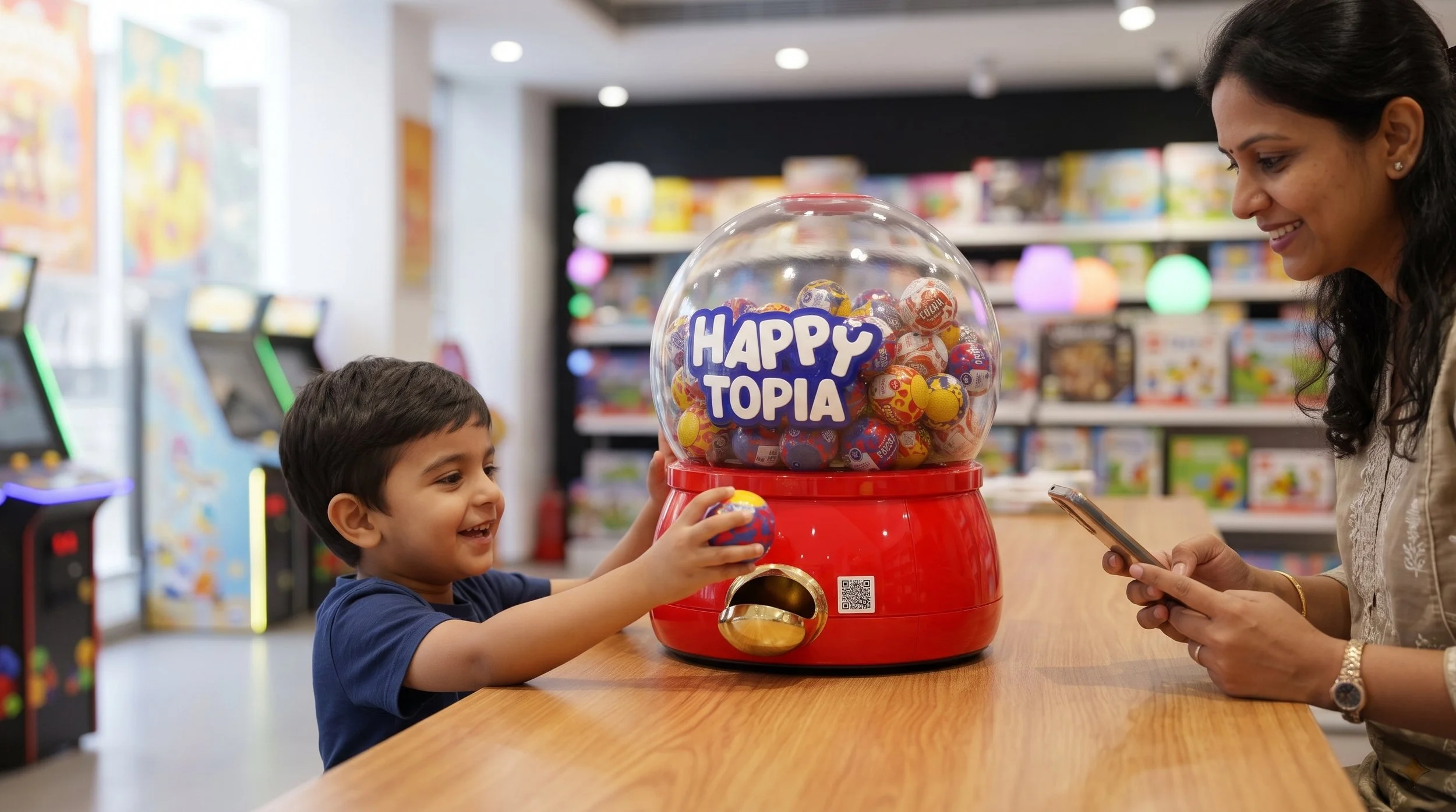
The capsule arrives in the brass exit, at a child's eye level.
2000 machines change every surface
The final model went to the engineering partner for a manufacturing review, and I turned their changes around the next day.
The first batch was planned at 2,000 machines, and the clear dome was the hardest part to buy. A prototyping firm recommended vacuum casting, which suits runs of a few hundred, then found that the silicone mould could not be pulled cleanly off the dome's shape. Happy Topia's engineering vendor reworked the dome. For the body I compared fibreglass, metal stamping and die-casting against one requirement: survive knocks and falls in public, and still look like the render.
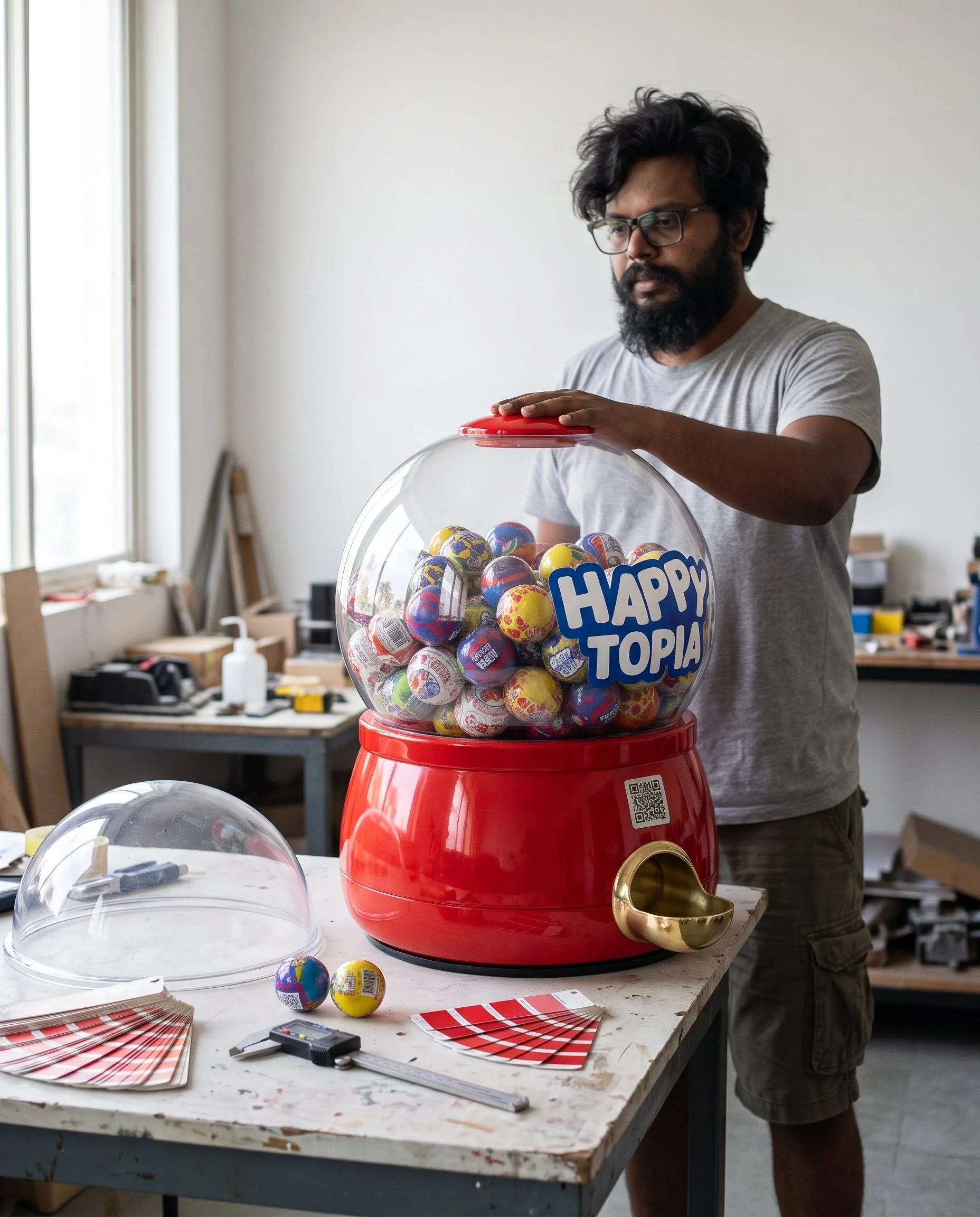
From a 30-foot wish to a family of machines
What changed for Happy Topia. A festive-season idea became two machines that vendors could quote. The Mega Ball was never built, but it left Happy Topia with fabrication drawings, parts lists and quotes for its sheet metal, fibreglass and polycarbonate, and a deck to take to malls. The countertop machine went to sourcing for its first 2,000 units as a motorised, QR-paid machine that works the same way as the rest of the fleet. Love Topia, a couples' machine that followed, kept the same hardware inside and went up as a steel prototype.
What I delivered. For the Mega Ball: four dome structures, three rounds of styling, fabrication drawings, STEP files and bills of materials, vendor briefs and quotes, and the deck for malls. For the countertop machine: the functional brief, the capsule study, twelve forms, four stands, four exit finishes, part drawings with colour references, and support through sourcing.
What comes next. If Happy Topia builds the Mega Ball, some questions only the real object can answer. A full-size dome panel needs to be vacuum formed and seen under mall lights. An install needs to be timed overnight with a real crew. The countertop dome needs to be made in its production material and then knocked over, the way children will knock it over.
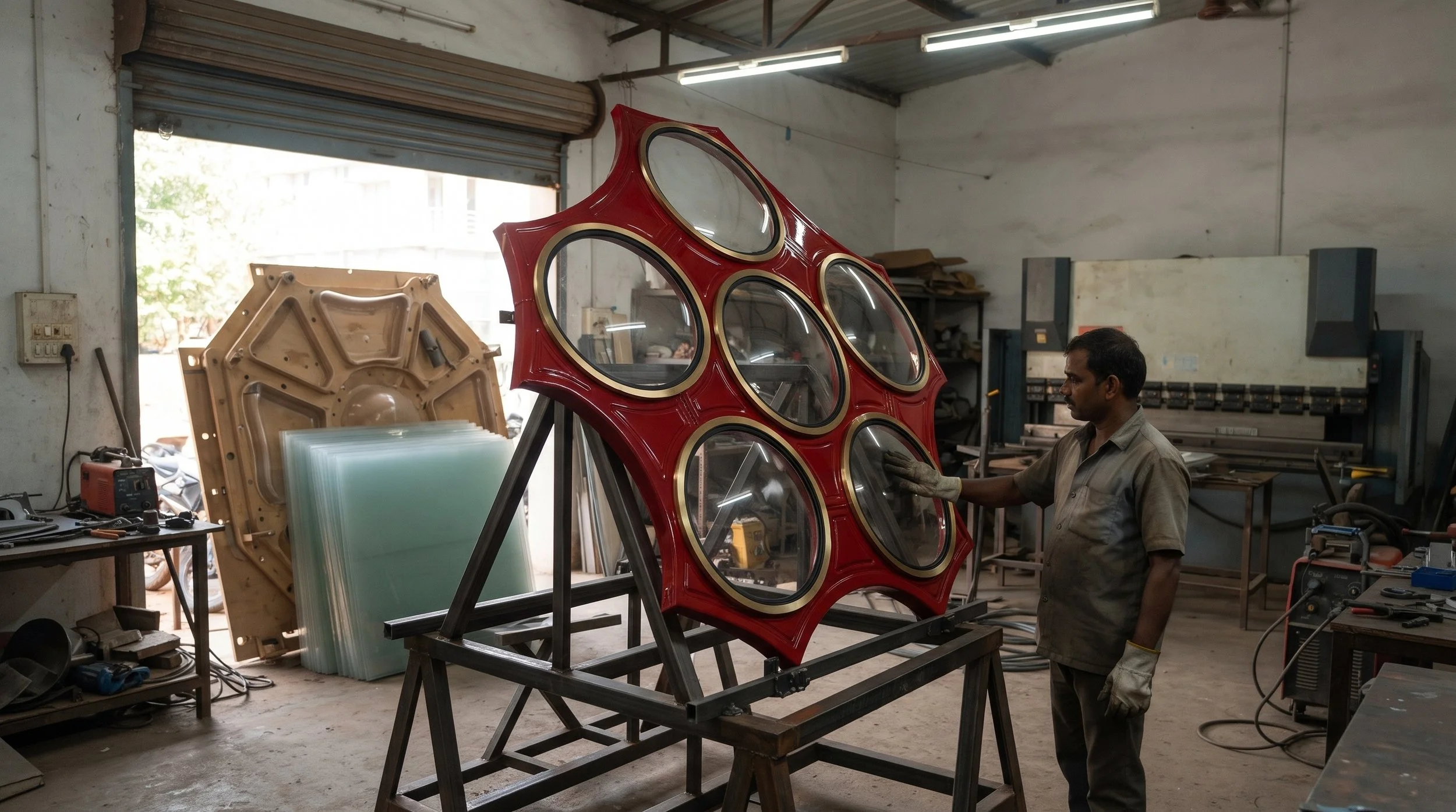
What I would do sooner. Form one real window early. The two hardest problems in this project were both clear plastic, and a physical sample settles that faster than any render.