Trify EV
A station every 10 kilometres
Designing a battery-swap station for riders who lose a fare every minute they wait.
Role : Lead industrial designer. Research, product architecture, form, CAD, design for manufacture, colour and finish, and visualisation for the swap station, its battery and the battery's place on the bike.
Team : Krishnan Raghunathan (founder, Trify), Trify's engineering team.
When : 2023
Tools : SolidWorks, KeyShot, iPad sketching, LiDAR scanning, Lightroom, InDesign
Status : Full-scale prototype built and refined.
Trify lets a motorcycle-taxi rider trade an empty battery for a full one, instead of waiting for it to charge.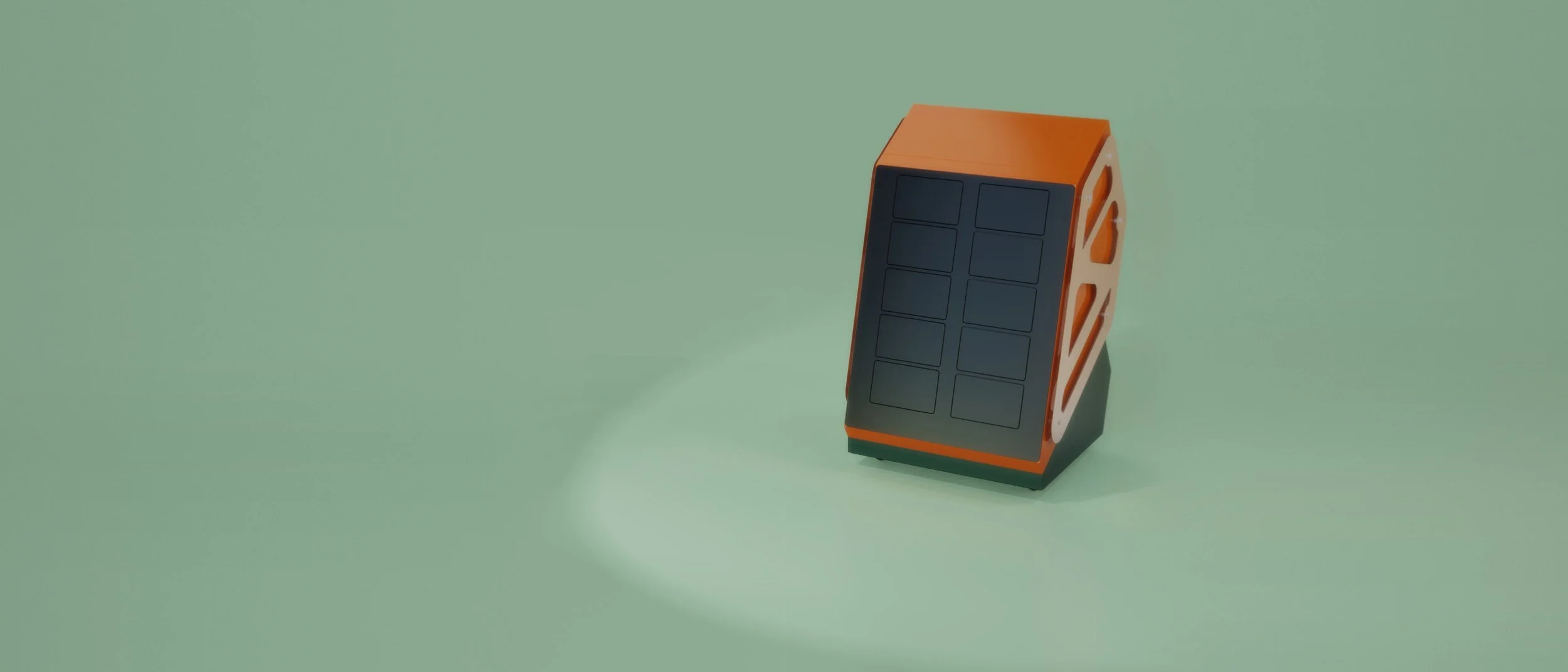
50
Stations planned for the first pilot, so each one had to be cheap to repeat
2
Battery brands one rack accepts
1
Full-scale prototype, built, tested and revised
In Kampala, a parked boda earns nothing
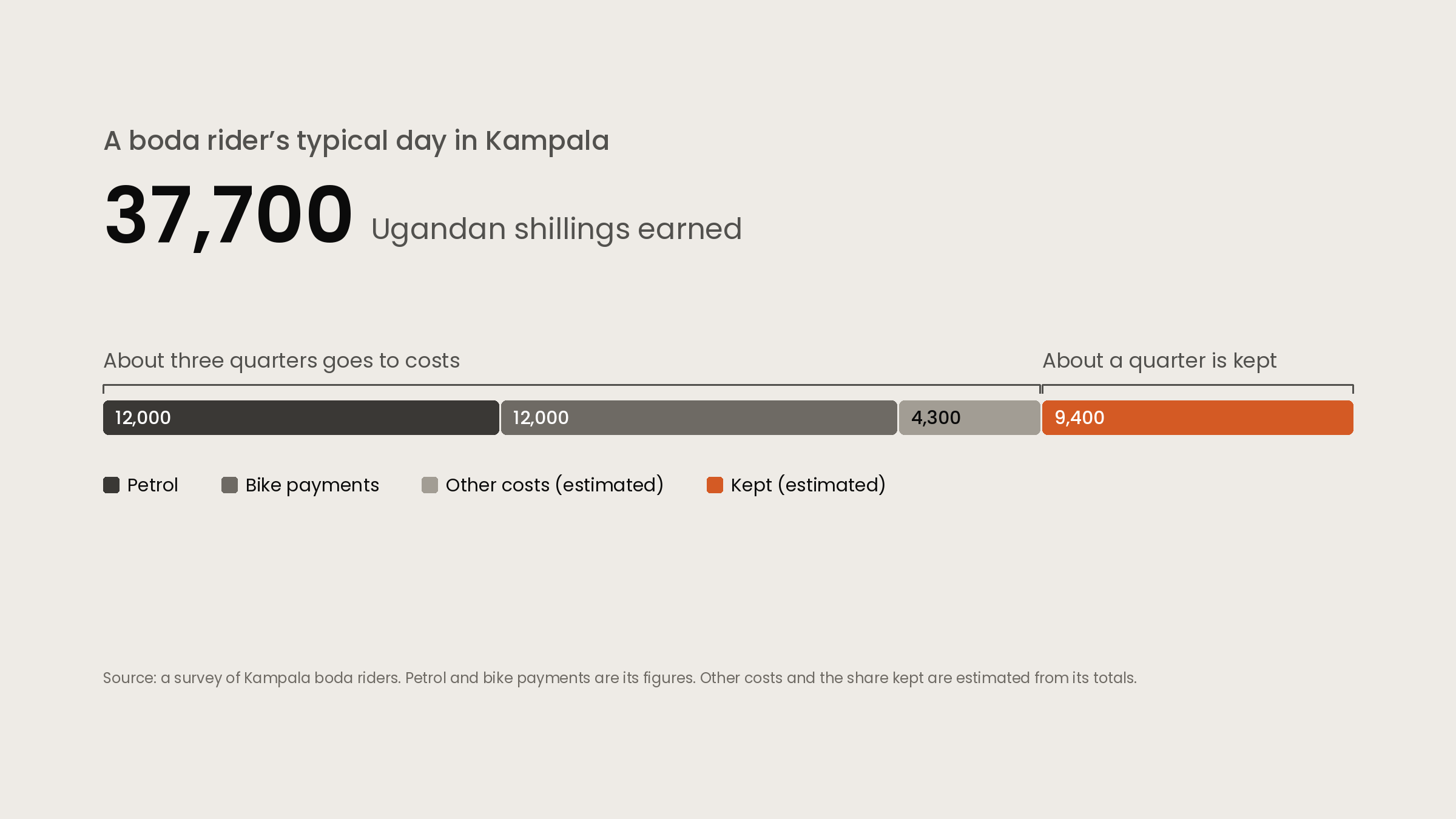
A boda-boda rider is paid by the trip. Many ride ten to twelve hours a day, most are still paying for the bike they ride, and a survey of Kampala riders found that costs took about three quarters of a typical day's earnings. Fuel and bike payments were the largest of them.
An electric bike cuts the fuel bill. It also brings a new way to lose a day. A battery takes hours to charge, and a flat one on the far side of town turns a working afternoon into a wait.
The long days carry a second cost. A study of injured riders in Kampala found that working late was one of the factors linked to crashes. Whatever we designed had to give riders time back.
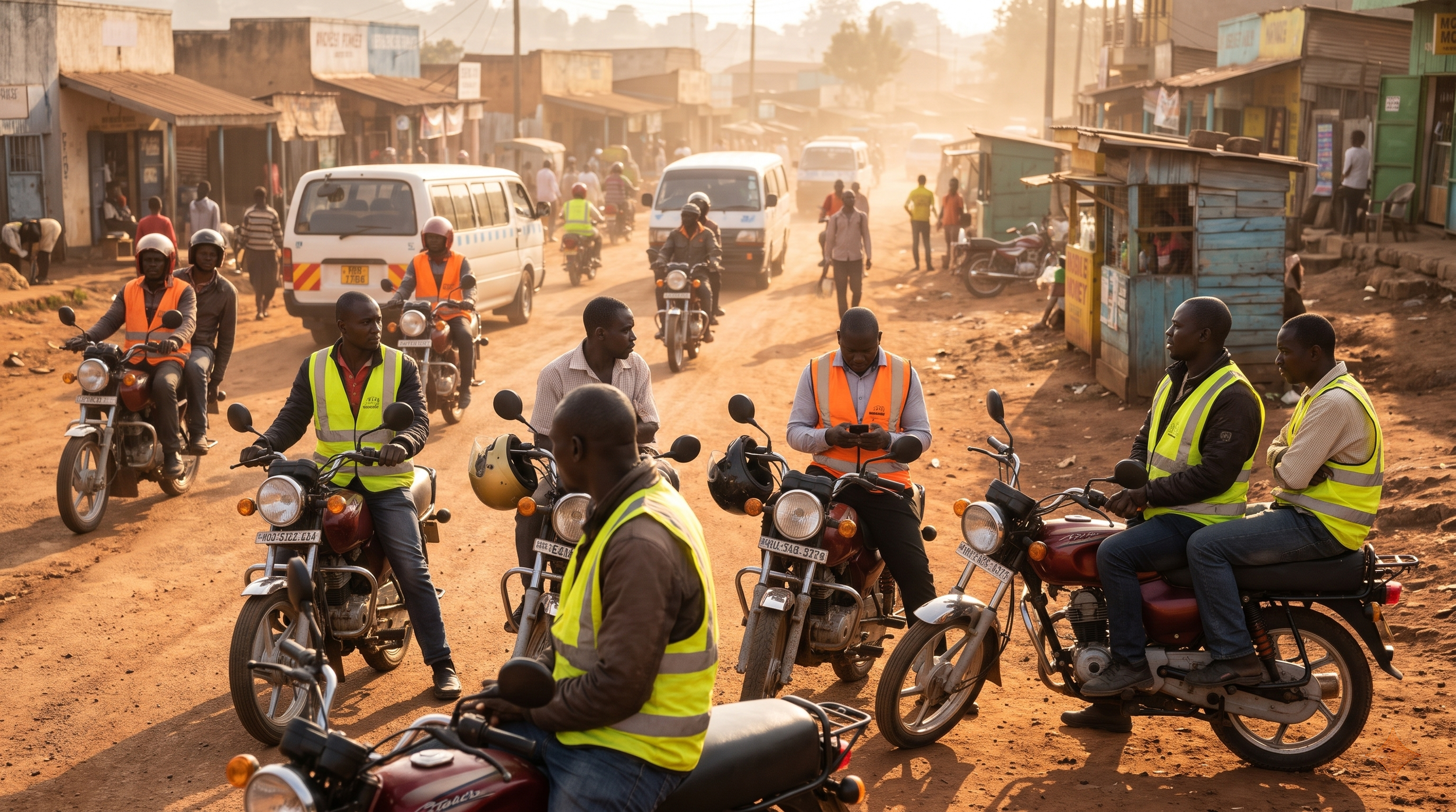
The meter starts when the bike moves. Everything else is cost.
Trify bet on the network that keeps bikes moving
Electric motorbikes already made economic sense for riders. Trify's founder saw why so few were on the road. Riders did not trust the batteries, the brands or the charging, and there was almost nowhere to swap. In a study of electric boda riders in Kampala, riders turned down trips because swap stations were too few and too far apart, and they asked for one every ten kilometres.
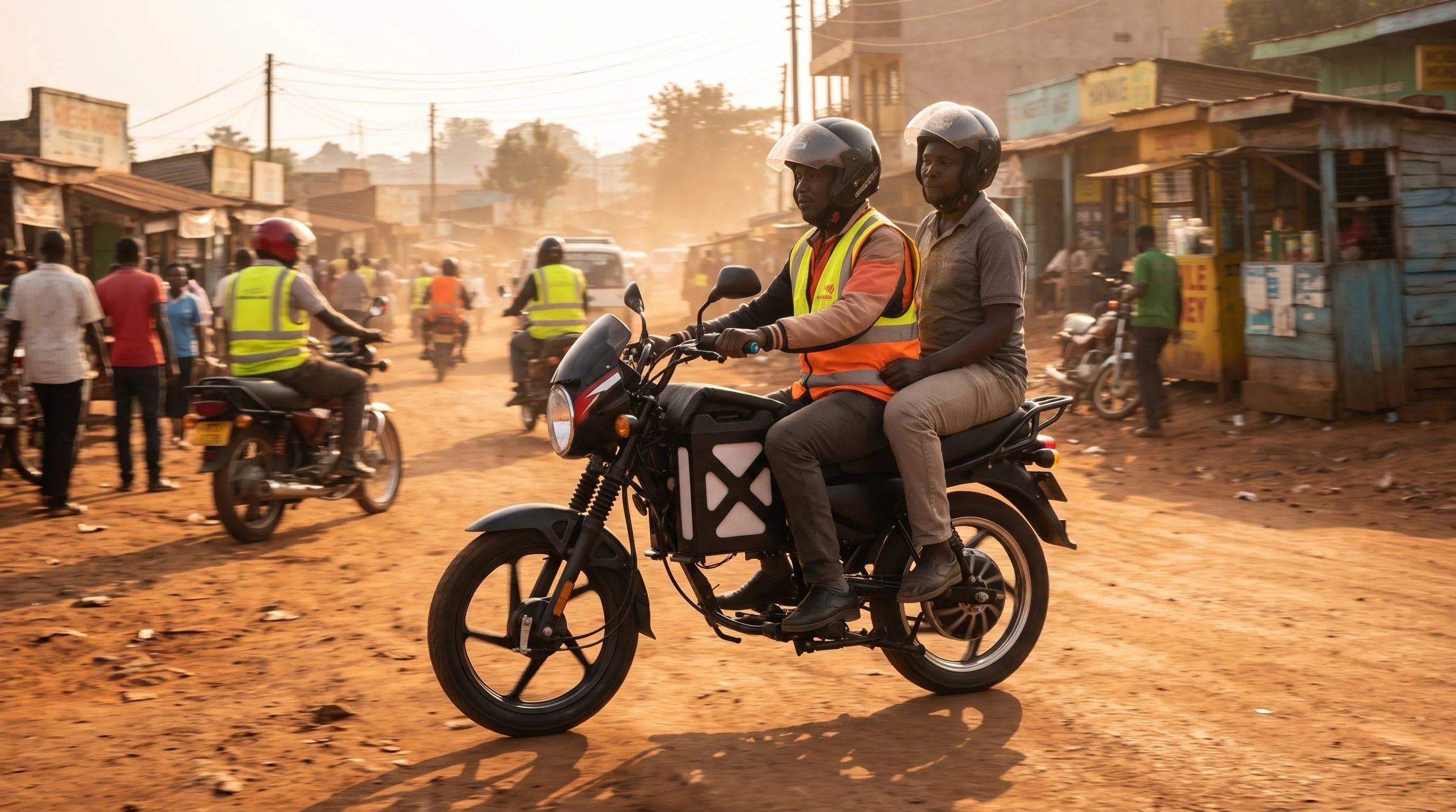
So Trify chose not to build motorbikes. It would partner with the makers riders already trust and build what sits between them: swap stations, batteries and the financing that gets riders onto electric bikes. The stations would stand at busy stages and outside local shops, and the first pilot called for fifty of them.
That set the real brief. Trify needed a station that ordinary workshops could build cheaply, again and again, and that riders would trust with their income.
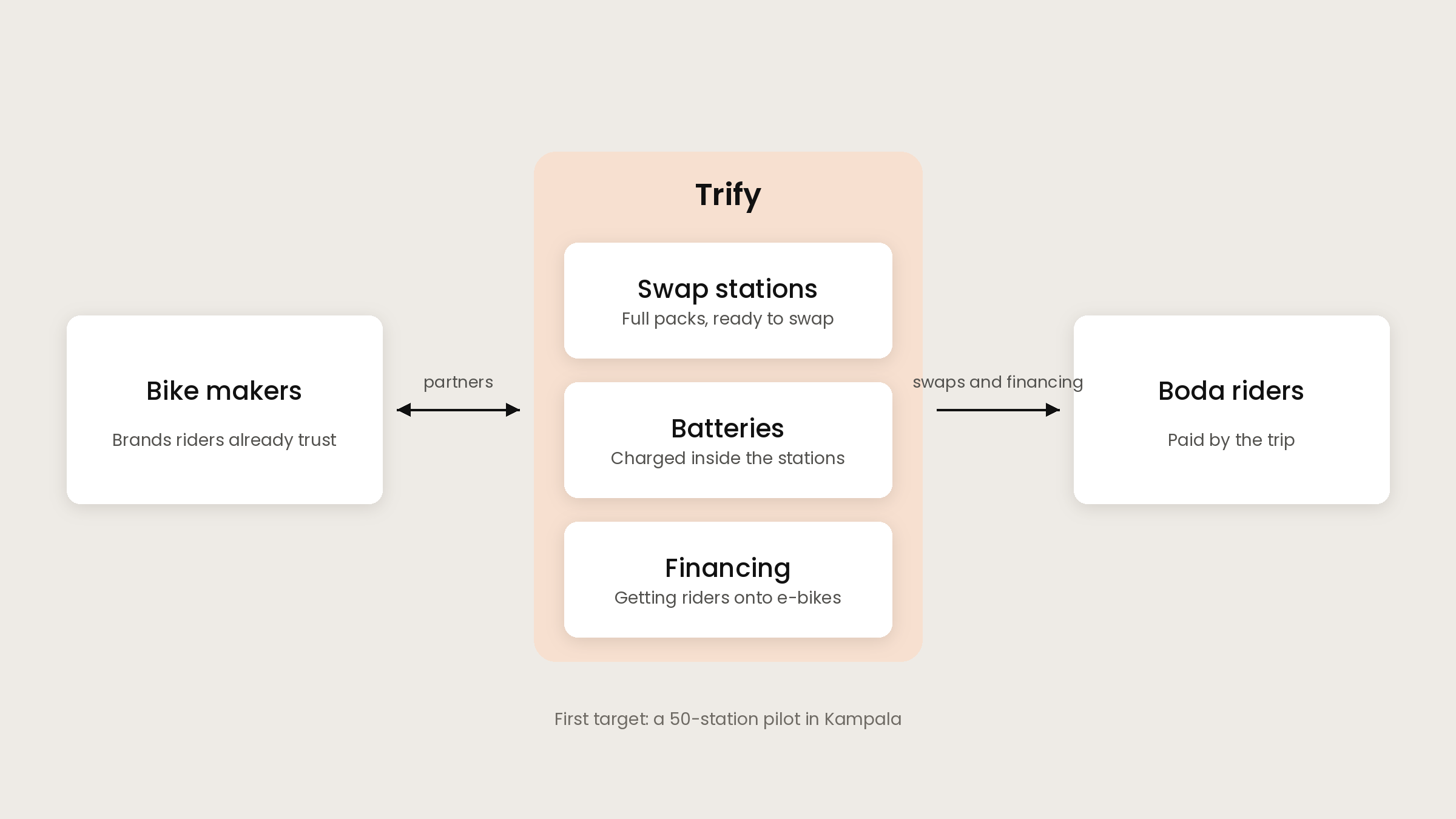
Trify sits between the bike makers and the riders: stations, batteries and the financing that joins them.
One swap has to work for four people
A swap looks like one gesture. Open a door, pull a battery out, push a full one in. Behind it stand four people who need different things from the same box.
The rider wants it over in seconds, without reading a screen or stretching for a slot. The shopkeeper who hosts the station needs it to fit a crowded shopfront and look after itself. The technician has to assemble it on site and keep it running with hand tools. And Trify needs every unit cheap to build, simple to ship and open to batteries from its partners.
Most decisions in this project came from holding those needs against each other. A taller station holds more batteries but puts the top slot out of a shorter rider's reach. A sealed box keeps batteries safe but traps their heat. A sculpted shell looks premium but needs tooling no small workshop owns.
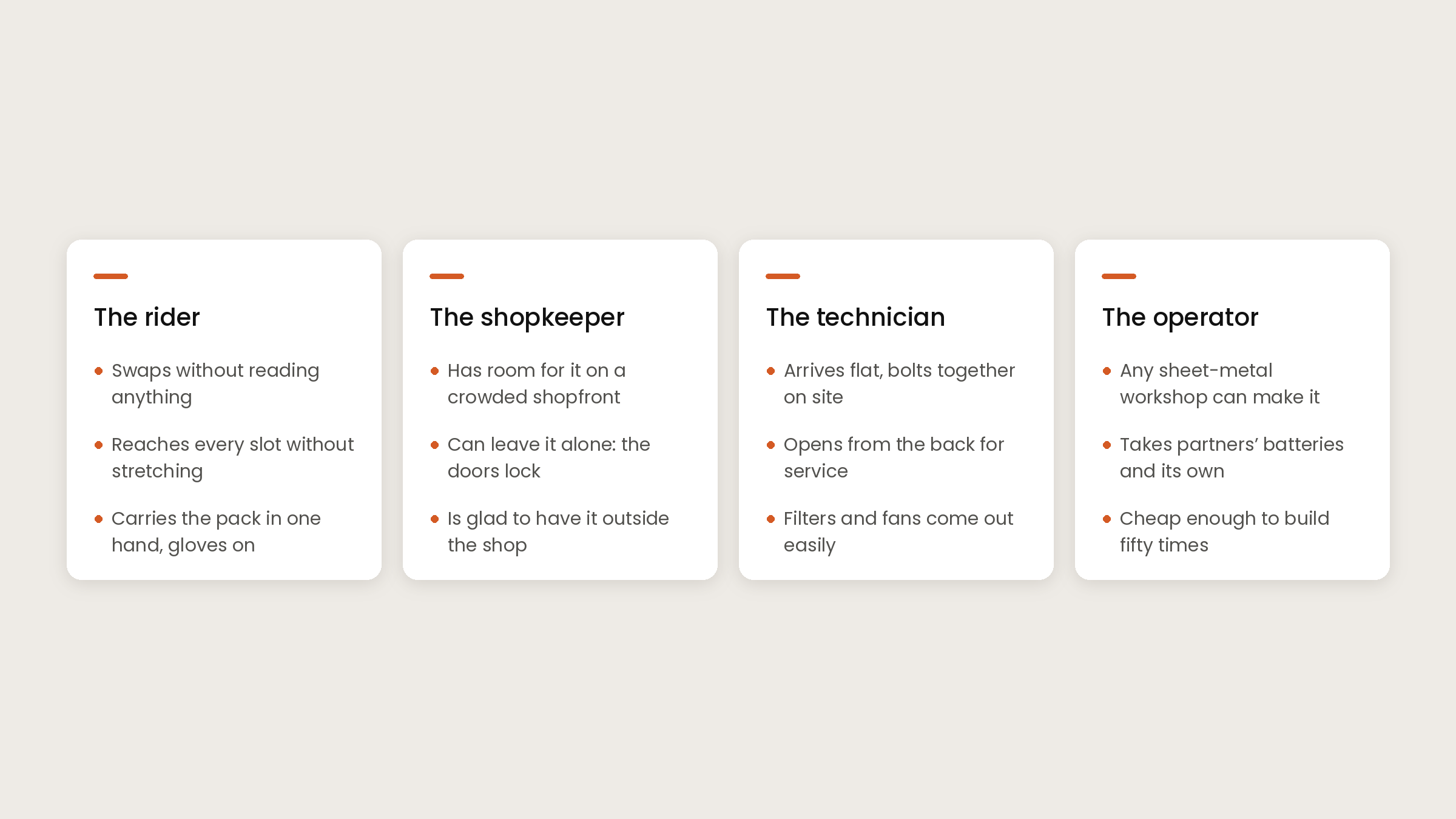
The swap is one gesture, but four people depend on it.
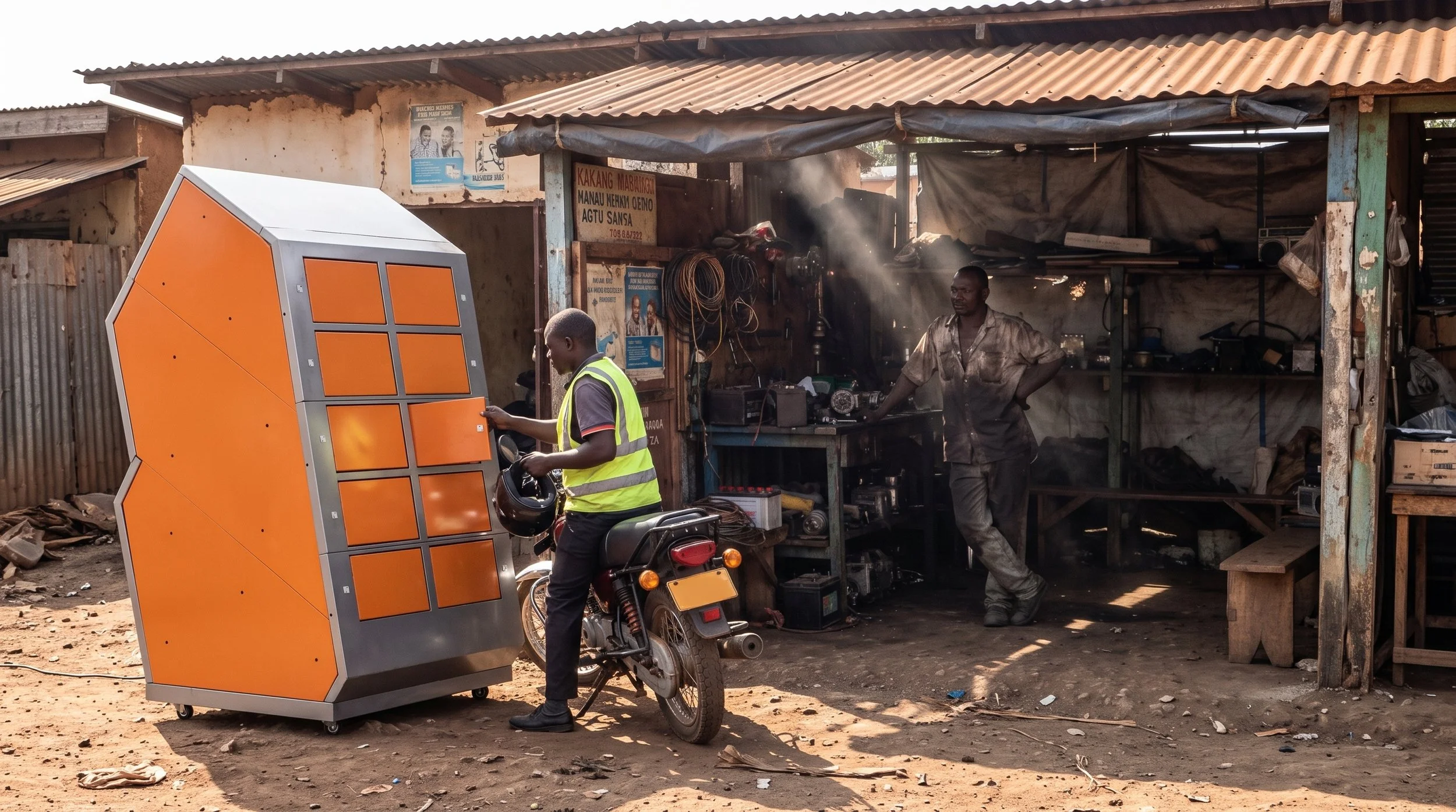
Before the station, the bike
The first thing I captured was not a street but a bike. On the first day of the project I LiDAR-scanned the frame of a commuter motorcycle, because before drawing a station I needed to know where a battery could live on the bikes riders already own.
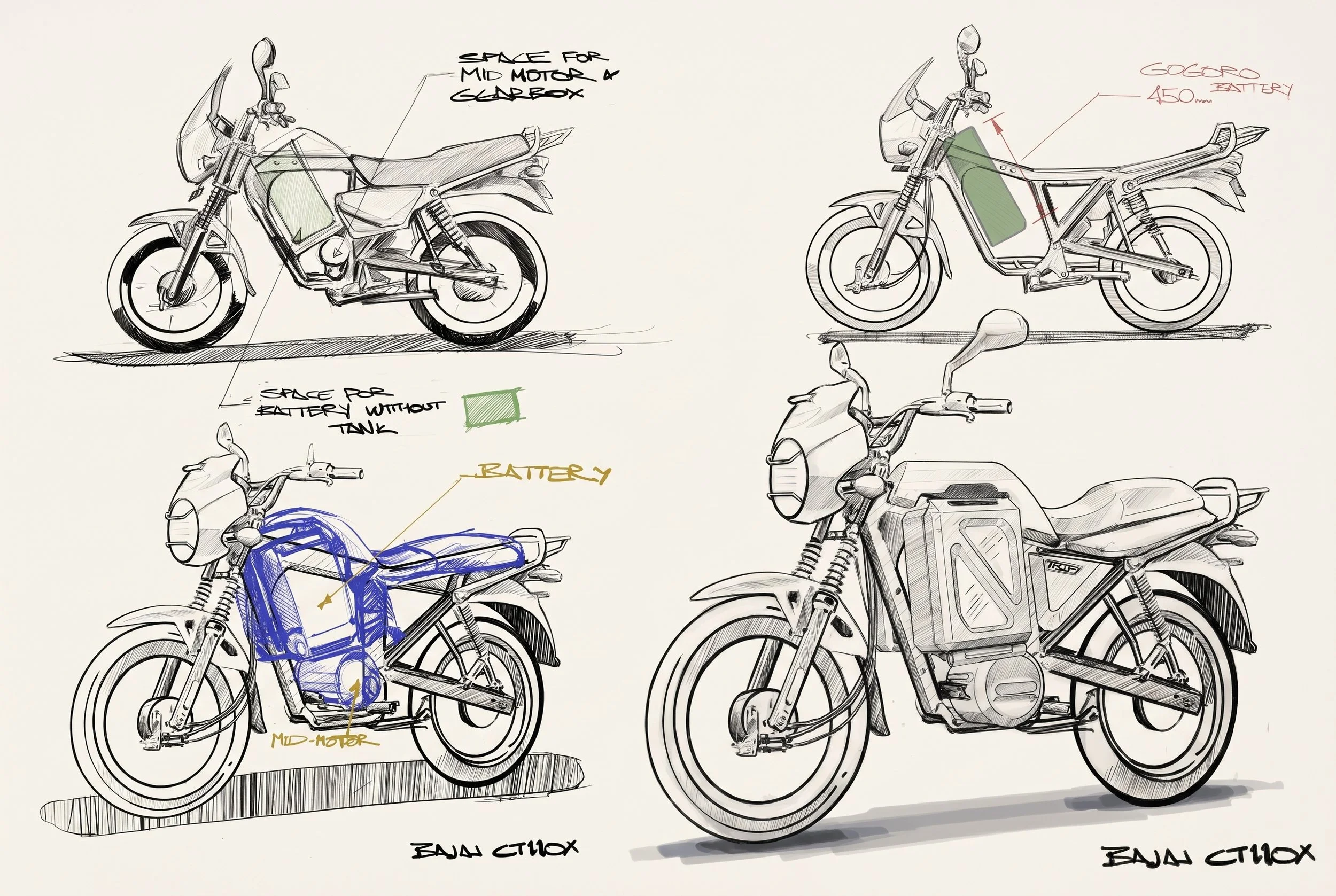
Two questions shaped everything after. With the fuel tank gone and a motor mounted mid-frame, how much room was left? And would a Gogoro-size battery fit there without crowding the rider's knees? I sketched both over line drawings of Bajaj's commuter bikes, the workhorses of the trade, then built the volumes on top of the scan in CAD.
A cardboard block taped into the empty frame tested that volume at full size before any steel was cut. The black steel box that replaced it holds the battery behind an X-shaped brace.
The research for my first presentation looked at the rider's body as well. Riders spend whole days in the saddle on rough roads, so the deck also proposed an upright, long-travel base bike, Hero's Xpulse, if Trify ever built its own.
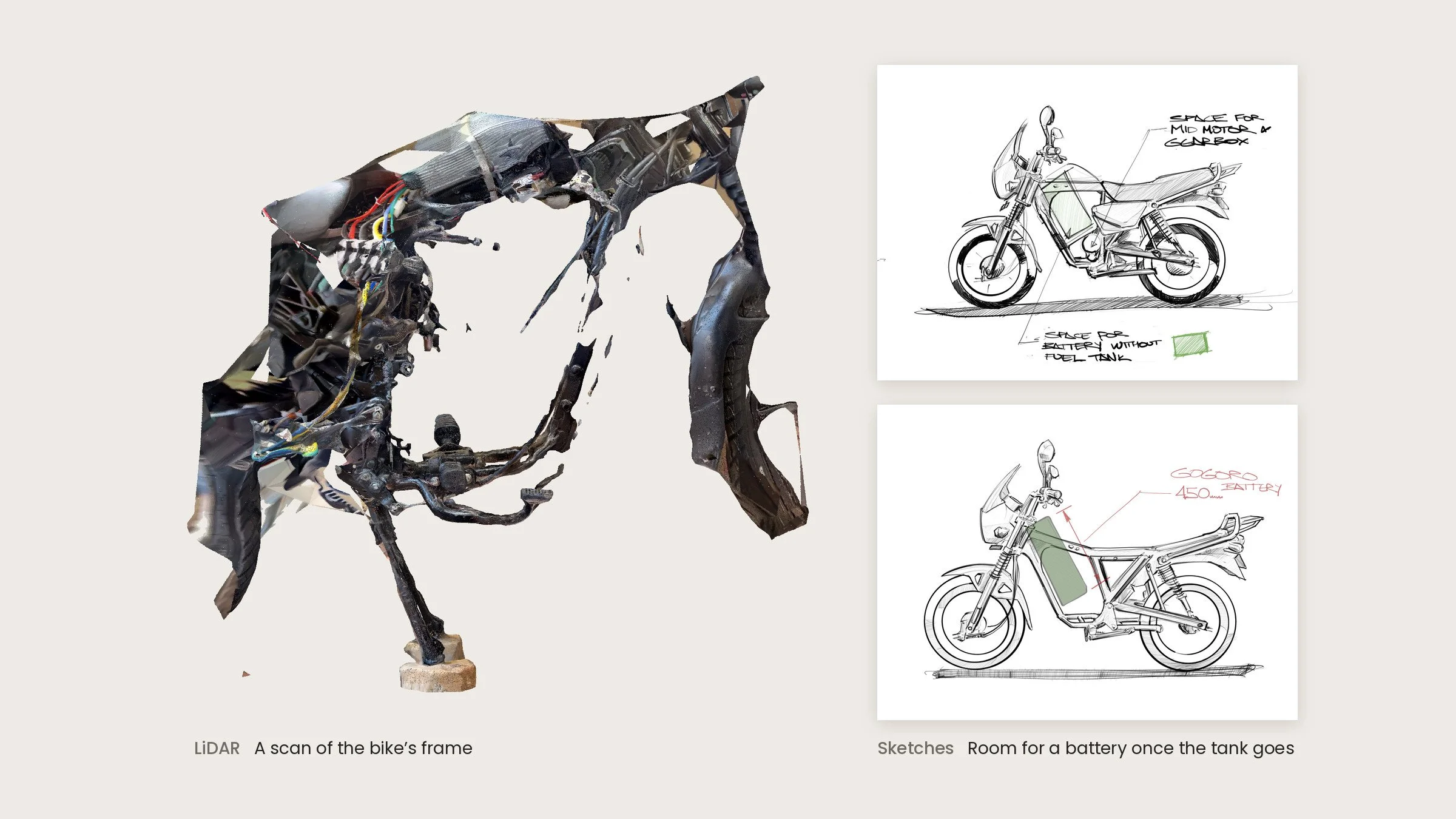
The bike came first: a scan, then sketches of where a battery could live without the fuel tank.
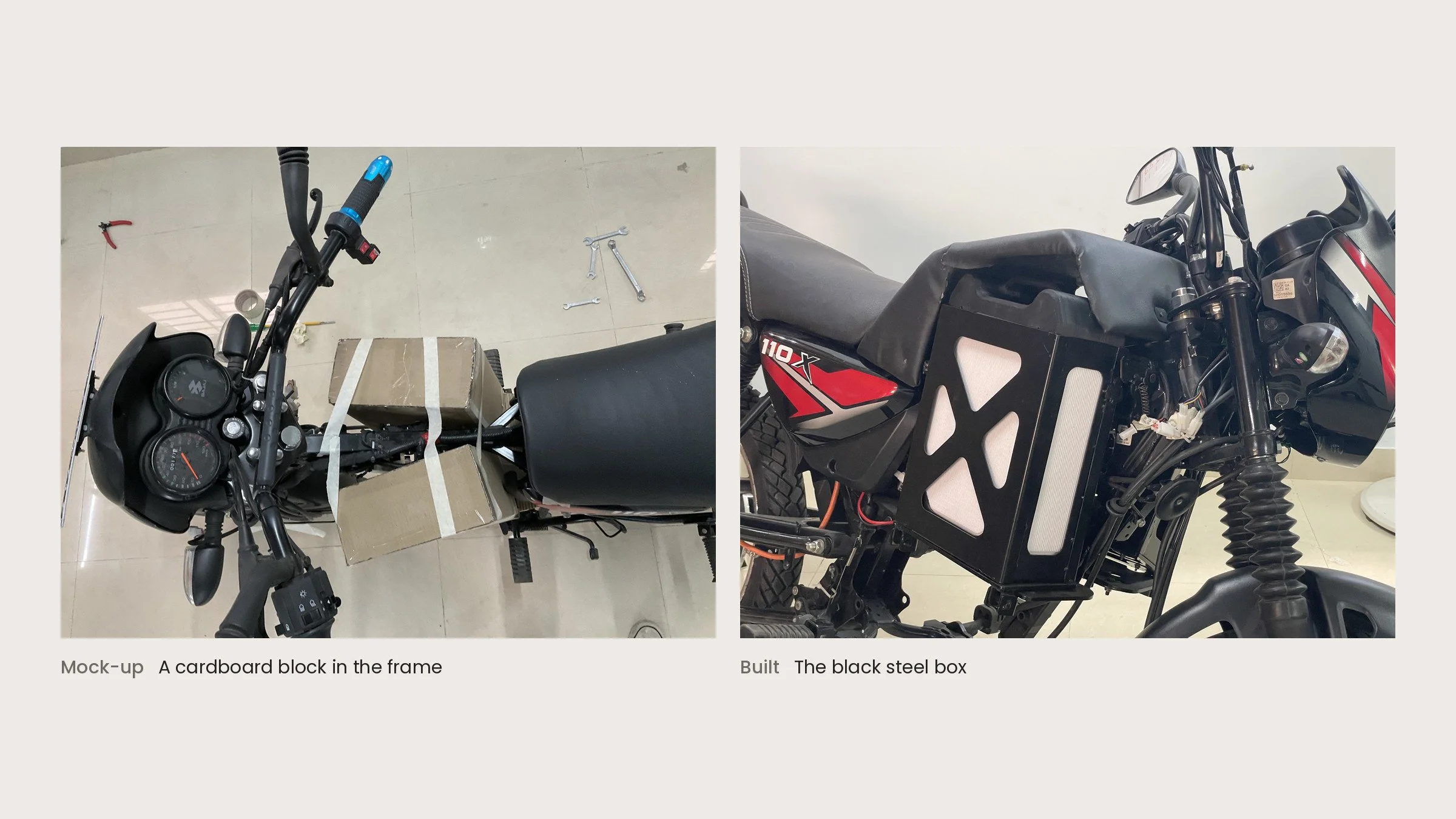
Cardboard first, to test the volume at full size. Then the steel box.
The first station was a kiosk. It became a shelf
My first render was the obvious answer: a steel cabinet with a large screen. It looked like a kiosk, and it asked a rider to read before he could swap.
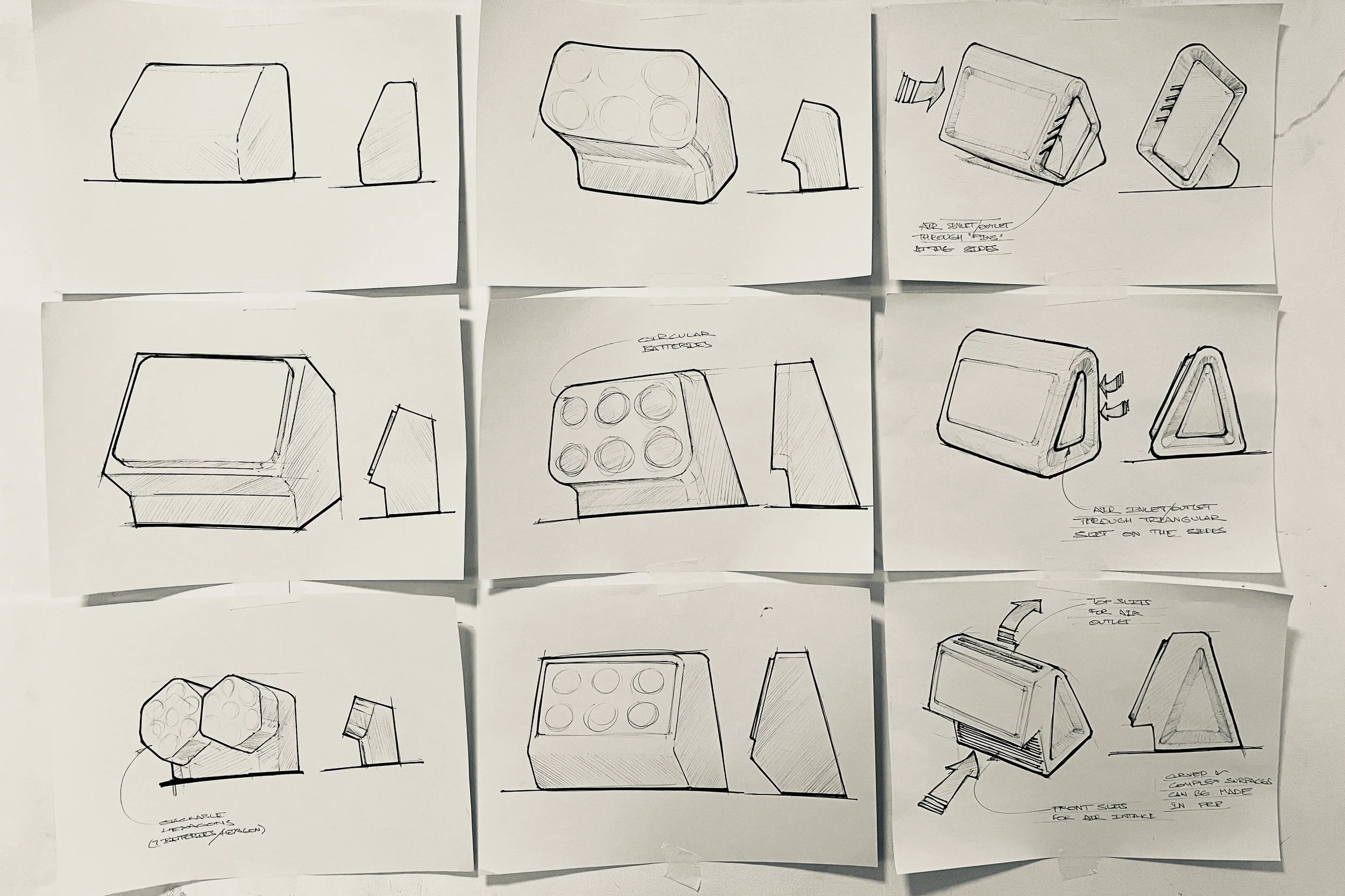
The next day I put a wall of paper thumbnails in front of the team and asked which way to go. Fibreglass allowed freer, curved forms. Sheet metal was the fastest route to a working station, made the way steel office furniture is made. Moulded plastic could wait for volume. A person stood beside the forms for scale, and one rule held for all of them: a rider had to be able to take a battery out and slide it back without strain.
Sheet metal won, and the cabinet became a shelf. Batteries tilt toward the rider inside a hexagonal side frame. The height stops at an average man's shoulder, so the top slot stays in reach. Each frame holds one brand of battery, so modules can line up side by side as the network adds partners. A full-size version was built, and its renders still front Trify's website.
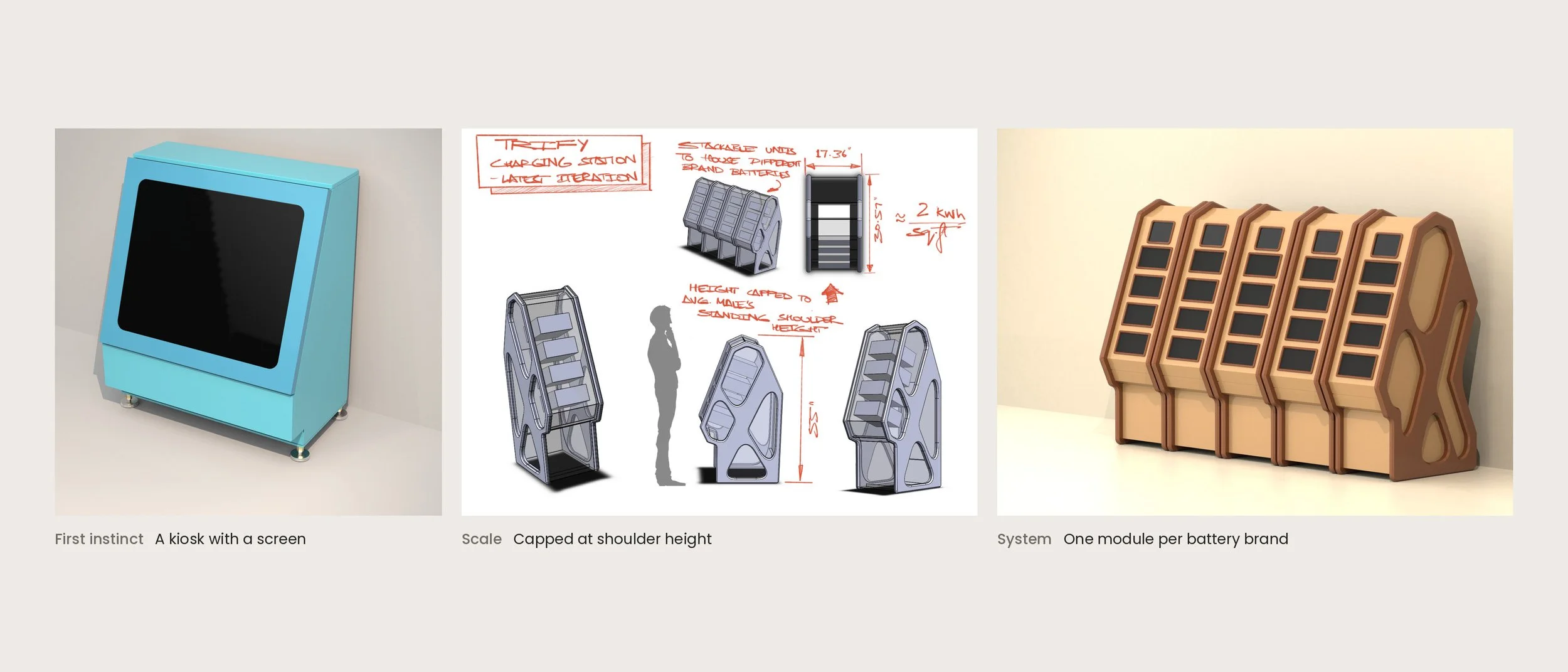
A kiosk with a screen, a wall of thumbnails, then a shelf of modules that line up by battery brand.
The second phase began by taking things away
When Trify came back for a second phase, the job was to turn a striking prototype into something a workshop could build fifty times. I wrote it up as a work plan the team could track, and it began with subtraction. The large screen went, and with it the most fragile and costly part. A small display and the rider's own phone could do its job. The station lost height, which brought the top slot closer to the hand. It grew deeper, to give air a path past the batteries.
The rest of the plan was about bringing reality in early. Order the real fans, chargers, cables and castors before finishing the CAD, because their sizes decide every hole in the frame. Match the rear louvres to a tool a local stamping shop already owns. Check every colour against what local painters can supply. And build one complete station before ordering fifty, because a mistake found on the fiftieth unit is fifty mistakes.
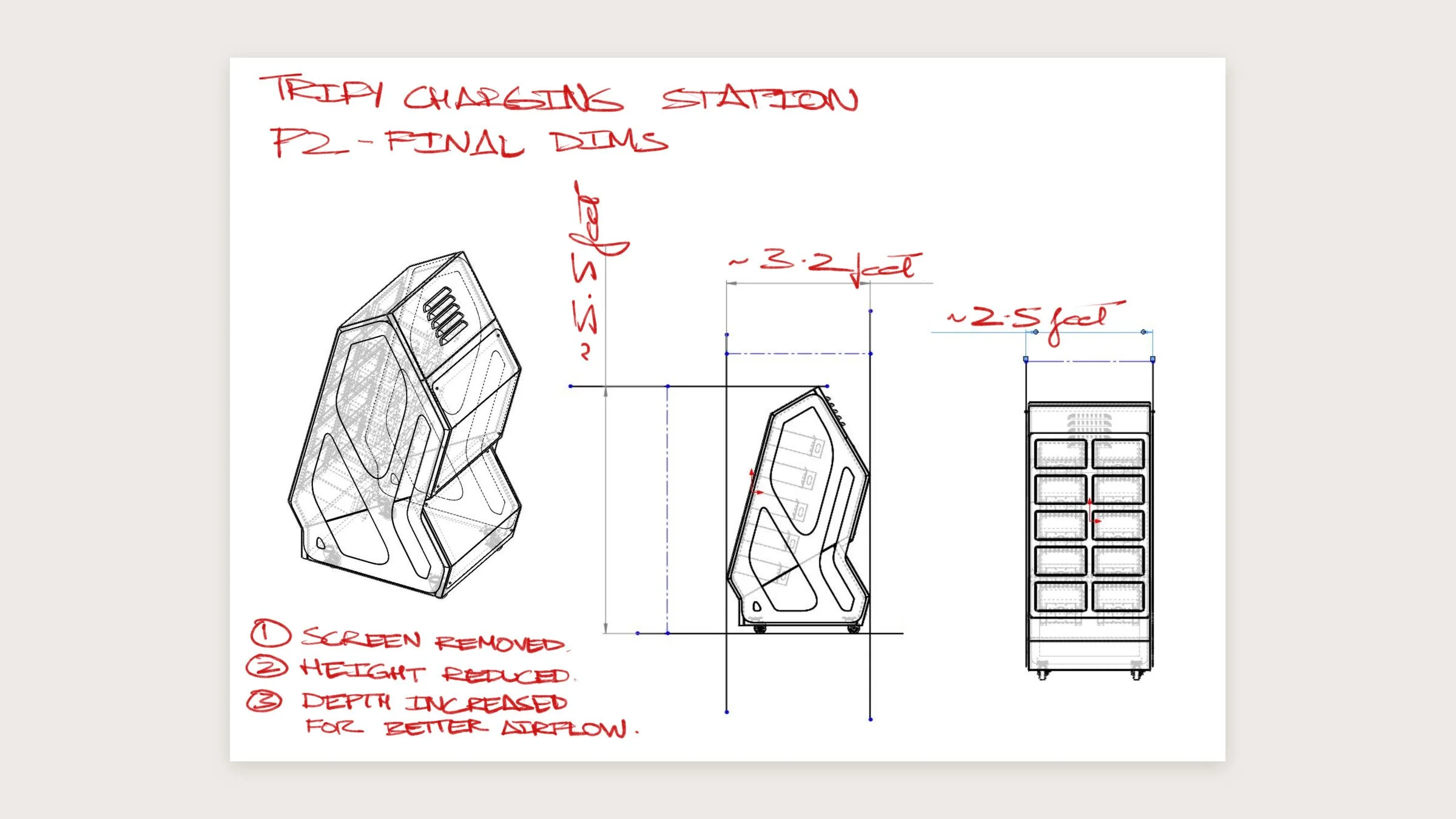
The second-phase brief in one markup: screen removed, height reduced, depth increased for airflow.
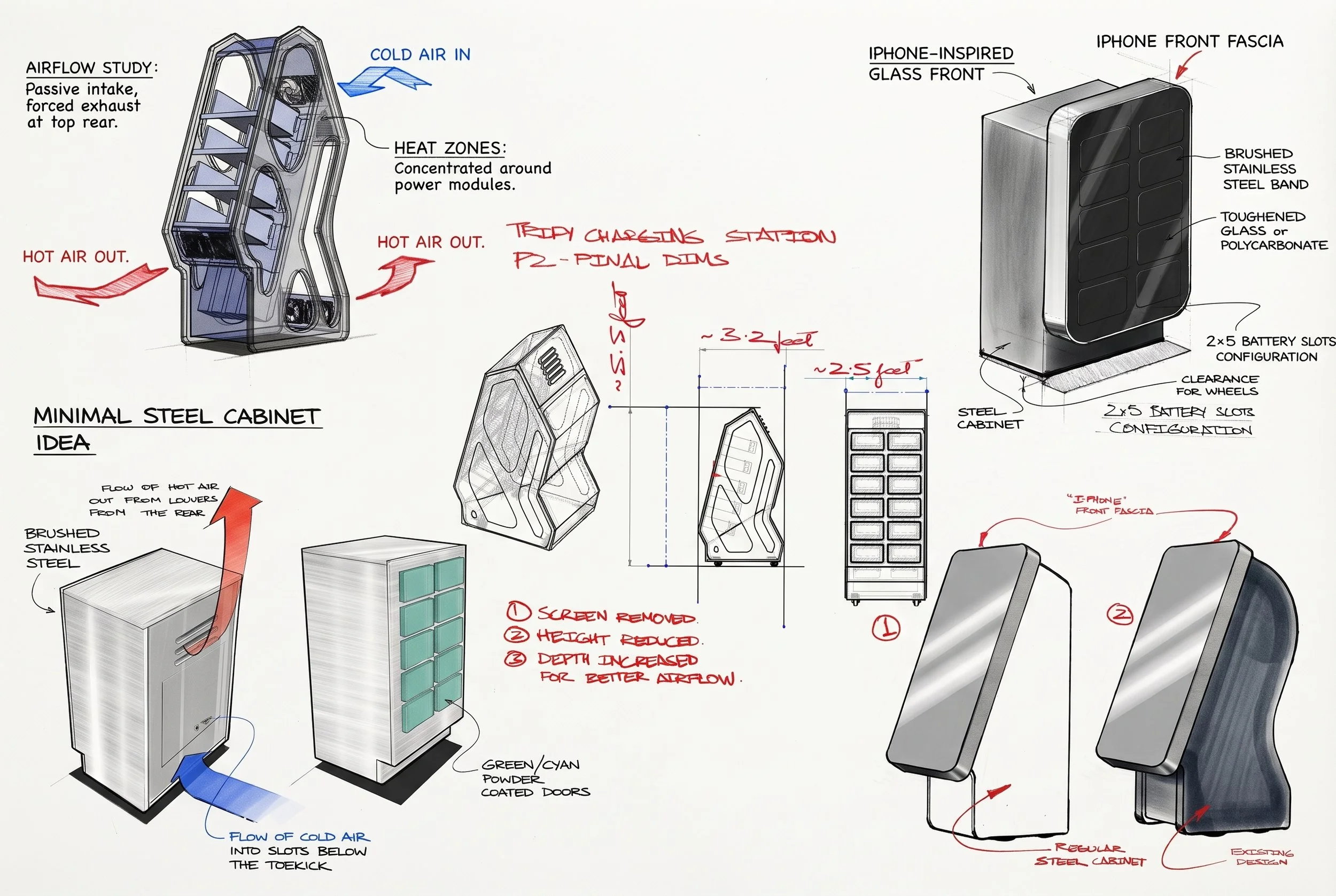
A phone taught the station to look calm
The hex frame had character. It also had too many edges for a rider to read at a glance, on streets already crowded with signs, stalls and traffic.
I went back to the iPhone 4S and 5: one black glass face held by a thin steel band. I sketched the station that way, then rendered it three ways: upright, slanted and rounded. The slant stayed. A dark face reads as one surface, the doors sit quietly inside it, and the angle tips each battery toward the hand.
The design that followed kept the hex frame's side rib as Trify's signature and set the calm face in front of it. Ten slots in a two-by-five grid lean back from a solid base that holds the electricals.
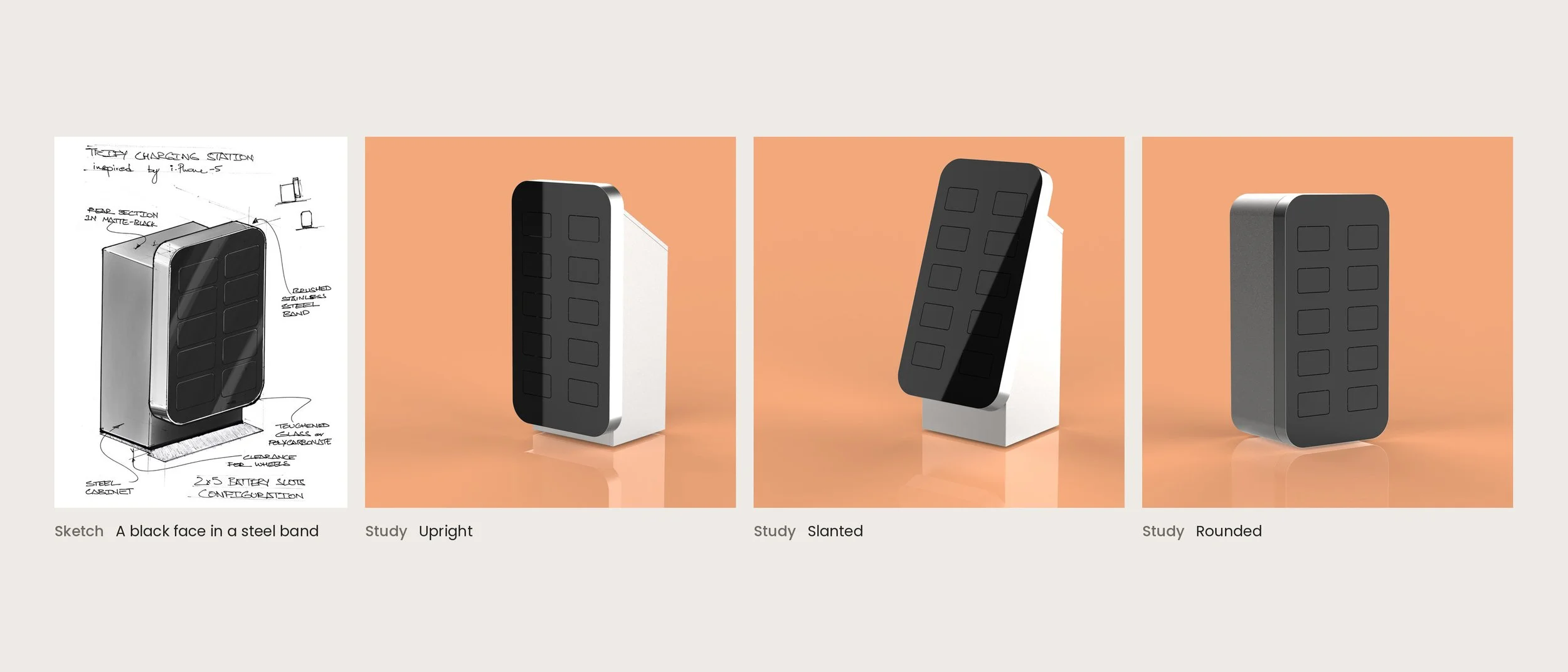
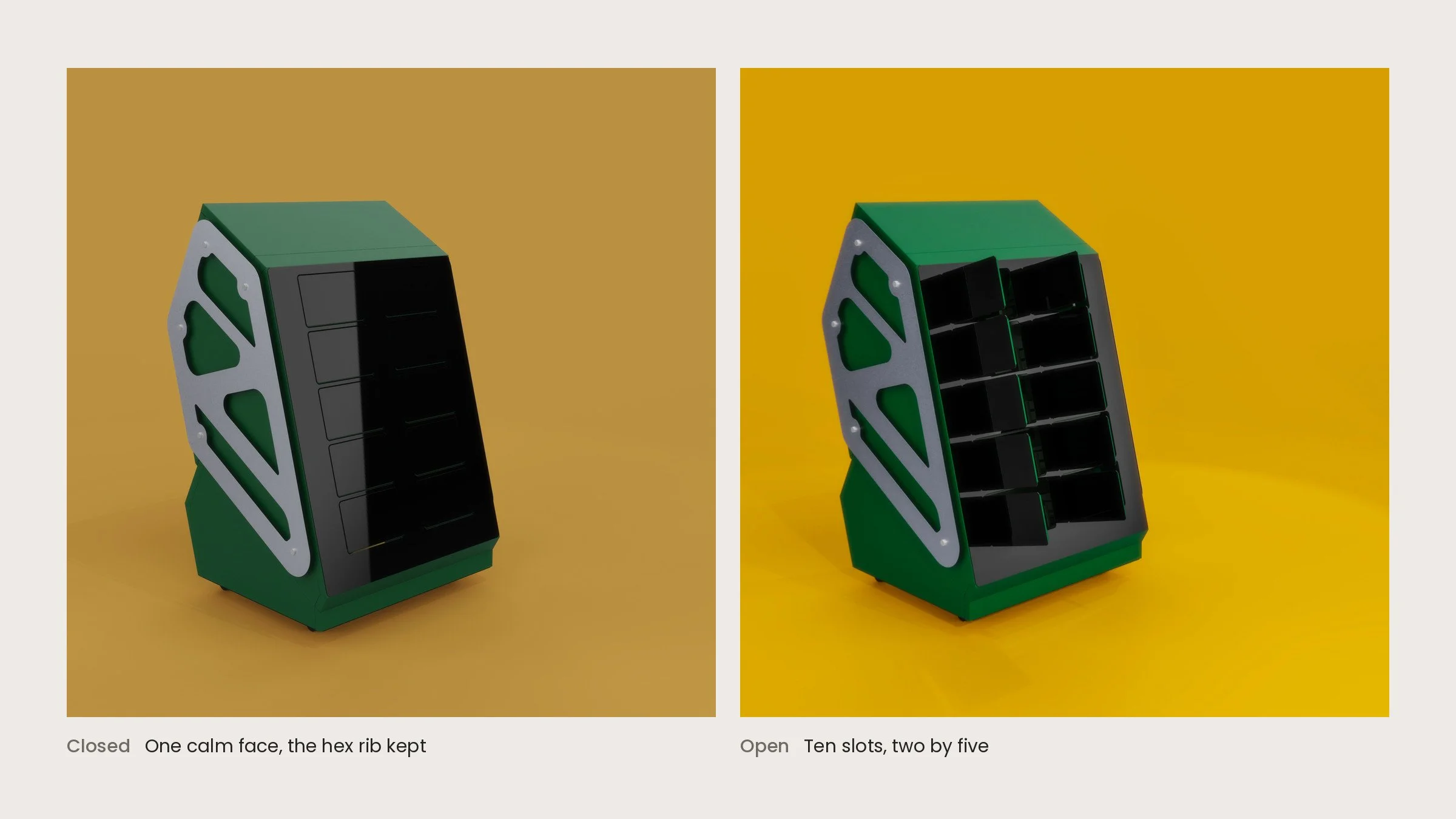
From the phone study to the final face: one dark surface, ten doors, the hex rib kept as a signature.
One rack, two battery brands
Trify had promised to work with the batteries riders already use, so the inside of the station could not be built around one pack. I designed a rack of folded steel channels in which every battery sits on its own slot plate. The same frame takes Hero's Vida scooter battery and Trify's own pack, and changing brands means changing a plate.
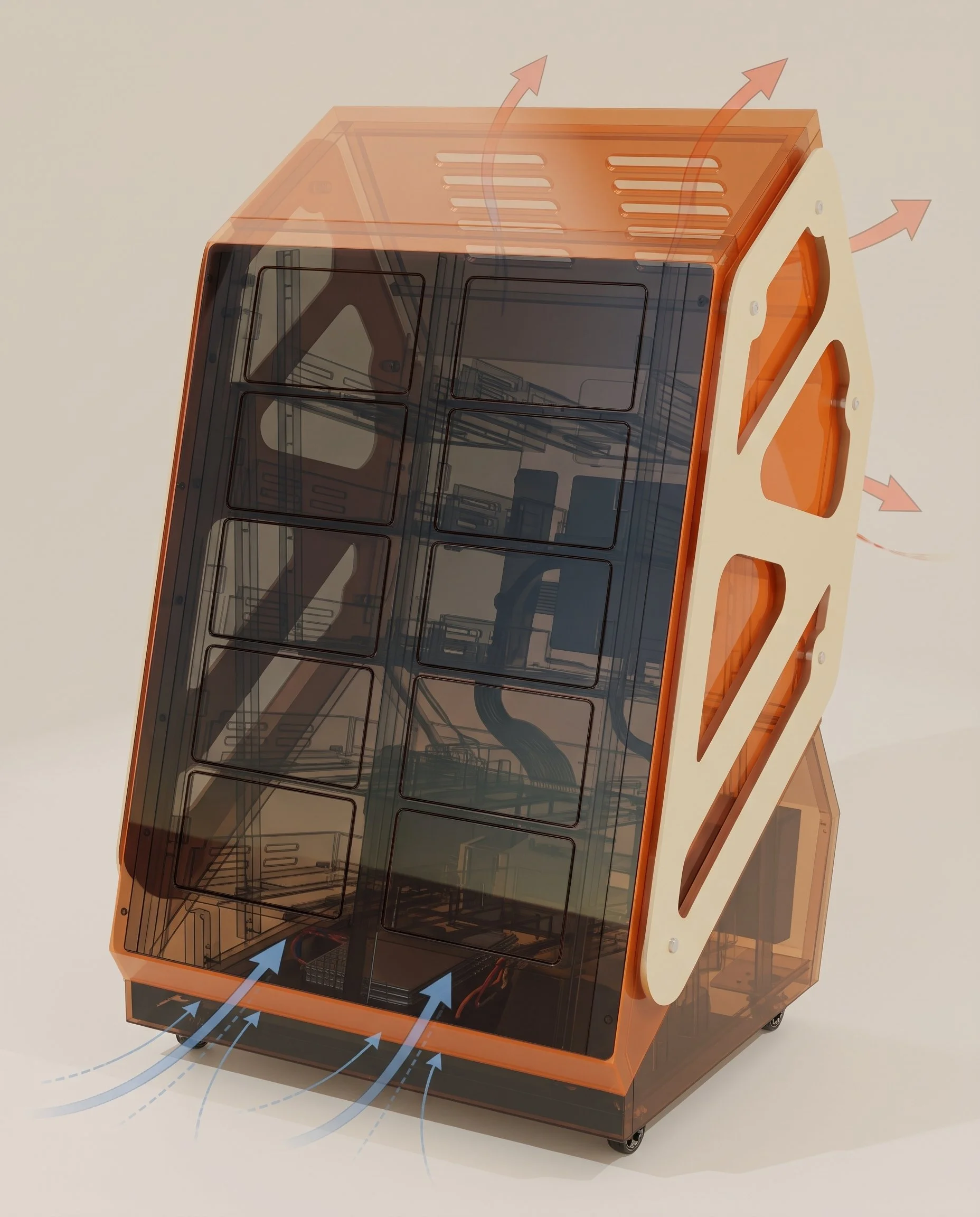
Heat was the constraint nobody could see. Ten batteries charging inside a closed steel box under an equatorial sun make their own weather. The rack decides how the box breathes. Cool air comes in low under the toe-kick, crosses the batteries and leaves through louvres at the back. I left room in the base for breakers, wiring and a large fan, added a filter tray that slides out for dust, and studied a thermoelectric cooler for the hottest hours.
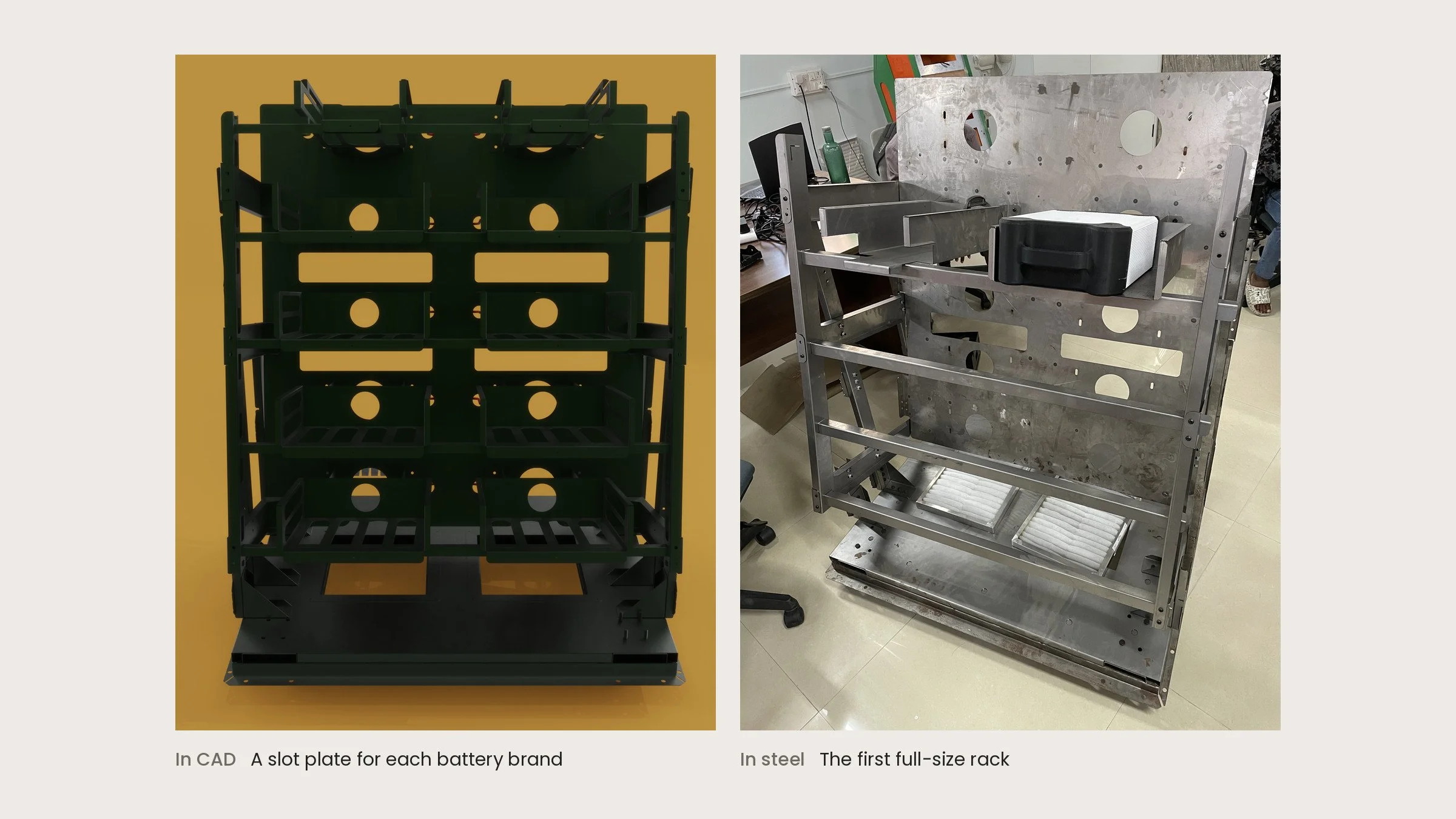
The rack in CAD, and the first full-size rack in raw steel.
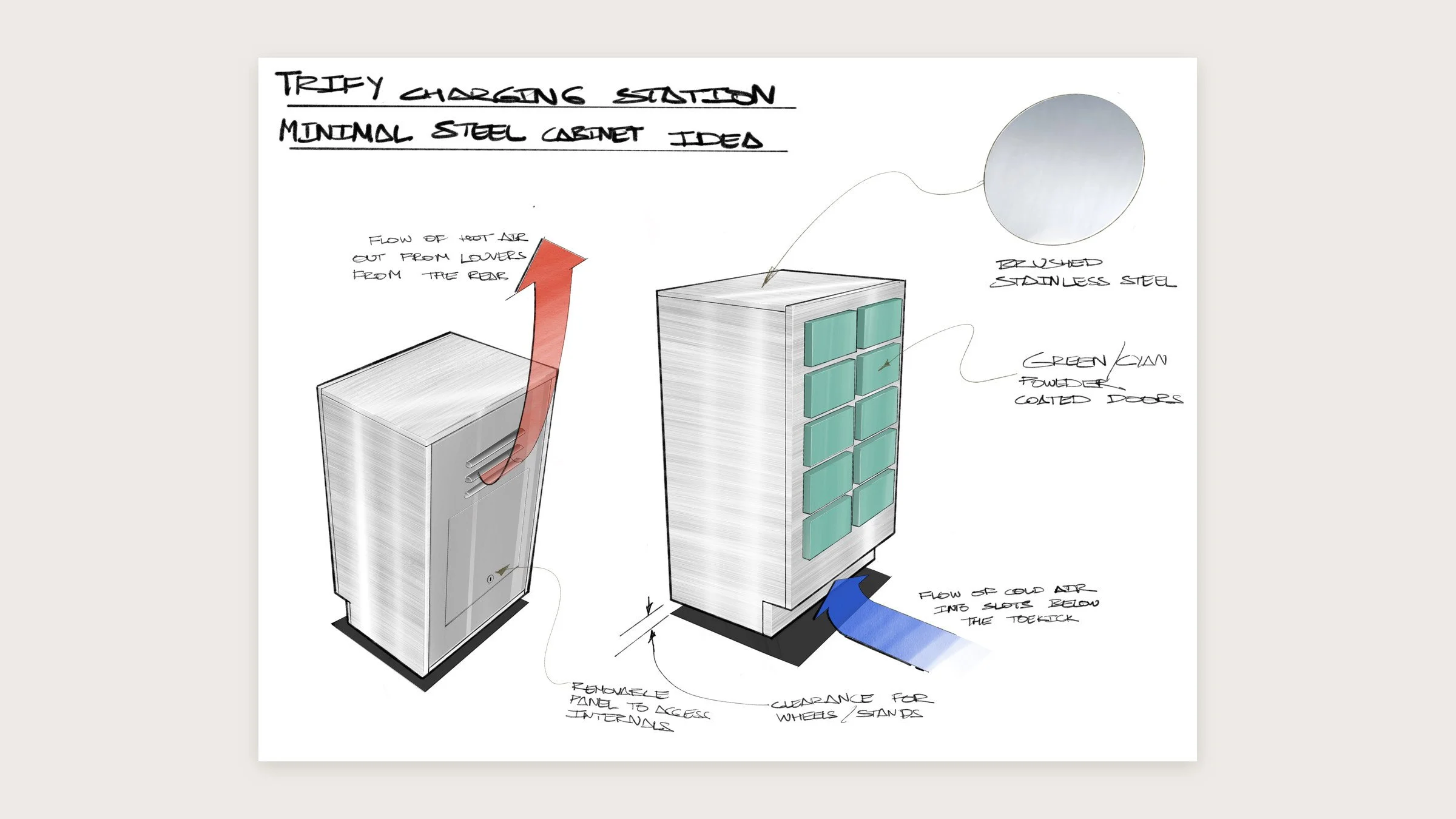
Cold air in under the toe-kick, hot air out through louvres at the back.
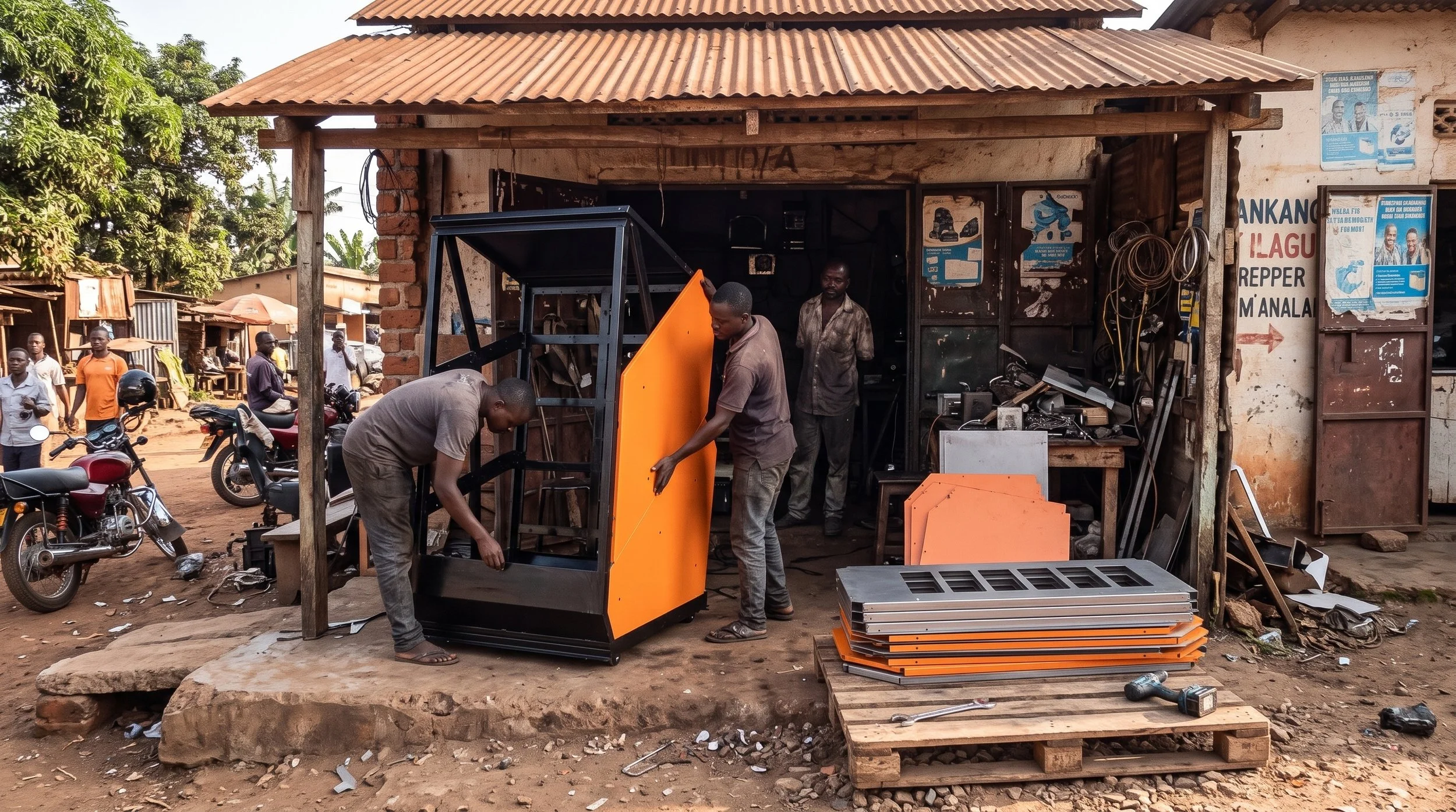
Nine flat panels, one bending tool
The skin had to survive the long trip from workshop to street, and then a technician working on a busy corner. I broke it into nine flat steel panels that stack like flat-pack furniture, travel within ordinary shipping limits and bolt onto the frame on site with hand tools.
Every bend in every panel uses the same press-brake tool, so a workshop with one machine can fold the whole skin without changing its setup. Every edge is deburred and broken, because a technician and then a rider will put their hands on it. All that has to travel is a welded base and a stack of sheet.
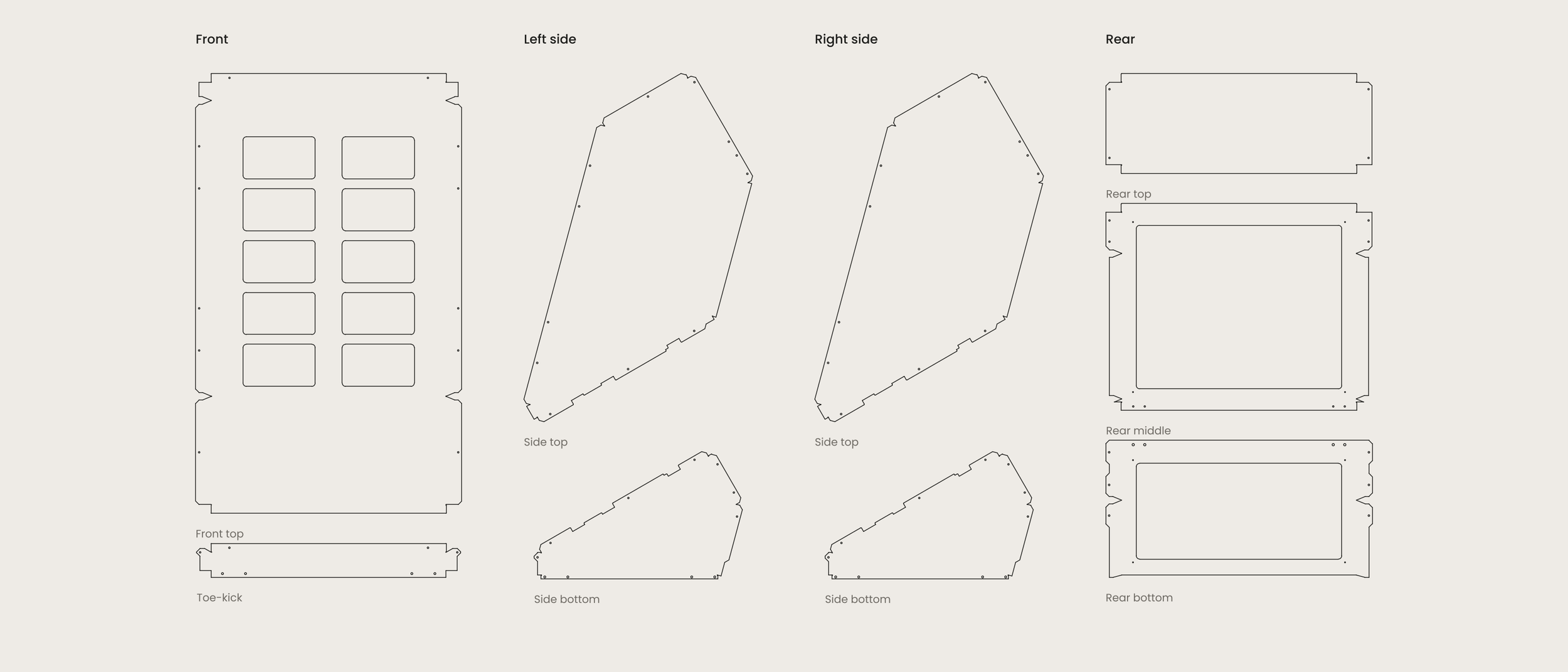
All nine exterior panels, cut flat and folded with one tool.
A battery you carry like a jerry can, built like a cabinet
The battery is the part of Trify a rider handles all day, so it started from something every rider already knows how to carry. In East Africa that object is the jerry can. My first forms borrowed its slim body and moulded handle, and slid into the station at an angle.
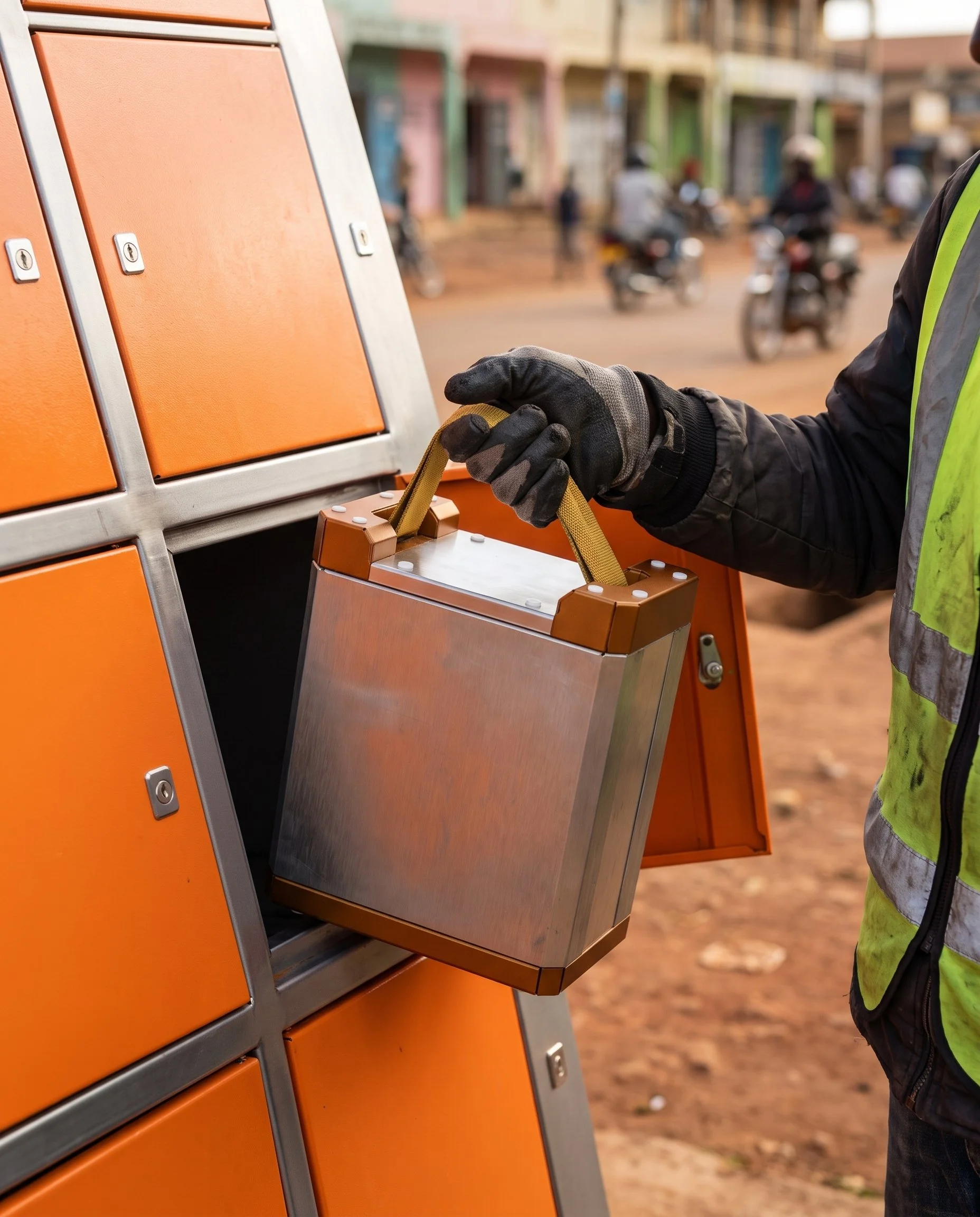
In the second phase the battery had to come from the same workshops as the station. I redrew it as a folded steel box whose long edges bend twice to read as a chamfer, closed by end caps simple enough to cast in polyurethane. The first version used an off-the-shelf folding handle. Handle studies replaced it with a woven strap between the two caps, which a gloved hand can grab from either side, and plugs now cover the bolt heads so nothing snags.
Trify's engineers designed what goes inside: the battery management board, the connectors and a fire-suppression module. My job was the shell that holds them and lifts out of a slot by its strap.
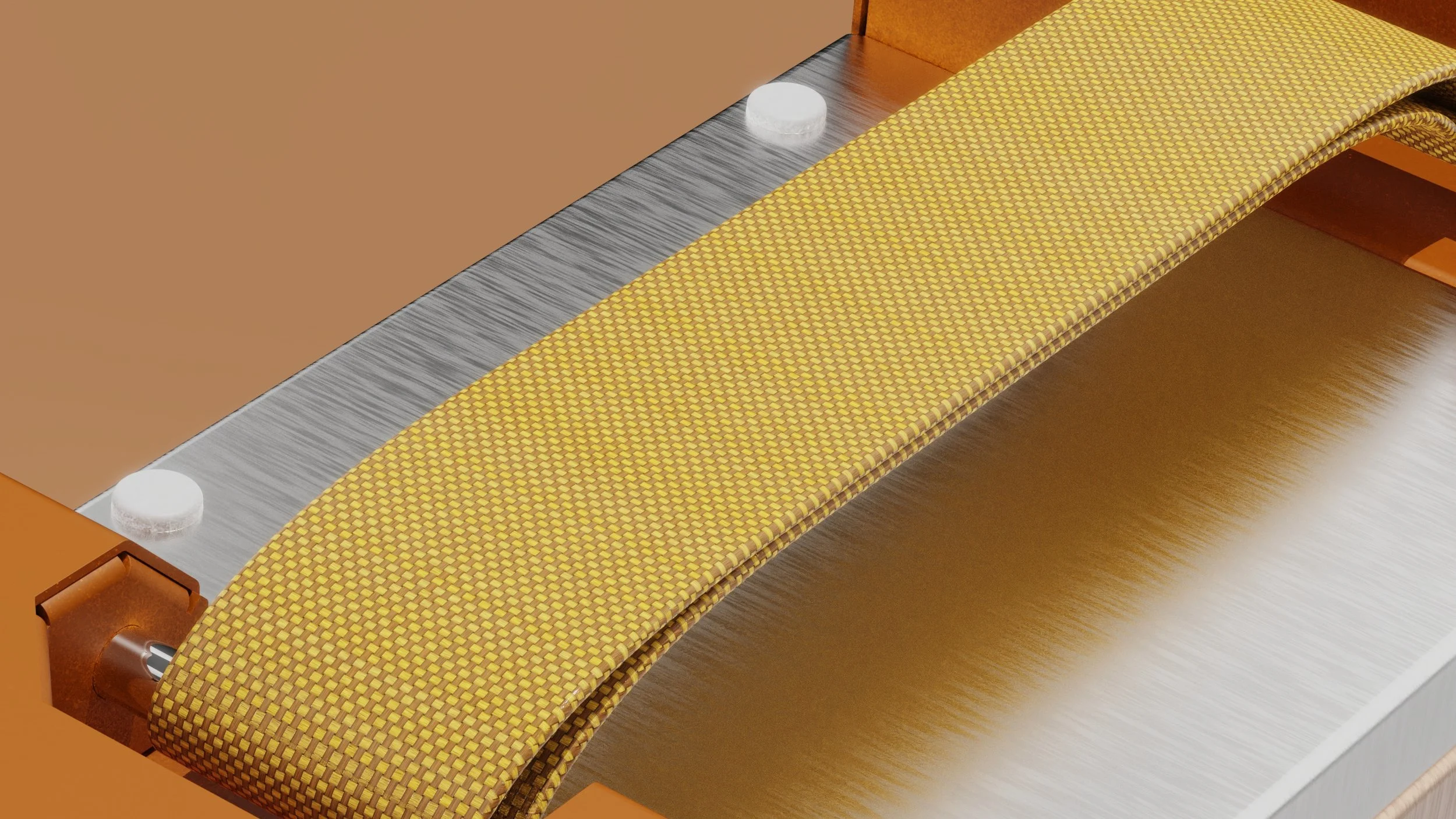
Plugs over the bolt heads, and a woven strap between two moulded caps.
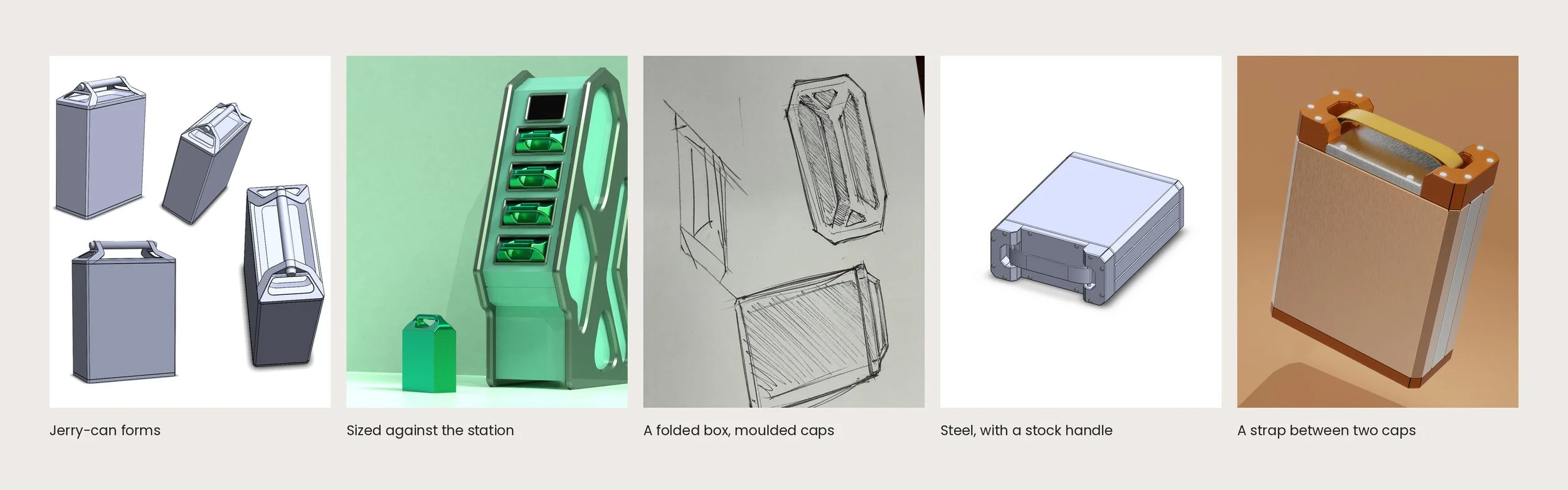
From jerry-can forms to a folded steel pack with moulded caps.
Build one before fifty
The drawings met the shop floor at a local laser and press-brake workshop, and the brackets went to a plater with half a dozen zinc finishes to choose from.
The first full-size rack then stood in Trify's office in raw steel, with a battery in one slot. We tilted it, rolled it and loaded it, and it answered questions no render could. The electricals needed to open from the rear. The skin had to split into smaller panels to ship. Parts flexed and were stiffened. Dust needed a filter that slides out. Doors had to clear a full battery, hinges had to clear the frame, slots had to fit the pack, and the doors needed a lock. Each answer went straight back into CAD.
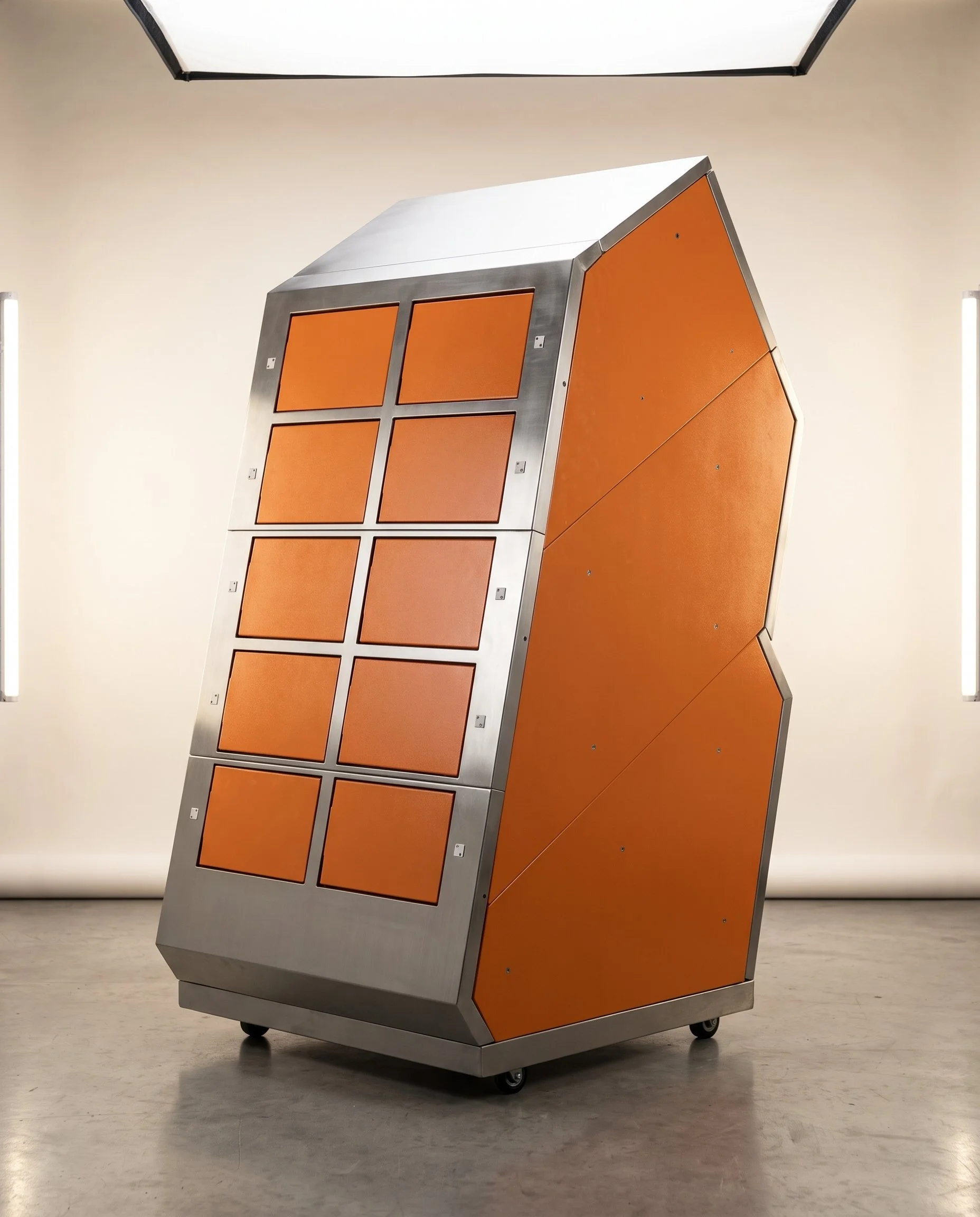
The finished prototype followed: a black frame inside a stainless skin, with orange sides and ten orange doors.
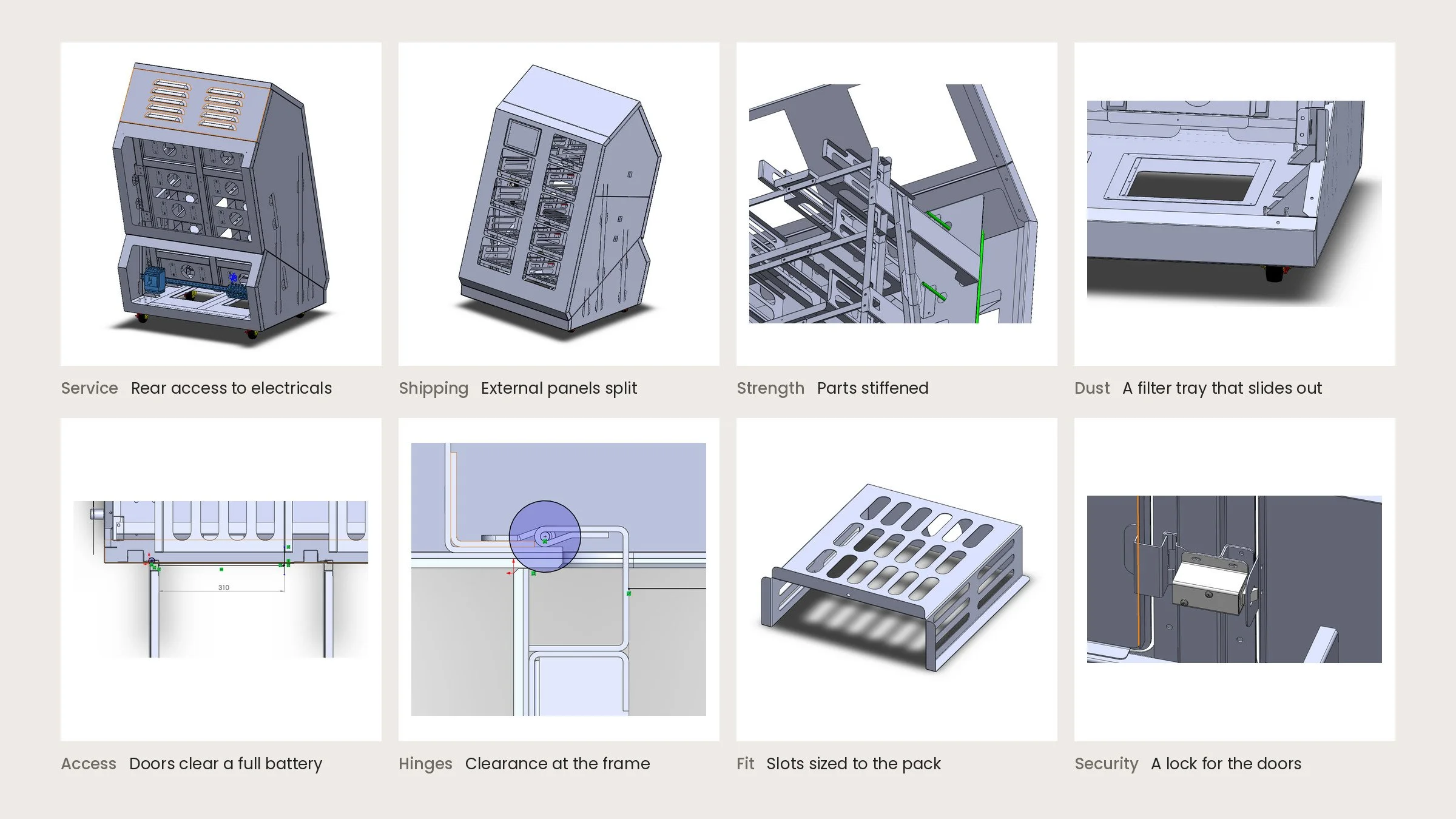
What the first full-size rack sent back to CAD.
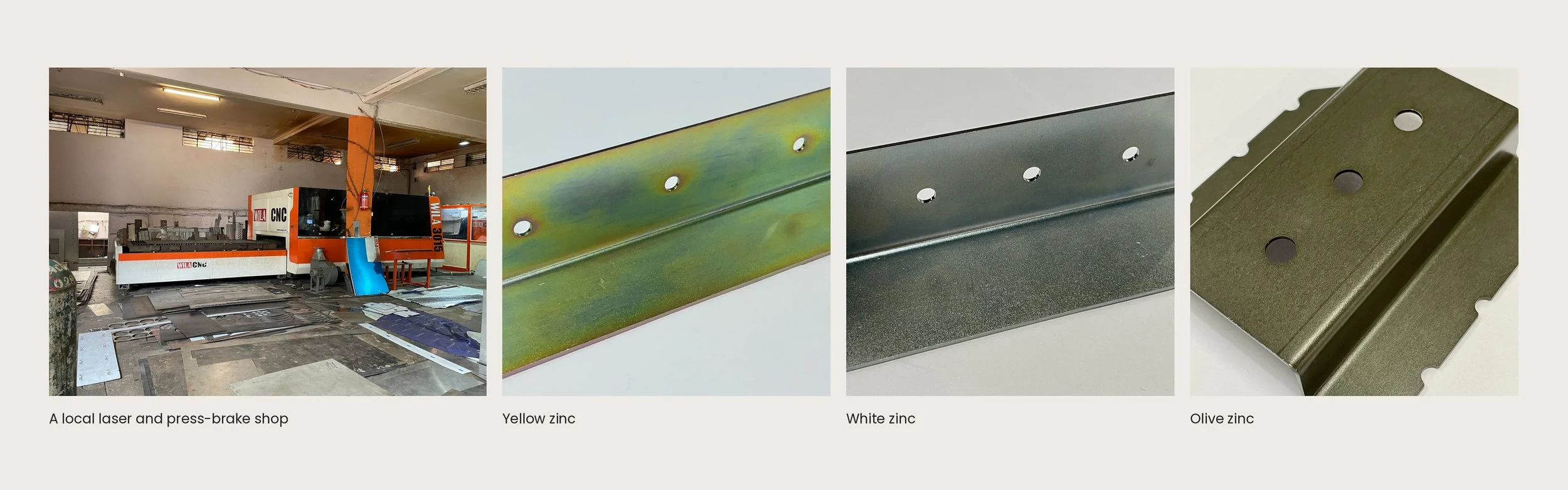
A local laser and press-brake shop, and the zinc finishes on offer for the brackets.
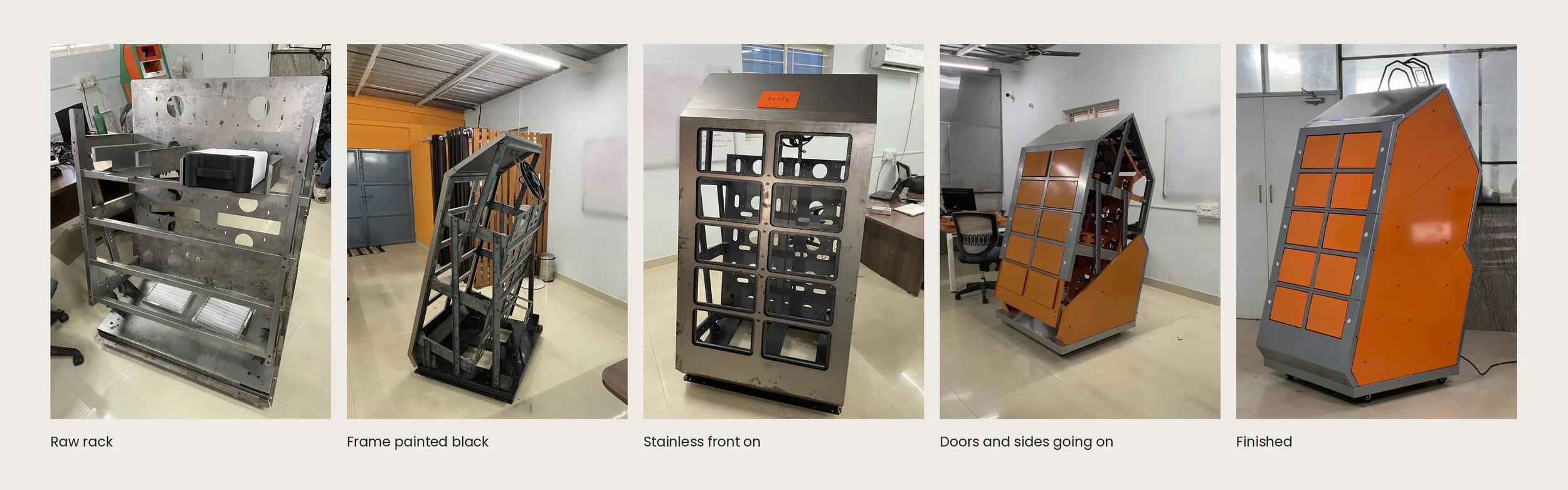
Raw rack, painted frame, orange doors: the station in metal.
Colour had to work from across the road
Colour was decided in renders, then checked against what local painters could actually supply. I rendered ten colourways from five angles each, so Trify could choose with a paint chart in hand instead of a mood board.
The two-tone schemes did the most work. A dark face keeps ten doors legible as one surface, and a coloured body and rib carry the brand from across a busy road. The prototype went orange. Trify's later engineering model went white, with orange outlines and an embossed logo.
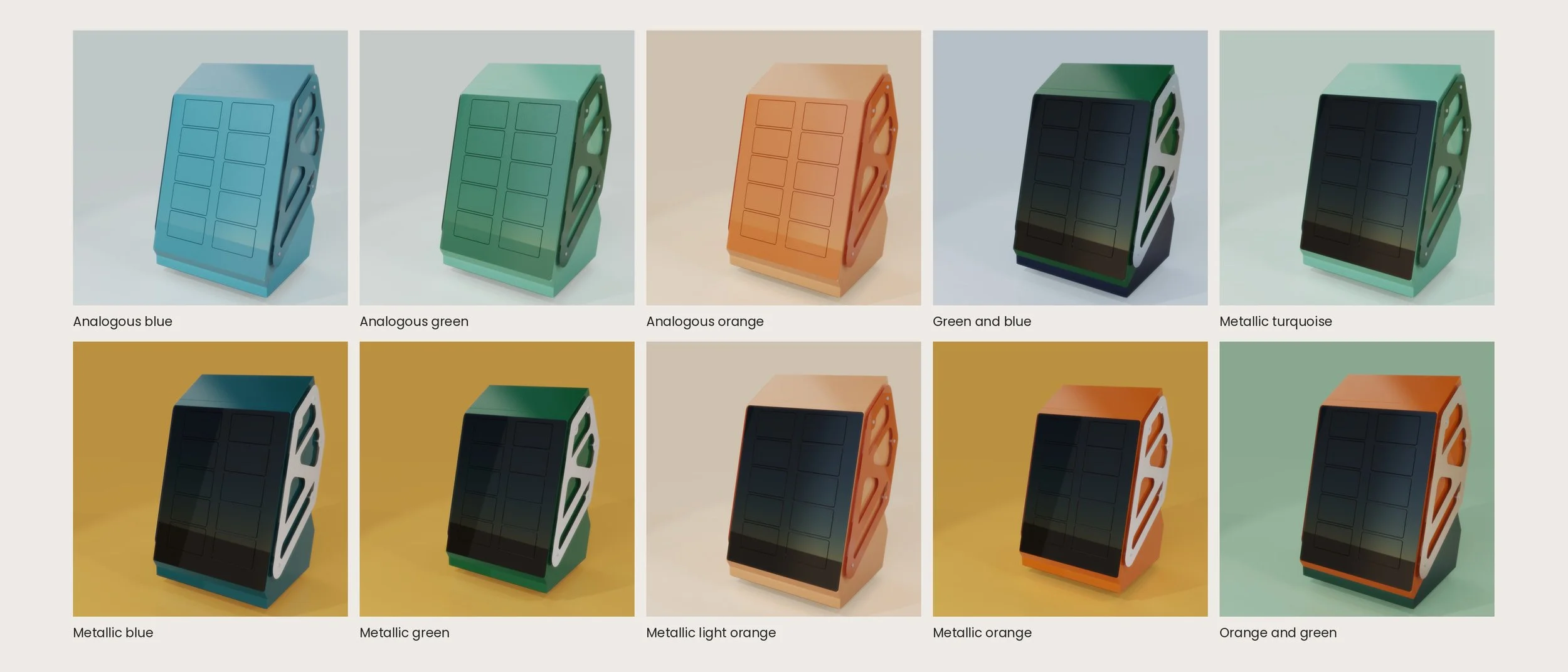
Ten colourways, five angles each.
From a scan to a station you can walk around
What changed for Trify. Trify went from a pitch deck to a station and battery that workshops could quote and build. A full-scale prototype stood in its office, renders, and its engineers carried the design into their own CAD.
What I delivered. Three generations of the station, five battery forms and the final pack, a complete set of manufacturing drawings, ten colourways, trials with local fabricators and finishers, the work plan the team ran, and the visual brief for the website.
What comes next. A station only proves itself on a Kampala corner. It needs heat and dust trials, swaps timed with real riders, and the small screen and phone app it was built to hold. At volume, the doors and end caps want moulded plastic, which the very first deck had planned for.
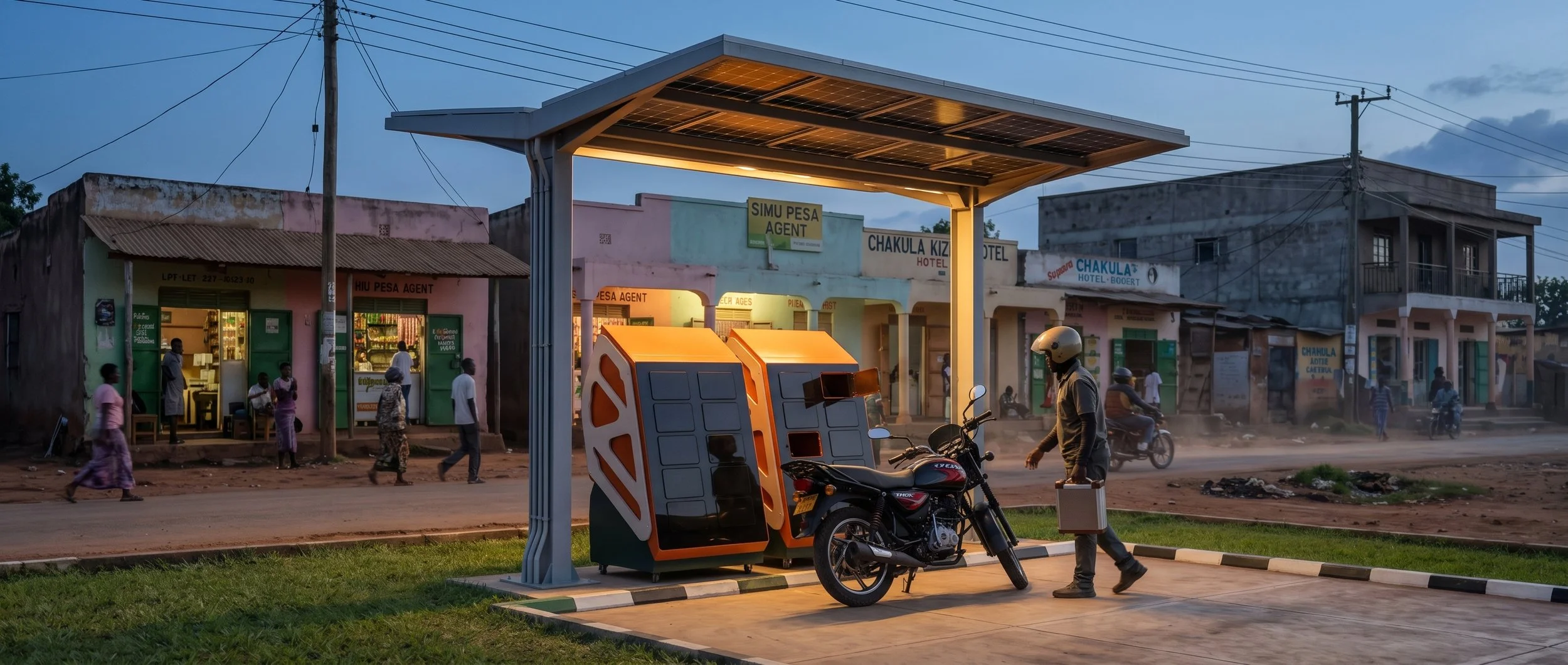
Riders asked for a station every ten kilometres. The design had to make that many stations cheap to build.